Posts Tagged parents.

STEM Tuesday– Coding– In the Classroom


Although I studied Electrical Engineering in college, I ended up spending most of my time as an engineer working with code. I love coding, and I’m happy to see so many great books about coding for young readers. Here are the books I read.

Coding Games in Scratch: A Step-by-Step Visual Guide to Building Your Own Computer Games
by Jon Woodcock

I love Scratch. It’s a block code, meaning you put the commands together rather like Legos. The code blocks are designed to help keep you from putting the code pieces together wrong. This book does a great job of walking you through the building of computer games in Scratch. If you want to learn basic coding concepts while making fun games, check out this book.

cover image of the book "Get Coding!" featuring two cartoon people, a computer, and a dog

Get Coding! Learn HTML, CSS & JavaScript and Build a Website, App, and Game
by Young Rewired State

This book is packed with information and activities for learning about coding and the web. It even has a related web site – https://getcodingkids.com – to help you through the missions.


Bonus Book: Hunting the Cyber Trail: Be a Computer Forensic Scientist
by Alix Wood

Follow a fictional computer forensic scientist as he searches computers for clues to the whereabouts of two missing kids. I love that this book gets into how information is formatted within computers, something I dealt with a lot when I was programming. This book also has lots of activities that are computer-related, but don’t require a computer to complete.

Now for some other activities you can try to get you into a programming frame of mind.

How-To

A computer program is basically a how-to for a computer. Programmers put together instructions that tell computers what they need to do.

A great activity as you start programming is to write a how-to. This could be a recipe, instructions for completing a craft, or instructions for something you do every day, like washing your hands. Once you’ve created your how-to, have someone try to follow your instructions. That’s when you find out if you forgot any instructions or if anything was unclear.

Flow-Charts

Flow-charts are really useful tools for programmers. They’re a graphical representation of a process or algorithm. Learn about flow-chart symbols and create a flow-chart for a process or algorithm. Here are some resources to help:
https://www.bbc.co.uk/bitesize/guides/z3bq7ty/revision/3
https://www.digitaltechnologieshub.edu.au/teach-and-assess/classroom-resources/lesson-ideas/have-fun-with-flowcharts
https://technovationchallenge.org/curriculum/coding-15-flowcharts

Explore ASCII

Remember me mentioning the formatting of information in computers? Well, one of those things is called ASCII – American Standard Code for Information Interexchange. It is a way to represent text characters using numbers. This is generally written in hexadecimal (base 16) numbers.

To learn about hexadecimal, read the beginning of this article: https://learn.sparkfun.com/tutorials/hexadecimal or this: https://www.codeproject.com/Articles/4069/Learning-Binary-and-Hexadecimal. You don’t have to get too deep into hexadecimal to work with ASCII.

Use an ASCII table (either from p. 24 of “Hunting the Cyber Trail” or here: https://www.sciencebuddies.org/science-fair-projects/references/ascii-table. (There are lots more versions out there if you want to find something different.)

Get the hang of ASCII by converting your name into hexadecimal ASCII code. Then, write a full message and give it to a friend. See if they can decode your message.

Explore More

There are lots of great resources out there that support programming. One of the biggest is Code.org. They have fabulous activities there, including a bunch that don’t require a computer: https://code.org/files/Hour-of-Code-Unplugged-Activities.pdf

—-

Janet Slingerland is the author of more than 20 books for young readers, including 3 books about coding. To find out more about Janet and her books, check out http://janetsbooks.com.

STEM Tuesday– Material Science– Writing Tips and Resources

Materials Science is a new category for me. My research turned up intriguing connections with arts activities because much of it is about discoveries. So, this blog post is about some Very New research on materials and a Very Old technique for science exploration that is wonderfully flexible, easy and inexpensive, and makes use of recycled and sustainable materials.Neri Oxman photo

I was particularly pleased to find the Very New in the work of Neri Oxman. She blurs the line between science and design. Wikipedia describes her work as “embodying environmental design and digital morphogenesis*, with shapes and properties that are determined by their context.” Yes*, I had to look it up too. It means, according to Merriam-Webster – a branch of biology that deals with the form and structure of animals and plants. There have been a number of good books on Materials Science in the previous May STEM Tuesday blogs. Ms. Oxman’s writings and articles are in anthologies and scholarly journals, so instead I have included a link to her documentary “Nature x Humanity,” with the hope that you will find her take on Materials Science to be worth following in the future.

She says that 2020 is the year in which the anthropomass (manufactured materials) will exceed the biomass on our planet. Current building practices are the main culprits. She offers alternate building materials and structures that will break down. For instance, one building material she helped to develop can be disposed of by dropping it into the sea. It will dissolve and provide nutrients for fish.

I emailed her and in her kind response, she sent a link to the documentary about sustainable architecture and protecting the earth’s resources (see below). It’s for adults and older students and very thought provoking. Imagine structures built from apple peels and shrimp shells (what do you suppose Legal Seafoods thought when she asked for all their discarded shrimp shells?). Or imagine a glass structure that can heat your home without conventional fuel, constructed on a 3D printer.

Here is the link to “Nature x Humanity.” The description says, “We are pleased to present our documentary entitled Nature x Humanity. The documentary debuts at a critical juncture when the anthropomass—the mass produced by humans—has exceeded that of the living biomass on our planet. Through the lens of five projects and their related material systems, we propose five tenets for a new Material Ecology: glass, polymers, fibers, pigments, and cellular solids. Motivated to unite the grown and the made, we demonstrate how each material system and the technology invented to shape it embodies and advances Nature’s way while continuing to promote human progress.”

I see such an imaginative approach to science as an argument in favor of including arts with the science curriculum. The processes for creativity and scientific inquiry are very similar – except creativity is much more flexible in verification. When curiosity and ideas reign without stress over outcome, the mind is freer to wander and invent. The kind of creativity that envisions new uses for alternate materials is developed though practice, making connections, and often, no stress over the outcome.

Real invention comes from dreaming and imagining.

Papier Mache Style book coverWhich brings me to the Very Old technique for science activities – papier-mâché. You might think, oh please, we did that in kindergarten. However, the technique deserves a second look in this current world where sustainability and recycling are essential. It’s inexpensive to do. It makes use of throw-away materials – newspaper (if you can find any), brown paper bags, junk mail, plastic bottles, even cloth scraps and shred.

Papier-mâché first appeared in China c. second century AD, where it was used for warrior helmets and pots. It spread along trade routes to the middle east and Europe. Lacquering and papier mâché became a popular and highly-prized art form.

Today it can be used as a great craft technique to design and create scientific models for a better classroom experience. The possibilities are endless – 3D botanical illustrations, bones, insects, display boxes, buildings. Here are some photos of one of my previous classes where we studied historic castles and made models. The students also wrote an accompanying history of their chosen castle. And you can see the imaginative recycling that engaged the students.papier mache clock

There are many recipes for mâché. My all-purpose fallback is cheap white school glue mixed 3 parts glue, 1 part water. That recipe makes a structure that is rigid. If you want flexibility (such as a book cover or mask) use Sobo Glue. I have seen others use glue made with flour, joint compound, and other materials. You can purchase ready-made “paper clay,” which is a delight to work with – and expensive. The paper clay is good for small pieces.

My standby book has been Papier Mâché Style by Alex MacCormack. (Krause Publications, 1994). There are many books available as well as websites and videos. It’s a real smorgasbord of great ideas. You really need no art experience to use papier-mâché, but need to be willing to be adventurous and persistent. And yes, it is messy and needs time to dry. But the results are well worth it.

Student papier mache castle in process. Art and design are essential for communicating science. The best content in the world is useless if nobody reads or looks at it. That means it has to be visually enticing. It also generally invites students to participate in their own learning in a more active way.

************************

Margo Lemieux is professor emerita at Lasell University, Newton, MA. She recently helped organize an exhibit and donation of fine art prints at the DaNang Museum of Fine Arts in Vietnam.

STEM Tuesday– Material Science– Book List


Materials Science is the field of researching and discovering materials. Not only is this field changing the face of sports and medicine; but it’s making strides in other places as well. Take a look at the titles below to discover more.


Amazon.com: Stuff Matters: Exploring the Marvelous Materials That Shape Our Man-Made World: 8601405513199: Miodownik, Mark: Books


Stuff Matters: Exploring the Marvelous Materials That Shape Our Man-Made World

by Mark Miodownik

Why do materials look and behave the way they do? This book speaks about the amazing properties of the materials all around us that we take for granted.


Molecules: The Elements and the Architecture of Everything

by Theodore Gray and Nick Mann (photographer)

In this book, the author explains how chemical structures work, and goes on to show how molecules make up the wonderfully wide variety of materials in our world.


Let’s Investigate Everyday Materials

by Ruth Owen

Readers will discover the properties of materials and how they’re suitable for specific tasks. In addition, they’ll learn how they’re made! Get up close to the worlds of wood, metal, plastic, glass, rock, and wool and discover how these items work for us regularly.


Working with Materials

by Sonya Newland and Diego Vaisberg.

This series takes a look at the different engineering fields. Hands-on activities encourage readers to develop their own skills after they examine the properties of basic materials. In addition, readers will learn more about how materials are made or mined, and how engineers decide to use them. The fascinating world of material science is here for discovery!


Experiments with Materials (Read and Experiment) by [Isabel Thomas]

Experiments with Materials

by Isabel Thomas.

The science of materials is the focus of this series which uses fun experiments to get readers involved. As they get hands-on with science, readers will be introduced to scientific concepts, analytical thinking, and so much more.


Discover Nanotechnology (Searchlight Books ™ — What's Cool about Science?)


Discover Nanotechnology

by Lisa J Amstutz

All about how scientists work with the tiniest objects imaginable to build wonderful things!


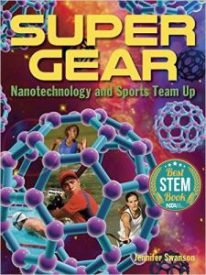
Super Gear 2017 STEM Book Award

Super Gear – Nanotechnology and Sports Team up 

by Jennifer Swanson.

Nanotechnology is an innovative science done at an atomic level. It’s used to create high-tech equipment for sports in ways we can only dream of! This book takes an in-depth look at the fascinating achievements of nanotechnology in sports and how it’s changing the game.


Nanomedicine

by Martin Gitlin, Alexis Roumanis

With this book, readers will learn about technological innovations and the world of nanotechnology. This world is tiny but fascinating, with applications in the field of medicine that might just surprise you.


Nanotechnology and Medicine 

by Don Nardo

Advances in nanotechnology are changing the world of medicine. This book speaks about how scientists and doctors are using tiny nanoparticles to give people longer, healthier lives.


Susan Summers is a wildlife enthusiast and an author. Contact her at: https://susan-inez-summers.weebly.com/


Shruthi Rao is an author. Her home on the web is https://shruthi-rao.com