|
|
Thinking back on the bookstores we’ve interviewed here on Mixed-up Files in 2014, I realize more than ever that independent bookstores are a children’s-book lover’s priceless treasure, and that the more we value them the more they will prosper. More is more. The things we give our energy and attention to increase.
Fortunately there’s good news out there at the moment, so in case anyone’s worried about the future of your favorite shop, I’d like to mention a few persistent myths about the business, then talk about what bookstores offer readers today, using this year’s interviewees as examples.
First, the myths:
Myth: #1 Thanks to Amazon and e-books, independent brick-and-mortar bookstores, like physical books, are becoming a thing of the past. Nope. According to the American Booksellers Association, indie bookstore numbers hit a low of 1,651 in 2009.  But since 2009, the number of stores has grown 19.3 percent to 1,971 and indie store sales have grown about 8 per cent each year since 2011.
That’s only partly due to the collapse of Borders. So what’s happening?  Indies are taking advantage of the growing buy-local movement, getting to know their communities and their customers
  and offering them a welcoming atmosphere for browsing and events. They’re hiring staff who read, know, and love books, and are eager to make personal recommendations and connections A number of the newer stores were founded by people with little or no bookstore experience who simply believed every town ought to have a bookstore, and theirs didn’t. (Hugely successful MG author Jeff Kinney is currently planning to open one in Plainville MA where he lives).
Myth #2 Independent bookstores are too small. I can find a bigger selection at the chain store. Maybe, if you’re mainly interested in the newest books and best-sellers. The chains, in order to stay competitive with Amazon, have adopted a business model that emphasizes more and more sales of fewer titles. Once you get past the headliners, you may be surprised how many good books are “out of stock.’ The indies are doing just the opposite: stocking fewer copies of a greater variety of books. And of course some indies aren’t small. Think Powell’s.
Myth #3 It’s a lot cheaper and more convenient to order books on line. That’s true. If you know what you want, you can order a book at deep discount cross that off your to-do list, and have the book delivered to your door or a giftee’s without ever having to change out of your pajamas. Of course you don’t meet very many interesting people that way.
Now for the magic: why shop at an independent bookstore?

“Forgiveness Booth” at Birchbark Books
Magic #1: unique atmosphere
People open independent bookstore owners for the love of it and do their best to realize their dream of what a bookstore could be. These stores are what Janet Geddi of Avid Bookshop calls “third places.” Joy and laughter are not uncommon. When we asked Jane Knight back in July what she hoped people would experience when they browsed at Bear Pond Books, she replied, simply “Nirvana!” Elizabeth Bluemle of Flying Pig Bookstore says, “We often hear from people that they like to come in when they’ve had a hard day.” Independent bookstores are created places as much as they are businesses.

Treasure Island Camp at Fountainhead Books

Puppet Theatre at Bank Street

Frank, the Fabulous Fiction Fan
The free hand of independents can lead to some wonderful bookstore features like the native American art and the Forgiveness Booth (a converted confessional booth with forgiveness guaranteed) at Birchbark Books, the books camps for kids at Fountainhead Books, the weekend performances of the Fractured Fables puppet theatre at Bank Street Bookstore in New York, or Frank the Fabulous Fiction Fan, who was created by a local 11-year-old boy and is Avid Bookshop’s answer to Waldo.
Magic #2: making memories
More and more we understand that what children will remember from their childhood are not the things their loved ones gave them so much as the experiences they shared. Spending hours together at a real bookstore and coming back with personally chosen books is a long-remembered experience. 
Magic #3: quality, diversity, & surprise
Independent bookshop owners are curators, free to indulge their own good taste. Valerie Welbourne of Fountainhead Books says: “The main thing we look for is good writing.” Unlike chain managers, independents can buy, promote, and display books any way they want. Of course they need to sell books and are aware of what’s current, but they have other considerations too.  As Elizabeth Bluemle of Flying Pig books says “I can stock some quirky title that no one’s ever heard of and keep it on the shelf forever if I want to.” What that means for us is that in any independent store you will find some titles that are available almost nowhere else. (That is certainly true of the Dakota, Ojibwe, and Lakota language books at Birchbark Books).
Magic #4: finding your people (and your book)
Indie booksellers aren’t trying to sell you reading devices or a company line. They’re passionate about books and their favorite thing is to talk with you about books you might enjoy and help you find the one that’s yours. They care about their community, and when you buy your books there, the profits stay home.
Most indies have a soft-spot for children’s books and their readers, especially for middle-graders. When we asked this year’s shops for their recommendations of middle-grade books, of course they mentioned the well-known and the award winners, but also some lesser known new and old favorites of theirs and their visitors. I’ll list some of these again, in hopes you may find among them something new to you, but you:
From Avid Bookshop, Athens GA (www.avidbookshop.com): Stephan Pastis’ Timmy Failure books, Frostborn by Lou Anders, and anything by  Jennifer Holm. (The Fourteenth Goldfish is now widely reviewed and praised, but I first learned about it from
 Avid Bookshop.)
From Bank Street Books New York NY (www.bankstreetbooks.com): The Real Boy by Anne Ursu, Flora and Ulysses by Kate DiCamillo, The Year of Billy Miller by Kevin Henkes, Carol Weston’s Ava and Pip , and Julie Sternberg’s Like Carrot Juice on a Cupcake.
From Bear Pond Books, Montpelier VT (www.bearpondbooks.com): The Meaning of Maggie by 
 Megan Jean Sovern, The Great Greene Heist by Varian Johnson, The Return of Zita the Spacegirl by Ben Hatke, and anything by Steve Jenkins or Linda Urban.
From Birchbark Books, Minneapolis MN (www.birchbarkbooks.com): How I became a Ghost, by Tim Tingle, Wolf Shadows by Mary Cassanova, Summer of the Wolves by Polly Carlson-Voiles, and Black Elk’s Vision, a Lakota Story, by S.D. Nelson.
From Children’s Book World, West Los Angeles CA (www.childrensbookworld.com): The Neddiad by Daniel 
 Pinkwater, Home of the Brave by Katherine Applegate, How They Croaked:

Home of theBrave
The Awful Ends of the Awfully Famous by Lesley M. M. Blume, Temple Grandin, by Sy Montgomeery and Temple Grandin, and Left for Dead: A Young Man’s Search for Justice for the USS Indianapolis by Pete Nelson.
From Edmonds Bookshop, Edmonds WA (www.edmondsbookshop.com) some old favorites —Walk Two Moons by Sharon Creech , Johnny Tremain by Esther Forbes and Wrinkle in Time by Madeleine L’Engle, plus Maile Meloy’s The Apothecary.
From Flying Pig Bookstore, Shelburne VT (www.flyingpigs.com):
Understood Betsy by Dorothy Canfield Fisher, Swallows and Amazons by Arthur Ransome, Neil Gaiman’s Fortunately the Milk and The Dolphins of Shark Bay by Pamela S. Turner.


From Fountainhead Bookstore, Hendersonville NC (www.fountainheadbookstore.com): Chaos Walking trilogy by Patrick Ness, Snicker of Magic by Natalie Lloyd, The Inventor’s Secret by Andrea Cremer, The Shakespeare Mysteries by Deron R. Hicks, and anything  by Donna Gephart.
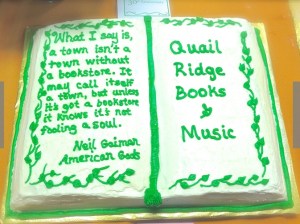
From Quail Ridge Books & Music, Raleigh NC
(www.quailridgebooks.com): Charlie Joe Jackson’s Guide to Making Money by Tommy Greenwald, Revolution by Deborah Wiles, and Gooseberry Park by Cynthia Rylant.
Readers, It’s almost January. Do you know where your nearest independent bookstore is? Go for the joy of it in 2015! And please, tell the rest of us where it is.
Sue Cowing is author of the middle-grade puppet-and-boy novel You Will Call Me Drog (Carolrhoda 2011, Usborne UK 2012, HarperCollins UK 2014).