Posts Tagged middle grade books

Author Spotlight: Rosanne Tolin + a Book Giveaway!

Today, Melissa Roske chats author Rosanne Tolin about her middle-grade novel, Freedom’s Game, an edge-of-your-seat thriller about a pair of Jewish orphans, set in Nazi-occupied France during World War II. Praised by National Jewish Book Award winner Nancy Churnin as “… a thrilling, well-researched historical tale of heroism and hope,” the novel is available now from Reycraft Books. (Don’t forget to enter the giveaway to win a copy of Freedom’s Game! Details below 👇)

Interview with Rosanne Rolin

Melissa: Welcome to the Mixed-Up Files, Rosanne. Thanks for stopping by!

Rosanne: Thanks Melissa, I’m really excited to be here! Especially as a long-time fan of what you and the rest of the group at MUF do for writers and readers of MG by spotlighting books.

Freedom’s Game: A Summary

Melissa: First, congratulations on the publication of Freedom’s Game. I inhaled it in one sitting, during a car ride from New York to Boston. (Don’t worry, I wasn’t driving. 🙂 )  Can you give Mixed-Up Files readers a brief summary?

Rosanne: Of course! Freedom’s Game follows its two young protagonists—both refugee children fleeing World War Two Germany—to their hiding place, an abandoned chateau in France. When a mysterious new instructor arrives to teach gym class, the kids are uncertain about him. Is he there to help them escape into war-neutral Switzerland, or is he a Nazi ally attempting to gain their trust for nefarious reasons? The book is based on a series of true events that were too awe-inspiring, in my opinion, to be omitted from the more talked-about annals of Holocaust history.

Melissa: Freedom’s Game is a dual-perspective novel featuring two 12-year-olds—Ziggy, an introspective bookworm, and Elka, a running-obsessed chatterbox—who meet at a Jewish orphanage in Annemasse France, near the Swiss border. Although Ziggy and Elka seem to have little in common, they quickly become BFFs. Can you tell us more about this unlikely pair of friends and what binds them together?

Rosanne: I think the idea that opposites attract applies to these two. Elka is much more outward in how she moves through the world. For the most part, she says what she thinks, is upbeat and positive and asserts her opinions. Ziggy, on the other hand, is more reserved and skeptical and studious, and Elka’s ability to pull him out of his shell is a big reason they become fast friends. But eventually, it’s Ziggy who coaxes Elka into revealing the source of her sadness. Before they’d met, she’d buried it deep inside.

Because they’re so different, one’s able to sense what the other needs during their darker moments. Wondering what’s happened to their parents and fearing for their safety is part of their daily existence—so the strength they gain from their unlikely friendship becomes a kind of survival mechanism, too.

A Tale of Two Perspectives

Melissa: As above, the novel is told from two perspectives. What was the impetus behind writing a dual-POV story? Also, what was your writing process like? Did you write Ziggy’s section and then Elka’s? The other way around? Or did you alternate?

Rosanne: My first few drafts of the manuscript were told entirely from Elka’s perspective. But when I set out to do serious revision work, I realized that Ziggy was as much at the heart of the story as she was. Although they’re from the same country, Germany, their world views are quite different. For that reason, I thought dual POV would be a great way to explore and contrast their interior lives. Elka believes Georges Loinger is there to rescue them from deportation; Ziggy is suspicious of his real motives. By playing off one another, in alternating viewpoints, I’m hopeful the reader’s experience is more immersive, even magnified. Will they empathize with Elka’s viewpoint, or Ziggy’s? Does that possibly change, chapter by chapter? By getting to know both characters in equal measure, is it harder to discern who’s “right”? I think the dual perspectives also become dueling perspectives, in a sense. And, as the story moves forward, the back and forth helps to push its pacing and momentum.

Georges Loinger: The Man Behind the Story

Melissa: Freedom’s Game is based on the true story of Jewish French Resistance member Georges Loinger, who at first Ziggy and Elka suspect is a Nazi spy. Can you elaborate? Also, what was it about Loinger’s story that compelled you to write about it?

Rosanne: Georges was born in Strasbourg, France—and because Strasbourg is so close to Germany, he grew up fluent in both German and French. This benefitted him later, during the war, allowing him to navigate travel through Germany—speaking whichever language he needed to, based on whom he encountered. His fair hair and blue eyes also aided his ability to move about freely, since his looks were classically “Aryan”—therefore he wasn’t suspected of being Jewish. He was also a world class runner and used his athletic prowess to evade Nazi patrols. Without giving too much away about the book, his work with Oeuvre de Secours aux Enfants (OSE), a Jewish children’s aid organization, would become his primary mission. On the fictional side of things, Ziggy and Elka felt it was frivolous to have gym class when they were in hiding, causing them to question his true intentions.

It was after reading Georges’ obituary in The New York Times in 2018 that I felt compelled to write about him. As a children’s author—and a former journalist—his story captivated me for so many reasons. I was sure it would captivate children, too! Beyond that, the real events that shaped the story were too incredible to keep to myself. It’s not that Georges’ role during the Holocaust was unheard of, but personally I’d not known it before. I figured others probably hadn’t, either.  That spurred me to bring these events, and the bravery these children displayed, to the literary forefront.

Marcel Marceau: Surprise Appearance

Melissa: As a follow-up, Georges Loinger had a famous cousin—Marcel Marceau—who makes a surprise appearance in the novel. Without giving away spoilers, can you tell us more about Marcel Marceau’s role in the novel, and in real life?

Rosanne: I was excited to learn that Marcel was Georges’ first cousin! His last name was originally Mangel, but he changed it to blend in (in France, during wartime). His father, Charles Mangel, was deported to Auschwitz and killed. This sad fact fueled Marcel to work with the resistance, and entertaining children with his antics and miming skills played a fascinating part in that. An interesting detail of note: I’ve read that the reason Marcel always wore a sad face—his makeup when miming included a teardrop drawn on his cheek—was because of the devastating circumstances surrounding World One Two and the genocide of Jewish people.

Hiding in Plain Sight

Melissa: Ziggy and Elka have to keep their Jewish identity a secret, in order to survive. What were you trying to say about the nature of secret keeping, including the toll it takes on those hiding in plain sight?

Rosanne: I think that toll was unquestionably profound. Not only did the kids have to be hyper-vigilant about their surroundings, but also, adopting false identities was confusing. Ziggy questions his faith, his hope, family traditions. For him, this manifests in a loss of trust in others. Elka struggles with isolation and loneliness, and the fear of losing her loved ones. She becomes extremely anxious when she’s alone with her thoughts, and the stress takes its toll on her physically.

“Where There’s Life, There’s Hope”

Melissa: Another important theme in the novel is hope. While Ziggy is afraid to be hopeful, Elka—like Anne Frank, who famously said, “Where there’s hope, there’s life. It fills us with fresh courage and makes us strong again”— survives on hope. Can you share your thoughts on this?

Rosanne: I didn’t totally shy away from the psychological harm the Holocaust had on children in Freedom’s Game. Kids in hiding were worried they’d never be reunited with their families again, but hope was their lifeline to this happy possibility. Bonding with the other children who understood their darkest fears was paramount, and small gestures—like Ziggy caring for Elka with simply an extra spoonful of stew or soup—allowed them to cope with their undeniable traumas. Anne Frank’s diary was and still is one of the ultimate testaments to hope we have of that painful period. Despite her confinement and being constantly under threat, she wrote about her dreams for the future, and her continued belief in the goodness of people. Can you imagine her inner strength? To say it’s admirable is a vast understatement.

It’s All in the Details

Melissa: Since Freedom’s Game is based on true events, you clearly had to do a ton of research to maintain the story’s authenticity. Can you tell MUF readers what this entailed? Also, where in the story were you able to take poetic license?

Rosanne: I did do a great deal of research to get it right. That’s a strong suit for me to begin with, or at least something I’m passionate about! Historical accuracy is one thing, but I love going down all the rabbit holes and finding unique details that make a story come to life.

Prior to writing a first draft, I scoured hundreds of pages of books and hours of Holocaust documentaries, particularly about refugee children living in chateaus in France during the war. I also watched several Shoah tapes and corresponded with incredible resources like the United States Holocaust Museum and the Library of Congress. I relied on resources offered by my local librarians, too. Once I felt the true events were in place that would propel the plot of the novel—and that I could authentically reflect the world inside and outside of the orphanage—I could concentrate on the little stuff. That was a lot of fun. I took poetic license with some details, but they’re still rooted in real life. For instance, I Googled things like, “What kind of candy would a young child have eaten in Germany in 1936?” The answer I got was Riesen Candies. So those became Ziggy’s favorite sweet treat, apart from his mother’s homemade confections.

Once the manuscript was in the hands of my publisher, and we began revising together, much of the minutiae fell into place. I also relied on my “inner circle”. For queries about what children in these orphanages might have known about concentration camps during the Holocaust, I turned to my former professor at Indiana University-Bloomington, who now heads the Institute for the Study of Contemporary Antisemitism. To be sure I was using German phrases properly, I asked an aunt who is a Harvard professor in Germanic languages and literature.

More Than Marmelade

Melissa: This is not your first children’s book to feature real-life characters. Your debut MG, More Than Marmalade (Chicago Review Press, 2020), chronicles the life of children’s author Michael Bond, the creator of Paddington Bear. What is it about historical figures’ lives that captures your imagination enough to write about them?

Rosanne: It’s probably the former journalist in me. That, and I’ve always found the truth to be stranger than fiction! And perhaps, too, there’s a piece of me that wants to carry on my father’s legacy. He was a pediatrician by day, but a historian and scholar whenever he had time to pursue those interests. He had a whole library at home with books about the Holocaust, World War Two, the Civil War…he was always reading. I’ve always been a bookworm too, but it’s only been recently that I’ve realized I possess that same history bug. Having a deeper understanding of the people and events that came before us can go a long, long way toward peaceful co-existence. Expanding our knowledge of the past is paramount for that. Plus, it’s just interesting!

Writing with Rosanne

Melissa: What does your writing routine look like, Rosanne? Do you have any specific rituals? Also, are you a plotter or a pantser?

Rosanne: Like a lot of writers, I’d say…it depends. Both are true! I’ve done three NaNoWriMo’s and have come close to writing a first novel draft each time. Freedom’s Game included. However, Freedom’s Game started out as a picture book, and I only decided to write the MG novel version after getting feedback from my agent and critique partner. That scared the heck out of me, because at the time, I’d never written a longer work of fiction—so participating in the 30-day November writing frenzy was a perfect, pressure-free way to get words on the page. Even considering that I needed to have the facts straight, the book was more of a “pantsing” project.

Since then, I’ve written a couple of other novels, one that’s currently out on submission that I’d say was both pantsed and planned, and the other that was more heavily plotted. With the latter, I’ve introduced a historical story in epistolary form, and I wanted the beats of the story to correspond with the letter writing. So that one required some outlining to really get going.

Melissa: What are you working on now? (If you’re able to spill the beans, of course!)

Rosanne: I’m working on my first YA novel. And, also, a dual POV MG mystery that scales younger than most of the manuscripts I’ve written. I love to challenge myself, and both projects are new territory for me. I also like to have multiple projects going at once, to mix things up, and having manuscripts at different stages—for example, outlining versus polishing—helps to keep me focused. It seems like the opposite would be true, but nope.

Lightning Round!

Melissa: And finally, no MUF interview is complete without a lightning round, so…

Preferred writing snack? Peanut butter granola + dark chocolate covered almonds.

Coffee or tea? BOTH! I enjoy a mug of Pete’s dark roast ‘Major Dickason’ coffee every morning when I set out to write, and an iced tea or hot tea later in the day…weather dependent. It’s my little pick-me-up and helps to redirect me, during the afternoon lull.

Favorite Paddington Bear fun fact? A few things come to mind—more so about the Paddington Bear movies! The creator of the Paddington character, Michael Bond, also appeared briefly in the first film. He played the role of the Kindly Gentleman. And when the films were dubbed into Ukrainian, Paddington was voiced by the country’s president Volodymyr Zelenskyy! Also, in the third Paddington film coming out soon, Paddington in Peru, the late Queen Elizabeth has a small cameo. She filmed it just a few months before she died.

Zombie apocalypse: Yea or nay? Like Night of the Living Dead stuff? No. I’m a scaredy cat, so I stay away from books and movies with zombies or ghosts (unless they’re friendly ghosts).

Superpower? Flying! I hate traffic, so being able to bypass it would be awesome. I’d love to ride the wind—like a bird. Can I add an element of teleportation in there too? Where time is compressed, and I can fly somewhere in the blink of an eye—and be with loved ones who live faraway, within seconds.

Favorite place on earth? Anywhere at all as long as I’m with my family. After that, probably the Colorado Rocky Mountains.

If you were stranded on a desert island with only three things, what would they be?

I assume “things” can’t include my husband or kids? Then let me take my dog(s), please!—plus a book (figuring out which one is a whole other issue), and a bottomless cup of strong coffee.

MR: Thank you for chatting with us, Rosanne—and congratulations on the publication of Freedom’s Game. I’m sure Mixed-Up readers will enjoy it as much as I did!

Rosanne: It was my pleasure. Thank you so much for your thoughtful questions, Melissa. I really hope readers enjoy it, too!

GIVEAWAY!

To win a copy of Freedom’s Game, please leave a comment on the blog. (U.S. only, please.) Giveaway ends at midnight EST on December 16.

All About Rosanne 

Born and raised in St. Louis, Missouri, Rosanne Tolin is the author of More Than Marmalade: Michael Bond and The Story of Paddington Bear and Freedom’s Game. An experienced and respected journalist, her work has focused primarily on children’s publications. She was the creator of an ALA notable website for kids, the managing editor of a children’s magazine, and a Hoosier State Press Award-winning features writer. She lives in Chesterton, Indiana, with her husband. When not working, she can be found hiking with her dogs in the Indiana Dunes or Colorado’s Tenmile Range. Learn more about Rosanne on her website and follow her on Twitter/X and Instagram.

Growing Hearts: 10 Middle Grade Books to Inspire Gratitude

Let’s talk gratitude!

Fall is the time of year we tend to consider the concept. I recently read Michael J Fox’s memoir No Time Like the Future. His theme: “With gratitude, optimism is sustainable” drove home the realization that gratitude isn’t just a feeling we should have (peaking sometime around Thanksgiving), it’s a practice we must have. If we want to have a forward-looking life in the midst of all the uncertainty and the curveballs life will throw at us…

We need to cultivate the practice of gratitude all year long.

For our young people growing up in this fast-changing world bombarded by sensationalist media developing gratitude is particularly important. Fortunately, developing gratitude (and empathy and kindness and hopefulness and so on) is an area where middle grade literature really rocks! A feeling of gratitude was certainly on my mind while writing my middle-grade novel, Wand. And in general the genre is rich with books to help young people develop this life-sustaining practice, without being preachy or moralistic.

Jenn Brisendine created a gorgeous post a few years back about reflection and gratitude this time of year, and about learning to appreciate what’s right in front of us. Building on that…

Here are 10 middle grade books to inspire gratitude:

Ana María Reyes Does Not Live in a Castle by Hilda Eunice Burgos

Cover for Ana Maria Reyes Does Not Live in a Castle

The Penderwicks meets In the Heights in this sparkling middle-grade debut about a young Dominican American girl in New York City.

Her last name may mean “kings,” but Ana María Reyes REALLY does not live in a castle. Rather, she’s stuck in a tiny apartment with two parents (way too lovey-dovey), three sisters (way too dramatic), everyone’s friends (way too often), and a piano (which she never gets to practice). And when her parents announce a new baby is coming, that means they’ll have even less time for Ana María.

Then she hears about the Eleanor School, New York City’s best private academy. If Ana María can win a scholarship, she’ll be able to get out of her Washington Heights neighborhood school and achieve the education she’s longed for. To stand out, she’ll need to nail her piano piece at the upcoming city showcase, which means she has to practice through her sisters’ hijinks, the neighbors’ visits, a family trip to the Dominican Republic… right up until the baby’s birth! But some new friends and honest conversations help her figure out what truly matters, and know that she can succeed no matter what. Ana María Reyes may not be royal, but she’s certain to come out on top.

Elvis and The World As It Stands by Lisa Frenkel Riddiough

Cover for Elvis and the World As It StandsA poignant middle-grade story about loss and finding family from the point of view of a newly adopted kitten.

Most shelter animals dream of going home with a forever family. But for Elvis, being chosen by Mrs. Pemberton is a nightmare. He’s been separated from his sister, Etta, and is determined to get back to the shelter to find her. In spite of himself, Elvis becomes curious about 10-year-old Georgina Pemberton, who builds LEGO skyscrapers in her bedroom while navigating her parents’ separation. The longer he’s in his new home, the more he starts recognizing new feelings: admiration for Georgina’s creations, affection for the other pets, and even empathy for the Pembertons–despite their inability to listen.

As Georgina sets out to build her most important skyscrapers yet–the Twin Towers–Elvis realizes that maybe both humans and animals can take a page from Georgina’s Big Book of American Architecture and “build a world of their own choosing,” even if the choices aren’t what they’d initially expected.

Harbor Me by Jacqueline Woodson

Cover for Harbor Me by Jacqueline Woodson

Jacqueline Woodson’s first middle-grade novel since National Book Award winner Brown Girl Dreaming celebrates the healing that can occur when a group of students share their stories.

It all starts when six kids have to meet for a weekly chat–by themselves, with no adults to listen in. There, in the room they soon dub the ARTT Room (short for “A Room to Talk”), they discover it’s safe to talk about what’s bothering them–everything from Esteban’s father’s deportation and Haley’s father’s incarceration to Amari’s fears of racial profiling and Ashton’s adjustment to his changing family fortunes. When the six are together, they can express the feelings and fears they have to hide from the rest of the world. And together, they can grow braver and more ready for the rest of their lives.

Homebound by John David Anderson

Cover for Homebound by John David Anderson

Leo Fender is no stranger to catastrophe, whether it’s the intergalactic war that took his mother’s life or the ongoing fight for his own. He’s seen his planet plundered, his ship attacked, his father kidnapped, and his brother go missing–and found himself stranded on a ship with a bunch of mercenary space pirates.

Still, nothing could have prepared him for the moment he and the crew tried to save his father…and discovered a dark plot that could destroy hundreds of worlds in the blink of an eye.

Now Leo is adrift. His father has sent him on a mission with nothing but a data chip and a name of someone who could help, and Captain Bastian Black and the crew of the Icarus are determined to see this through to the end with Leo, to fulfill his father’s wish and prevent further conflict.

But as Leo searches for answers, he can’t help but wonder what it would take to end the war, to track down his father and brother and return to whatever home they have left–and if the cost of doing so is one he would be able to pay.

Kat Greene Comes Clean by Melissa Roske

Cover for Kat Greene Comes Clean by Melissa Roske

Life is messy.

Kat Greene lives in New York City and attends fifth grade at Village Humanity School, an ultra-progressive private school in New York’s Greenwich Village. At the moment she has three major problems: dealing with her boy-crazy best friend; partnering with the overzealous Sam in the class production of Harriet the Spy; and coping with her divorced mom’s preoccupation with cleanliness–a symptom of her worsening obsessive-compulsive disorder. Kat wants to tell her dad what’s going on, but he’s busy with her new family uptown.

With nowhere to turn, Kat reaches out to the free-spirited psychologist at her school, Olympia Rabinowitz, for support and guidance. Olympia encourages Kat to be honest. Eventually, Kat realizes that sometimes asking for help is the best way to clean up life’s messes.

Other Words for Home by Jasmine Warga

Cover for Other Words for Home by Jasmine Warga

Jude never thought she’d be leaving her beloved older brother and father behind, all the way across the ocean in Syria. But when things in her hometown start becoming volatile, Jude and her mother are sent to live in Cincinnati with relatives.

At first, everything in America seems too fast and too loud. The American movies that Jude has always loved haven’t quite prepared her for starting school in the US–and her new label of “Middle Eastern,” an identity she’s never known before.

But this life also brings unexpected surprises–there are new friends, a whole new family, and a school musical that Jude might just try out for. Maybe America, too, is a place where Jude can be seen as she really is.

This lyrical, life-affirming story is about losing and finding home and, most importantly, finding yourself.

Simon Sort of Says by Erin Bow

Cover for Simon Sort of Says

Simon O’Keeffe’s biggest claim to fame should be the time his dad accidentally gave a squirrel a holy sacrament. Or maybe the alpaca disaster that went viral on YouTube. But the story the whole world wants to tell about Simon is the one he’d do anything to forget: the one starring Simon as a famous survivor of gun violence at school.

Two years after the infamous event, twelve-year-old Simon and his family move to the National Quiet Zone–the only place in America where the internet is banned. Instead of talking about Simon, the astronomers who flock to the area are busy listening for signs of life in space. And when Simon makes a friend who’s determined to give the scientists what they’re looking for, he’ll finally have the chance to spin a new story for the world to tell.

Simon Sort of Says, the Newbery Honor-winning novel by Erin Bow, is a breathtaking testament to the lasting echoes of trauma, the redemptive power of humor, and the courage it takes to move forward without forgetting the past.

Smack Dab in the Middle of Maybe by Jo Watson Hackl

Cover for Smack Dab in the Middle of Maybe

11 days. 13 clues. And one kid who won’t give up.

How far would you go to find something that might not even exist?

All her life, Cricket’s mama has told her stories about a secret room painted by a mysterious artist. Now Mama’s run off, and Cricket thinks the room might be the answer to getting her to come back. If it exists. And if she can find it.

Cricket’s first clue is a coin from a grown-over ghost town in the woods. So with her daddy’s old guidebook and a coat full of snacks stolen from the Cash ‘n’ Carry, Cricket runs away to find the room. Surviving in the woods isn’t easy. While Cricket camps out in an old tree house and looks for clues, she meets the last resident of the ghost town, encounters a poetry-loving dog (who just might hold a key to part of the puzzle), and discovers that sometimes you have to get a little lost . . . to really find your way.

The Other Half of Happy by Rebecca Balcárcel

Cover for The Other Half of Happy

One-half Guatemalan, one-half American: When Quijana’s Guatemalan cousins move to town, her dad seems ashamed that she doesn’t know more about her family’s heritage.

One-half crush, one-half buddy: When Quijana meets Zuri and Jayden, she knows she’s found true friends. But she can’t help the growing feelings she has for Jayden.

One-half kid, one-half grown-up: Quijana spends her nights Skyping with her ailing grandma and trying to figure out what’s going on with her increasingly hard-to-reach brother.

Quijana must figure out which parts of herself are most important, and which pieces come together to make her whole.

This is a heartfelt poetic portrayal of a girl growing up, fitting in, and learning what it means to belong.

When Stars are Scattered by Victoria Jamieson

Cover for When Stars are Scattered

A National Book Award Finalist, this remarkable graphic novel is about growing up in a refugee camp, as told by a former Somali refugee to the Newbery Honor-winning creator of Roller Girl.

Omar and his younger brother, Hassan, have spent most of their lives in Dadaab, a refugee camp in Kenya. Life is hard there: never enough food, achingly dull, and without access to the medical care Omar knows his nonverbal brother needs. So when Omar has the opportunity to go to school, he knows it might be a chance to change their future . . . but it would also mean leaving his brother, the only family member he has left, every day.

Heartbreak, hope, and gentle humor exist together in this graphic novel about a childhood spent waiting, and a young man who is able to create a sense of family and home in the most difficult of settings. It’s an intimate, important, unforgettable look at the day-to-day life of a refugee, as told to New York Times Bestselling author/artist Victoria Jamieson by Omar Mohamed, the Somali man who lived the story.

Let me know in the comments which other middle-grade books have inspired gratitude in your students or kids!

Author Spotlight: Erin Becker + a GIVEAWAY

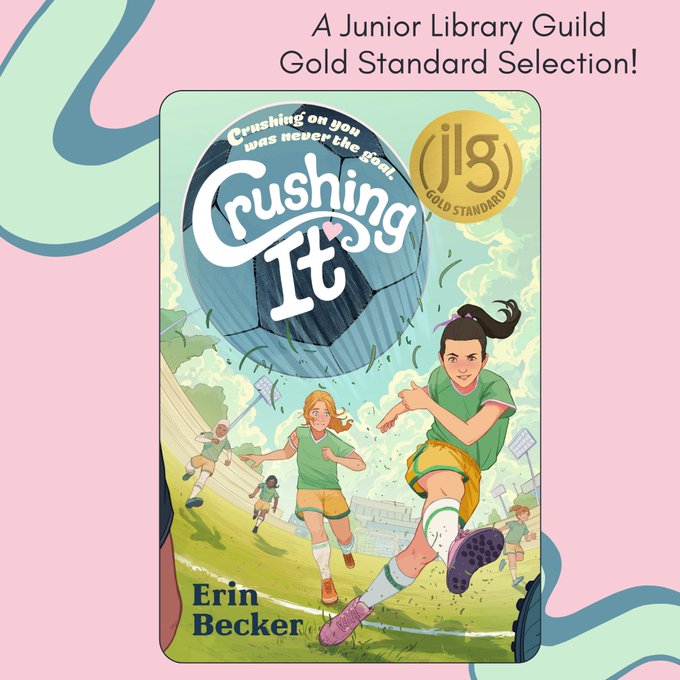
In today’s Author Spotlight, Sydney Dunlap chats with debut author Erin Becker about her middle-grade novel, Crushing It, an “enemies-to-first-crushes” story published by Penguin Random House and chosen as a Junior Library Guild Gold Standard Selection. Erin is an author and marketer living in Washington, DC. She grew up in Cedar Rapids, Iowa, studied English and creative writing at UNC-Chapel Hill, and holds her MFA from Vermont College of Fine Arts. When she’s not writing, you can find Erin at the gym or occasionally playing soccer (though not nearly as well as the protagonists of her novel). Learn more and connect with Erin at erinbecker.me.

All About the Book!

On the soccer field, Magic Mel is in her element. She’s ready to lead her team to victory at the city championship in her new role as captain. Off the field, however, is a totally different story. Mel can’t get a handle on her class presentation, her friend group has completely dissolved, and her ex-friend-current-teammate, Tory, is being the worst. The only place she feels like herself is in her text conversations where she shares her secret poetry with BTtoYouPlease.

Tory McNally, on the other hand, is keeping everything together, thank you very much. So what if her mom is more preoccupied with her craft projects and new husband than her, or that she’s down to one IRL friend because of annoying, overly peppy “Magic” Mel? She’s perfectly fine, and even when she maybe isn’t, she’s got NotEmilyD to text with.

As the championships loom closer, everything around Mel and Tory starts to get more and more complicated: the dynamics on the field, the rift between their friend group, and, as they connect anonymously online, maybe even their feelings for each other…

From debut author Erin Becker comes an action-packed but tender novel about first romance, identity, and learning how to be brave when it matters the most.

Scroll down for details about how enter a giveaway to win a signed copy of Crushing It.

Interview with Erin Becker

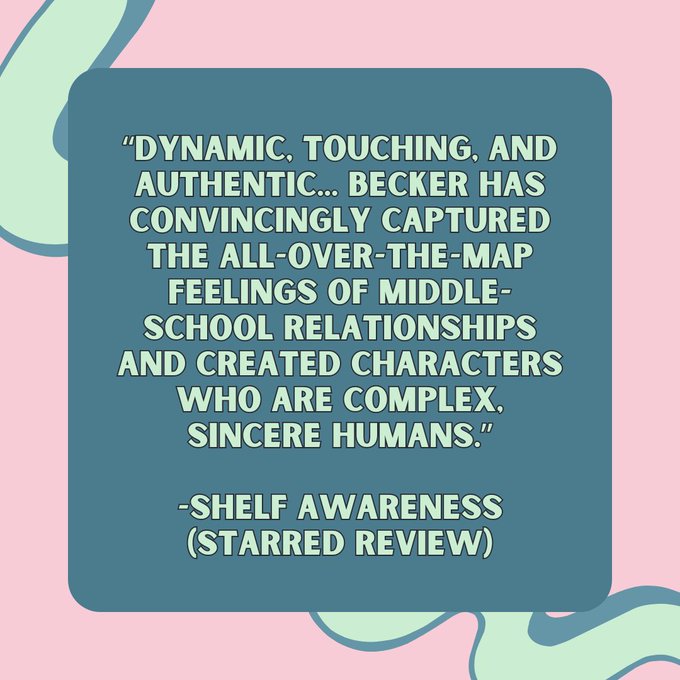
Sydney: I absolutely loved Crushing It. The characters were so real and so relatable. It’s such an honest, touching story that really hits the mark about what it’s like to be thirteen: the friendship and family struggles, crushes, challenges at school, in sports, so much going on. Can you tell me a little about the inspiration behind it?

Erin: First of all, thank you! I’ve had a lot of adult readers tell me the book really took them back to their middle school years. Sometimes I wonder if I should be thanking them or apologizing, since middle school is such an intense time.

The inspiration for this story actually came from the “Poetry Friday” tradition at Vermont College of Fine Arts, where I got my MFA. Each Friday, someone sends a poetry prompt to an all-school list serv, and the idea is that anyone who wants to can write a poem in five minutes and share it via email. That maybe sounds a little intimidating, but everyone is really supportive. I don’t remember exactly what the prompt was, but one Friday I wrote a poem about a girl who becomes soccer captain of her eighth-grade team. She’s excited to be given the captain’s key, which opens the shed where the team keeps the balls, the cones, and everything else they need for practice.

A friend replied to the poem, saying she felt like there was some potential there for a story. I agreed, and eventually, that girl turned into Mel and the poem turned into this book.

Points of View

Sydney: You do such a great job with narrating Crushing It in two points of view, from Tory’s and Mel’s, after their four-person friend group has been split in half. Their voices are very distinctive. How did you make them each sound so unique? And do you personally relate to one of them more than the other? 

Erin: First, I want to give an answer for the poetry nerds out there. Originally, Crushing It was a novel-in-verse, so everything was written as poems. Mel’s poems were roughly in iambic pentameter and kind of flowed and were easy to read, whereas Tory was more staccato and used a lot of enjambment, cutting off the lines in unexpected places and making her poems a little more difficult to “get into.” So even on a rhythm/meter level, their voices were very different right from the start.

Later, when I rewrote this as a prose novel, I felt like I knew the girls really well, so I was able to translate that difference in their voice into the new structure.

Something that’s helped me as a writer is understanding that voice isn’t just the words on the page, but also what the character notices (or doesn’t notice). For example, Tory is really hard on herself and the people around her when it comes to appearances and being organized. But Mel would be less likely to notice details like that. So the world you’re constructing for each point of view is slightly different, because they experience everything—school, their families, their friend group—in a different way.

Sports Angle

Sydney: You describe the soccer games and practices and the experience of being on the team really authentically. Do you have a sports background? What are your favorite sports now, and what were your favorite sports as a kid? 

Erin: I love sports! I played soccer and ran cross country and track and field growing up. Now, I still play soccer sometimes, but I’m getting more into the non-contact-sports world: yoga, dancing, running, walking.

Because playing sports and being on teams has been such an important part of my life, I was really excited to write a book with a focus on sports. I’ve made some of my best friends on the soccer field, going on runs together, or at the gym. It was fun to celebrate that, and to show all the complexities that emerge on teams: the highs and lows of competition, the friendship drama. And of course, there’s the built-in narrative tension, with the clock ticking down to the championship the entire book.

Other Characters

Sydney: I love the family situations that are included in your book. Do you have a favorite secondary character? Who and why?

Erin: I guess I shouldn’t play favorites, but it’s absolutely Terrance, Tory’s older stepbrother. Every draft I wrote of the book, there was more and more Terrance. I love the unexpectedness of that brother/sister relationship. Tory and Terrance are so different, and they give each other such a hard time, but they become really important to each other as the story progresses. This was totally organic and just emerged as I was writing.

Sydney: Yes, I thought he was very interesting, and I enjoyed reading about their evolving relationship.

Thematic Elements

Sydney: Shifting gears, what do you hope readers take away from this story?

Erin: It’s okay to make mistakes, and it’s okay if things get messy sometimes. You still deserve the love, friendship, and respect of the people around you.

Sydney: Those are such important themes for young readers. 

Process

Sydney: Will you tell us a little about your writing process? Are you a plotter or pantser? Where/when do you prefer to write?

Erin: I usually write in the mornings for a couple of hours before I start my day job. I used to be a pantser, but I am coming around to the idea that plotting makes things a lot easier, at least for me. I need quiet to write, so I usually write at home in my office or at a coworking space, with noise-canceling headphones on. I wish I could live out my romantic fantasies of being that cool girl writing in the corner of a café. But every time I try it, I get totally distracted by the music!

Sydney: Same here. I can only write in total silence.

Influences

Sydney: What are some current books that have influenced you as a kidlit writer?

Erin: K.A. Holt’s Redwood and Ponytail was a big influence on Crushing It. Kwame Alexander’s Crossover and Booked as well. I absolutely love Erin Entrada Kelly and Rebecca Stead’s work. Also, I recently read The Language of Seabirds by Will Taylor, and that book and its absolutely beautiful, atmospheric feel will be staying with me for a long time. I’d love to capture something like that in a book I write one day.

Sydney: What a great list of authors and books. Can you give us some insights into what you’ll be working on next?

Nothing’s official yet, but I am working on something that—although it’s not a sequel to Crushing It—should very much appeal to the same readers!

And the Lightning Round:

Coffee or tea?

Coffee 100%. That’s also part of my morning routine: walking to get a coffee at an adorable café in my neighborhood first thing each day.

Sunrise or sunset?

Sunrise!

Favorite place to travel:

Chile. I lived there for a long time and, in my very biased opinion, there’s no better place in the world for backpacking.

Favorite dessert:

Chocolate chip cookies.

Superpower:

Yes please! 🙂

Favorite music:

My tastes range pretty widely, but lately I’ve been loving Karol G.

Favorite book from childhood:

I was a big reader of fantasy as a kid. But for this interview, it seems appropriate to mention that one of the childhood favorites I return to to this day is From the Mixed-Up Files of Mrs. Basil E. Frankweiler by E.L. Konigsburg. 

I still fantasize about running away to live in a museum like Claudia. There are a lot of them here in DC so who knows, maybe I will someday?

Thanks again, Erin! It was so much fun to learn about you, your writing journey, and your amazing novel! Learn more about Erin on her website and follow her on Twitter and Instagram.

For a chance to win a signed copy of Crushing It, comment on the blog!  (Giveaway ends November 22, 2024 MIDNIGHT EST.) U.S. only, please.