Posts Tagged mglit

WNDMG: Jewish-American Heritage Month – Jewish Stories in MG

We Need Diverse MG

Hello Mixed-Up Readers!

Hope you are all well!

If you haven’t been paying attention, and I don’t know why you wouldn’t have, but our own Heather Murphy Capps and Aixa Perez-Praido have brought a great new monthly feature to Mixed-Up Files, called WNDMG, which of course means, We Need Diverse Middle Grade. I know Heather, in particular, has been passionate about amplifying diverse voices, and hopefully, this year, she’ll have good news about her own book to share with everyone. She deserves it, especially since she has put in so much time to promote others.

Honestly, it’s an important item to feature, because every kid should be able to see themselves in books. Every child should be able to read about others just like them, and show those kids being the heroes of stories. Diversity is important, not just in real life, but also in books for kids. So, with all that being said, I was thrilled and honored when Heather asked me to write this month’s post for WNDMG, since May is Jewish-American Heritage Month.

I was even more thrilled, because, unfortunately, I haven’t always felt that warm and fuzzy feeling when it comes to including Jewish stories in kidlt. As a matter of fact, many years ago, when I first started trying to become a children’s book writer, I was told by a decision-maker in kidlit, to make a story less Jewish, so it would appeal to a broader audience. Oh, it happened to be a story based on Jewish mythology. From what I discovered later, I was not alone in that. Many other Jewish authors have told me of similar experiences, where agents or editors told them that their work wouldn’t sell because it was “Too Jewish”. While I do think that things are a little better now than then, I still see some pushback against including Jewish stories. And not just from decision-makers. Even see it from some who are dedicated to promoting diversity in kidlit. It’s not a great feeling when you’re told, we want to be inclusive, but just not to your group.

I’m not sure why that is, but it really needs to stop. Groups should all be trying to amplify each other instead of finding reasons why to exclude someone. Especially, if you’re a part of another group calling for more representation. And if you’re actively trying to exclude Jewish books, maybe ask yourself, why? On that topic, here are a few facts. You know, those pesky little things that get in the way of certain narratives. Jews make up only 2.4% of the population, yet account for an incredibly high percentage of hate crimes being perpetrated against them. Over the last ten years, antisemitism has steadily risen, and it’s not just coming from one political “side”. So, when you’re then told that you don’t qualify for inclusion in talk of books pushing diversity, that you’re not welcome in that club, it’s really mind-boggling, and incredibly hurtful. I’d use other words, but this is a site dedicated to kidlit, so will refrain.

With antisemitism being what it is, it is more important than ever for kids, all kids, not just Jewish ones, to see Jews represented in children’s books. We bridge gaps by not just letting Jewish kids see themselves, but also by letting other kids see Jews and realize that maybe the differences aren’t so great. And whatever differences there are, are to be embraced and learned from. It starts with children, and it’s also what any group would want for themselves.

To my shame, those many years ago, I changed my book to make it “Less Jewish”. Would never do that again. I’m older and wiser. Well, all right, just older. But, I now decided to put a Jewish character into anything that I write. Either the main character or at least, a supporting one. I think with things being the way they are around the world, it’s too important not to. Not going to lie, it’s gonna be tough when I write that sci/fi, alien race invading other dimensions story, but I’m sure going to try and figure out a way.

Maybe Klaatu Cohen? Hmmm, I’ll try and think of something better.

Anyway, with this being Jewish-American Heritage Month, I’m going to do my part to amplify Jewish voices. Jewish stories. Jewish authors. Not just Holocaust books, which are still important, but also books showing Jewish kids just being kids. So, if you’re a teacher, librarian, parent, caregiver, or anyone who helps make reading choices for kids, please seek out some Jewish-themed stories or even stories with Jewish characters to share with the children in your lives. It’d be a mitzvah!

If you need any recs, drop me a line. I’ll make time to answer anyone who writes. Honestly.

And next year, you can pick up a Bnai-Mitzvah-themed anthology that I helped put together called, Coming of Age. It has thirteen stories from twelve great Jewish authors and also one from me! Hey, I had to get some shameless self-promotion in here somewhere!

That’s all for now Mixed-Up Readers. Thank you all for reading, and until my next post, I bid each and every one of you, Shalom!


We Need Diverse MG

Artwork by Aixa Perez-Prado

WNDMG – Guest Post – Christina Li Why Kids Need Diverse Middle Grade

Christina Li
We Need Diverse MG

Artwork by Aixa Perez-Prado


Happy New Year,  from all of us at We Need Diverse MG … and WOW, are we excited it’s finally 2021!

For our first entry in 2021, we’ve got a real treat: a guest post from debut author Christina Li. We’re excited to tell you all about Christina’s debut novel, CLUES TO THE UNIVERSE (Quill Tree Books/HarperCollins) … but first, a great reflection from Christina on why kids need diverse middle-grade books.

Christina Li

Photo credit: Bryan Aldana

Guest Post: Christina Li

See it and Be it: Why Kids Need Diverse Middle-Grade books 

By Christina Li

One of the texts I read at the beginning of high school was Emily Style’s piece, “Curriculum as Window and Mirror”, in which she described literature taught in education as a series of mirrors and windows. Later on, I also read a piece in which Dr. Rudine Sims Bishop added that literature can be viewed as not only mirrors and windows, but also sliding glass doors. More often than not, literature is made of books that are “windows”—in which you can peer through and see the experiences of others, or “sliding glass doors”, in which you can walk in and experience the author’s story as a participant. Sometimes, literature ends up being a “mirror”, in which you can view experiences that reflect your own identity, culture, and upbringing.

Growing up, I never had thought of literature as mirrors or windows or sliding glass doors—books were simply just escapes for me. I grew up as a shy child–the kind who, when the teacher called on the class to share their answers or their work, would silently hope to not get picked because even the thought of reading a paragraph aloud to the class terrified me. And so, naturally, I fell into books. I read about kids going on epic quests and facing down fearsome monsters and saving the ones they loved. I read about them standing up to bullies and finding a voice.

((Like Dr. Rudine Sims Bishop’s sliding glass doors perspective? Read this archived MUF post here which also investigates windows, mirrors, and sliding glass doors.))

Seeing Through Windows

It didn’t really register in my mind that for the most part, the books I were reading had main characters who didn’t look like me. I didn’t realize that for the most part, I was looking through windows, until I read Where the Mountain Meets the Moon by Grace Lin. It was a Chinese mythology-inspired middle grade novel about a young girl named Minli who, upon hearing magical tales from her father, sets out to change her family’s fortuneIt wasn’t just that I fell in love with the book itself, with its enchanting magic, the sweeping quest of crossing lands to find fortune for one’s family, and the talking dragon (because who doesn’t love talking dragons?). It was that Minli was the first Asian protagonist I’d ever come across, and looked like me and spoke the language that I spoke and was clever and resourceful and caring. It was that the story referenced the cultural details that I also grew up with. It was that I was, for the first time, finally looking into the mirror.

Being the Hero

I didn’t realize for so long that I was seeing myself only passively portrayed in books—if at all—until I finally saw myself actively reflected in a story. I saw myself as someone who could be the hero of the story—someone who could take charge and speak up, someone who could go on her own adventures and actively shape her destiny. And moreover, I saw myself as someone who could write those stories as well. I raced through the rest of Grace Lin’s books, and just weeks later, I began slowly brainstorming story ideas of my own. And the following year, when the teacher asked for volunteers to share their pieces during the creative writing unit, I was one of the first to speak up and volunteer.

In my experiences as a reader and a writer, seeing yourself—your identity and background and culture—reflected in books is one of the most validating things in the world. You’re no longer a passive observer; you actively relate to the narratives in the story. You see little cultural elements and details included in the book that you’re familiar with and you feel a small, comforting connection. You see characters who look like you take on struggles and challenges and epic adventures with bravery and resilience, and you think, I can be brave too.

Serving as Mirrors

Over the years it’s brought me so much happiness, as an Asian reader and writer, to see and read more and more diverse middle grade books with protagonists of Asian descent. And it’s been such a validating experience to write Asian middle grade stories of my own. In my own debut novel, Clues to the Universe, it was an absolute joy to write one of the main characters, Ro, a biracial Chinese-American girl. I loved including small details from my own Chinese-American upbringing, from pastries to jasmine tea to having Ro’s mother address her with the same endearing term that my own mother addressed me with. And moreover, I loved having Ro’s character shine on the page, with her hopes and fears and dreams. She was a fearless and inventive scientist. She had sky-high ambitions but was also struggling with grief and loss. She embraced her Chinese culture. She wasn’t afraid to speak out on behalf of her friends and her family. And most importantly, she was unquestionably and uncompromisingly the hero of her own narrative.

And that is truly what diverse books do, and what I hope to accomplish with my books: to include narratives that help serve as mirrors. That can help readers feel seen. That help kids feel like they can—and deserve to be—the heroes of their own stories.

About CLUES TO THE UNIVERSE

Clues to the Universe

On the surface, Rosalind Ling Geraghty and Benjamin Burns are completely different. Aspiring rocket scientist Ro normally has a plan for everything. Yet she’s reeling from her dad’s unexpected death, and all she has left of him is a half-built model rocket and a crater-sized grief that she doesn’t know how to cope with. Artist Benji loves superheroes and comic books. In fact, he’s convinced his long-lost dad, who walked out on his family years ago, created his favorite comic book series, Spacebound–but has no way to reach him.

Ro and Benji were only supposed to be science class partners. But when a mix-up turns the unlikely pair into friends, Benji helps Ro build her rocket, and Ro helps Benji search through his comics—and across the country—to find out where his dad truly could be.

As the two face bullying, loss, and their own differences, Benji and Ro try to piece together clues to some of the biggest questions in the universe.

CLUES TO THE UNIVERSE publishes next week … on January 12, 2020.

Christina Li

Christina Li is a student studying Economics at Stanford University. When she is not puzzling over her stats problem set, she is daydreaming about characters and drinking too much jasmine green tea. She grew up in the Midwest but now calls California home. You can find her here:

Website:

Twitter

Instagram:

Spooky, Scary Stitchers

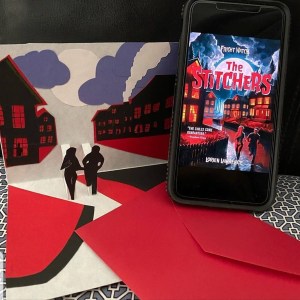
For those of you who love spooky, scary middle grade, I have a treat for you. The Stitchers (ABRAMS/Amulet 2020), by debut author Lorien Lawrence, releases this week, and alongside that spooky scary goodness, it’s SO. MUCH. FUN.

The Stitchers Cover

About The Stitchers:

Thirteen-year-old Quinn Parker knows there’s something off about her neighbors. She calls them “the Oldies” because they’ve lived on Goodie Lane for as long as anyone can remember, but they never seem to age. Are they vampires? Or aliens? Or getting secret experimental surgeries? Or is Quinn’s imagination just running wild again?

If her dad were still around, he’d believe her. When he was alive, they’d come up with all sorts of theories about the Oldies. Now, Quinn’s determined to keep the investigation going with the help of Mike, her neighbor and maybe-crush. They’ll have to search for clues and follow the mystery wherever it leads–even if it’s to the series pond at the end of the street that’s said to have its own sinister secrets. But the Oldies are on to them. And the closer Quinn and Mike get to uncovering the answers, the more they realize just how terrifying the truth may be.

Interview with Debut Author Lorien Lawrence

Welcome, Lorien Lawrence, to the Mixed-Up Files! As I often do, I shared your book with my son, who’s a middle grade and young adult reader.  He loved the Stitchers–which meant he and I got to collaborate on these interview questions.  NOTE: This interview has been edited slightly in order to group topics and transitions.

HMC: I am always curious about origin stories – where did you get the idea for the Stitchers?

LL I think I say this in another!er interview, but there’s nothing scarier than losing someone you love. I wrote this story after my dad suddenly died. I had just moved back to my hometown with my husband, and we would go for these really long walks and try to make sense of what happened. Eventually, my childhood streets brought back happy memories and feelings of nostalgia instead of sadness. And we started to play a “what if” sort of game, where we took turns wondering “what if that house was haunted?” or “what if that pond was magical?” Eventually, one of these “what ifs” turned into THE STITCHERS. So I guess writing Quinn’s story helped me come to terms with my own grief.

Writing About Loss for MG

HMC: (As you just mentioned,) your main character, Quinn, is coping with the loss of her father … and picking up where he left off, investigating the same mystery. Loss and fear are pretty scary subjects no matter how old you are … how did you balance respecting your middle-grade readers’ maturity with knowing when the subject matter needed to be age-appropriate?

Finding this balance was probably the most difficult part of the writing experience for me. I knew I needed to show Quinn coming through the other side, so to speak. She doesn’t miss her dad any less, but she learns how to live a new kind of normal. Her dreams continue, her friendships continue, even though she herself has changed. But the change isn’t all bad: she’s stronger. She’s braver. She’s more determined and more vulnerable. And she realizes that she’s still surrounded by people who love her.

Questions from HMC’s Son

HMC’s Son: What was your favorite part of this book to write? 

LL: Great question! My favorite part to write was the scene in the basement of the funeral home. I won’t give it away, but it was delightfully gruesome and fun to imagine!

HMC’s Son: What did you like most about Quinn? 

LL: Another great question! I like that Quinn is flawed. She lies. She hides the truth. She hides her true feelings. But these are things that normal 12 year olds do. And by the end of the book, she makes things right.

HMC’s Son: This book is the beginning of a series. Can you give us any hints about what is coming up next for Quinn and Mike?

LL: The next book in the series is called THE COLLECTORS, and it comes out next fall. It follows Quinn once again as she and Mike launch into a new supernatural investigation – but I don’t want to give too much away! 😊 I can say that it picks up directly where THE STITCHERS leaves off.

Stitchers Fan Art

                                                                                Stitchers Fan Art, by Elle Jauffret

Eternal Youth, Monsters, and Witches

HMC: Another interesting theme in your book is about the eternal quest for youth … and how it can make people do strange things. (!!) What takeaways do you think this element in your plot has for the middle-grade reader?

I think I was inspired by the day-old conundrum of kids wanting to be older, and adults wanting to be younger. In reality, we need to just learn to appreciate where we are in the moment.

HMC: In this book, I found lots of literary and theater connections, from Frankenstein to the Crucible. Did any of those influence your writing?

LL: Oh my gosh, I’m thrilled that you noticed! YES! I’ve always been taken with Frankenstein and The Crucible – really the whole idea that society creates the monsters, not the other way around.

Open Mic Question

HMC: What do you want us to know about The Stitchers that we haven’t asked?

LL: A quick fun fact: I have tiny clues hidden in THE STITCHERS and THE COLLETORS that hint towards future books in the series!

THE PANDEMIC QUESTIONS

HMC: I’ve begun a new line of pandemic questions in all my interviews because I’m curious about how we as kidlit authors are going to handle the pandemic in our writing going forward. You’re a middle school teacher in New England – will you be going back into the classroom to teach this fall, or will you be teaching virtually?

LL: As of right now, I still don’t know where or how I will be teaching. I am assuming that I’ll be teaching virtually as I did in the spring. I’m from Connecticut, and our state got hit with the virus early, so my school closed in early March and remained closed for the year. Whatever I end up doing, I’ll try to make the best of it!

HMC: How has the coronavirus pandemic affected your writing life?

LL: I grew up with (and still struggle) with anxiety, and writing has always been a coping mechanism for me. So I’ve actually been writing a lot! I wrote two new manuscripts during quarantine. I don’t know if these books will ever see the light of day, but it helps me to throw myself in a made-up world when times are scary.

HMC: Will Quinn and Mike have pandemic related conversations in your new book?

LL: This is a great question! I honestly don’t know the answer! They won’t be talking about it in the first two books in the series, but if I’m able to publish more adventures of Quinn and Mike, I’ll have to have a serious think about what to do with that. Maybe I’ll ask my students if they would be interested in reading about something so scary and recent. I’m sure they’ll have strong opinions either way!

((More about pandemic writing in this archived post on Writing Prompts for a Pandemic))

HMC: Thanks so much, Lorien. Congratulations on your debut and best of luck to you!

Debut Author Lorien Lawrence

Lorien Lawrence

Lorien Lawrence is a writer and middle school English teacher from Connecticut. When she’s not reading or writing, she can be found hunting ghosts with her family. The Stitchers is her debut novel.

Where to find the Stitchers:

  1. Bookshop.org
    1. Click on this link, then search for THE STITCHERS — or any other book.
  2. Amazon