Posts Tagged interview

Interview with Laura Shovan + Giveaway

As we look forward to National Poetry Month, I thought it would be a nice time to have a poet on the blog. Laura Shovan is a celebrated poet whose debut novel in verse, THE LAST FIFTH GRADE OF EMERSON ELEMENTARY, comes out on April 12th. Read through to the end for an opportunity to win it!

Laura Shovan

Photo credit: Karen Leigh Studios.

Why is poetry appealing to kids?

Children love the idea that words can create pictures in their minds. I sometimes play a game with them where I say, “An elephant is not standing on your teacher’s desk.” And we all laugh about the elephant who suddenly appeared in our imaginations, in spite of the word “not.” Prose has imagery too, but the white space of poetry allows those images to breathe. The pause we naturally make between one line and the next gives the reader time to absorb the sensory images and ideas, and to make connections.

For kids who haven’t discovered poetry yet, what are some good places to start?

I love Calef Brown’s books for early experiences with poetry. At home, we started with his Polka Bats and Octopus Slacks. The poems are short and funny. They include quirky rhymes and great characters, like Olf the terrible pirate (“terrible” as in really bad at being a pirate) from Brown’s book Dutch Sneakers and Flea Keepers. Nursery rhymes are great, as are tongue twister books such as Charlotte Pomerantz’s The Piggy in the Puddle and Dr. Seuss’s Fox in Socks, which both feature wordplay.

As children move through elementary school, I like poetry books on subjects they are interested in, such as Marilyn Singer’s Echo Echo for fans of Greek mythology, Jeff Moss’s dinosaur book Bone Poems, and Laura Purdie Salas’s A Fuzzy-Fast Blur: Poems about Pets. Sharon Creech’s Love That Dog is a wonderful introduction to novels in verse.

Can you recommend some exercises to get kids writing poetry?

The first thing I recommend is to focus on a single poetry-writing skill in each workshop, at least with elementary schoolers. One of my favorite workshops to begin with is onomatopoeia poems. I ask students to write about a place they know well, or an activity they like to do, using as much onomatopoeia as they can. We make it into a riddle poem. The poet will read his draft out loud to the class and everyone guesses where he is or what he is doing in the poem.

The fun part about this workshop is that, as we move ahead and write other poems, the onomatopoeia words stick. The children naturally incorporate them into their later writing. This and other writing prompts for kids are included in the back of THE LAST FIFTH GRADE OF EMERSON ELEMENTARY.

Can you share any stories about your work with kids and poetry?

I hope you don’t mind a sad story.

I was doing a fourth grade poetry residency one winter. There was a boy in the class whose mother had died. He hadn’t been participating much, but sat with an aide in the back of the room. Then one day, he wrote a poem wishing his mother could come down from heaven and scold him for not doing his chores. All of the adults started tearing up. I found out later, it was the first time he had talked about his mother’s death at school.

There is something about making space in the school day, or at home, for writing poetry, that allows young people to open up. I think it’s because the writing task is different from the usual school assignments, which focus on analysis, persuasion, and earning a grade. When we ask children and teens to write about their experiences, the things they feel deeply about, we’re letting them know that they are valued not only as students, but as full human beings. That’s a powerful thing!

last fifth grade cover

Laura Shovan’s engaging novel, THE LAST FIFTH GRADE OF EMERSON ELEMENTARY, is a time capsule of one class’s poems during a transformative school year. The students grow up and move on in this big-hearted debut about finding your voice and making sure others hear it. To win a copy of this lovely story, leave a comment below by midnight EDT on Friday. For two entries, tweet about this giveaway! (Please make sure your email address and twitter profile are included in your comment.)

Laura Shovan is former editor for Little Patuxent Review and editor of two poetry anthologies. Her chapbook, Mountain, Log, Salt and Stone, won the inaugural Harriss Poetry Prize. Laura works with children as a poet-in-the-schools and is currently serving as the Howard County Poetry and Literature Society’s Writer-in-Residence. The Last Fifth Grade of Emerson Elementary, her novel-in-verse for children, will be published in April 12 (Wendy Lamb Books/Random House).

Katharine Manning is a middle grade writer who has loved poetry since a teacher handed her Gwendolyn Brooks’s We Real Cool in fourth grade. You can read her middle grade book reviews, including of THE LAST FIFTH GRADE OF EMERSON ELEMENTARY, at Kid Book List. You can also find her at www.katharinemanning.com and @SuperKate.

Author Interview: Meet Nancy Roe Pimm

Ready for a quiz?  I know, this blog post just started, and already I’m quizzing you. But this won’t take long. Here goes:

1)  What was Amelia Earhart attempting to do when she and her plane went missing over the Pacific Ocean?

Of course, you answered that quickly. She was trying to become the first women to fly around the world.

2)   Who was the first women to fly solo around the world?

If you came up with the name Jerrie Mock, chances are you either live in central Ohio or you Googled the question before answering.

jerrie cover

Today I’m thrilled to have author Nancy Roe Pimm with us.  Nancy’s middle-grade biography of aviator Jerrie Mock, titled The Jerrie Mock Story: The First Woman to Fly Solo around the World, released on Tuesday, March 15th.  To find out more about this remarkable woman, let’s chat with Nancy. And, I promise, there will be no quiz at the end.

Tell us a little bit about Jerrie Mock, who she was, and how she became interested in flying.

When Jerrie was only seven years old, her parents took her to a fair where she took her first airplane ride. She loved it so much, she told her father afterward that she wanted to be a pilot when she grew up. In school, she saw pictures of exotic places around the world, and she was fascinated by other cultures. She aspired to combine her love of flying with her desire to see the world. After high school, she became the only female student studying aeronautical engineering at The Ohio State University. She did well in college, but in the 1940’s, there was a lot of pressure on young women to marry and raise a family. When her high school sweetheart proposed, she left college began the life others expected her to live.

As a woman aviator in the 1960’s, what challenges did Jerrie face?

When her children were a little older, Jerrie did go to flight school and eventually got her pilot’s license. At the time, women in the cockpit were not the norm. She tried to maintain her femininity for public perception, wearing skirts and heels for photographs. She entered flying races called air derbies and became known as “The Flying Housewife,” a moniker she very much disliked. Even though she was an airplane mechanic and pilot, her male colleagues expected her to get them coffee.

Jerrie and Amelia lived in different time periods. Do you feel Amelia paved the way for Jerrie to fly around the world? Why do you think it took so long for a female pilot to successfully complete the journey Amelia set out on?

Amelia Earhart was Jerrie’s hero. Jerrie was in middle school in 1937, a 12-year-old fan of the woman who was attempting to fly around the world. She’d race home from school every day for the radio update on Earhart’s journey. In the early 1960s, Jerrie was surprised to learn that no woman had flown solo around the world. I don’t know why it took so long for another female pilot to do it. Maybe it was because of the way Amelia’s journey ended in tragedy.

What do you hope middle-grade readers find when they read The Jerrie Mock Story: The First Woman to Fly Solo around the World?

I hope they find inspiration. Jerrie was an ordinary person who did extraordinary things.  You have to have a dream. Dreams can’t come true unless you have a dream. Jerrie also lived in a time when women had little power, but Jerrie very humbly did what she knew she could. The book shows how much womens’ roles in society have changed. Jerrie’s story has so much – history, culture, geography, science. I learned so much writing the book. I know readers will learn a lot reading it, too.

Finally, tell us a little about Nancy Roe Pimm.  Have you ever flown an airplane?

I’ve flown an Ultralight, which is like a motorized glider. I was with Mario Andretti (my husband used to drive race cars and we became friends with the Andrettis) and Mario told me to take over the controls just above the tree tops. I was terrified, but it was exhilarating! 

I grew up in Brooklyn, New York, and I always dreamed of living on a horse farm. I married a farmer who turned race car driver. He drove in the Indy 500 and the Daytona 500. He followed his dreams and encouraged me to follow my own dreams of writing. The Jerrie Mock Story is my fifth book for young readers.

Nancy-Roe-Pimm-websmall


Thanks so much to Nancy for taking time to stop by The Mixed-Up Files of Middle-Grade Authors. You can find Nancy at www.nancyroepimm.com and on Twitter as @nancyroepimm.


Mixed-Up Files blogger Michelle Houts has written four books for middle-grade readers, including Kammie on First: Baseball’s Dottie Kamenshek, which is part of the same series as Nancy Roe Pimm’s The Jerrie Mock Story. Both books are part of the Biographies for Young Readers Series from Ohio University Press.

Interview–and Giveaway–with Robin Yardi

MidnightWar_NewVersionFinal

Robin Yardi lives in the California foothills, where—every once in a while, in the dark of night—a skunk or two will sneak by. She loves good stories, animals of all sorts, homemade cakes, and kids. She blogs about books, teaches at her local Natural History Museum, and is the author of the nonfiction picture book, They Just Know: Animal Instincts, and the absolutely-not-nonfiction middle grade novel, The Midnight War of Mateo Martinez, scheduled for release on March 1.

Life is confusing for Mateo Martinez. He and Johnny Ramirez don’t hang out anymore, even though they used to be best friends. He and his new friend Ashwin try to act like brave, old-time knights, but it only gets them in trouble. His parents keep telling him to hold his sister’s hand when crossing busy streets, even though she’s the one who always runs ahead.

And last night, two skunks stole Mateo’s old trike.

Wait—two skunks stole his trike?

Mateo is too big for that rusty kid toy. He has a cool, shiny new bike anyway. But Mateo also has a neighborhood to protect. And he’s about to begin a big, stinky quest to catch the thieves. A quest that starts in the middle of the night!

Kirkus called The Midnight War of Mateo Martinez, “A magnificent novel that defines what it is to be an older brother, a friend, and, yes, even a knight.” Come visit her on the web to ask a question, schedule a Skype visit, or peek into her books: www.RobinYardi.com!

Your first book They Just Know: Animal Instincts (Arbordale Publishing 2015) features anthropomorphized animals and humor to teach about instinctive animal behavior. How does that compare to your approach to The Midnight War of Mateo Martinez?

they just

I’ve never thought about it before, but both books feature animals doing things kids usually do! In the picture book those funny images of animals playing board games, hugging teddy bears, and getting coached, are contrasted by spreads that show the real deal. Frogs don’t get coached—they just know how to hop! Snakes don’t need stuffed animals—they already are stuffed with animals!

Learn to Leap

The Midnight War of Mateo Martinez begins with two skunks creaking away on Mateo’s rusty old trike, again an animal doing something a kid would, but the real deal in the novel is all about being a boy, not a skunk, about being a big brother, and a good friend, and an honorable knight… even when you are nine.

So, I guess, my books leave room for real life and imagination. I believe kids need both!

You are obviously an animal lover. What can you tell us about your work with the Santa Barbara Museum of Natural History? In a typical week, what animals do you interact with in real life? Any close encounters with skunks?

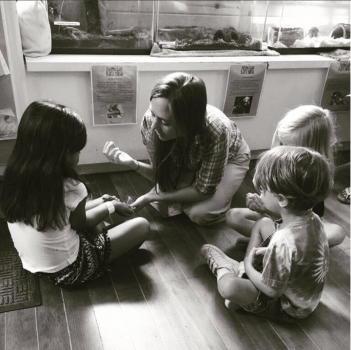
I teach in a special, very kid centered, section of the Museum that we call the Backyard. We have a clubhouse with specimens and live animals, an outdoor waterway with wooden boats and pumps, tins, spoons, pots, and pans for making mud pies, and a dig pile for finding worms and pill bugs and millipedes. All that is surrounded by a riparian woodland of oaks and sycamores! When a child comes into the clubhouse I become a librarian of creepy crawly animals.

  • Which snake should we bring out (we have three)?
  • Have you ever held a beetle?
  • Would you like to hold a frog?
  • Do you know what a stick insect is?

BY

I try to keep to the facts when I’m teaching at the museum, but I am the only naturalist, so far as I know, who has insisted on naming all of our tree frogs.

And don’t get me started on my animals at home… sometimes we name our spiders.

Where did the idea for skunks on a trike come from?

Well, the idea for that book started in my backyard. One night, through the backdoor, my daughter and I watched skunks, raccoons, and stray cats battling it out for some leftover dog food. I said, “I wonder if the skunks and raccoons play on the playground at night when you’re asleep?”

“How would they even get there?” my daughter asked.

“On your creaky old trike!” I told her. She laughed pretty hard, so I knew I had a good beginning.

Mateo, his little sister, Mila, and his best friend, Ashwin, were inspired by kids I know and teach in Santa Barbara. In fact I overheard one of my favorite Mila lines while working in the Museum Backyard. Someone asked a little girl, “How do you think snakes get clean?”

“They lick themselves like kitties,” was her answer, which I thought was brilliantly funny and completely plausible, so I stole it and snuck it into the book!

If there was one single thing that you wanted readers to get from The Midnight War of Mateo Martinez, what would it be?

Mateo is struggling to understand the world around him and how he fits into it.  He’s dealing with changing friendships, his Mexican-American identity, his need to be a good big brother and an honorable knight. That’s a lot. Any kid who reads my book is going to have their own worries, things they don’t quite understand, maybe some things they never will. I want kids who read the book to deal with those worries bravely and with honor, without leaving behind the fantastical thinking of childhood, because sometimes that’s the only way to find understanding, by following the trike-riding skunks that are creaking down your driveway, up your street, and through your dreams.

What other books do you recommend to readers who enjoyed The Midnight War of Mateo Martinez?

I love The Hoboken Chicken Emergency, the Dyamonde Daniel books, the Cold Cereal Saga, and the whole Clementine series. And this one is a bit of a throwback, but The Mouse and the Motorcycle has a tidy kinship to two skunks on a trike, don’t you think?

How long did it take from first spark of an idea to finished book in your hands?

SIX years. My daughter was three when we watched those skunks through the backdoor—she’s nine now.

Why do you write middle-grade?

First, middle grade kids don’t question how real life worries and trike riding skunks end up in the same book. They just know. They get it! I guess part of my brain never grew out of that kind of thinking.

Second, as a kid middle grade novels were a huge part of my life. Sometimes books were my best friends. Sometimes books were my only friends. They kept me company and taught me about the world. I hope my books can do the same!

What advice do you have for someone who wants to write middle-grade fiction?

Don’t underestimate your audience. Middle grade readers can be deep thinkers… deep thinkers who like fart jokes and talking animals. Respect what they can understand and respect what they like and want to read! Be funny, be adventurous, and be honest. Pretend you are still nine, or ten, or eleven—in short, be AWESOME!

Robin has kindly offered a signed hardcover copy of The Midnight War of Mateo Martinez and a bookmark for a giveaway. Leave a comment by midnight on Friday, February 12. The winner will be announced on Saturday, February 13.

Jacqueline Houtman is the author of the middle-grade novel The Reinvention of Edison Thomas (Front Street/Boyds Mills Press 2010) and coauthor, with Walter Naegle and Michael G. Long, of the biography for young (and not-so-young) readers Bayard Rustin: The Invisible Activist (Quaker Press 2014).