Posts Tagged interview

STEM Tuesday Cool Inventions and the People Who Create Them – Interview with author Mary Kay Carson

Welcome to STEM Tuesday: Author Interview & Book Giveaway, a repeating feature for the fourth Tuesday of every month. Go Science-Tech-Engineering-Math!

Today we’re interviewing author Mary Kay Carson who wrote this month’s featured cool invention book, Alexander Graham Bell for Kids: His Life and Inventions 

Find out how Alexander Graham Bell invented not only the telephone, but also early versions of the phonograph, the metal detector, airplanes, and hydrofoil boats. This Scottish immigrant was also a pioneering speech teacher and a champion of educating those with hearing impairments, work he felt was his most important contribution to society. Bell worked with famous Americans such as Helen Keller and aviators Glenn Curtiss and Samuel P. Langley, and his inventions competed directly with those of Thomas Edison and the Wright Brothers.

May Kay’s books include  a number of titles in Houghton Mifflin Harcourt’s award-winning SCIENTISTS IN THE FIELD series, including  Park Scientists and The Bat Scientists, an ALA’s 2011 Notable Children’s Books for Middle Readers. Her book Exploring the Solar System was the 2009 recipient of the American Institute ofAeronautics and Astronautics Children’s Literature Award and the State Library of Ohio selected Beyond the Solar System as a CHOOSE TO READ OHIO book for 2015 & 2016. Visit her at marykaycarson.com  or on Twitter at @MaryKayCarson

Support Independent Bookstores - Visit IndieBound.org

JAS: Thanks for joining us today, Mary Kay. This is a fabulous book! I love how you found such a unique trait to describe this historical figure. I mean, everyone knows that Alexander Graham Bell invented the telephone, but not many know why. Can you tell us how you discovered this fact? And also why you used it to create your whole book?

MKC: In today’s terms, we’d call Alexander Graham Bell a third-generation speech therapist. Bell’s father and grandfather worked with people trying to overcome speech impediments like stuttering or pronunciation struggles because of hearing impairments. Alexander Graham Bell was born into a family where the proper mouth position for making the sound of S was dinner table talk. Bell naturally went into this line of work, as well. Growing up with a mother who couldn’t hear gave him a deep understanding of both the isolation of the hearing impaired as well as a motivation for understanding how sound is made, transmitted, and perceived.

JAS: How did you come up with all of the activities? And why did you choose to add activities to your book?

MKC: I knew Alexander Graham Bell For Kids would include activities as a title in the Chicago Review Press “For Kids” series, all of which have 21 activities. It’s actually why I thought the book would be such a good fit for the series. Bell’s experiments, investigations, and inventions run the gamut from sound and light to flying machines and sheep genetics. The telephone invention alone lends itself to activities about electricity, sound, vibrations, and batteries. I’ve written four other books in this series with activities and Alexander Graham Bell For Kids was by far the easiest to come up with activities for. He was a wellspring of ideas.

JAS: The use of original sketches of Bell’s inventions are really great. How difficult was it to get permission to use them?

MKC: The Library of Congress has a huge Alexander Graham Bell archive, much of it digitized and in the public domain. It includes laboratory notebooks, invention blueprints, journals, personal letters, and photographs. It’s a real treasure trove of primary source material.

JAS: Why do you think learning about inventors is a so important for kids?

MKC: One of my favorite Bell quotes is: “The inventor is a man who looks around upon the world and is not contented with things as they are. He wants to improve whatever he sees, he wants to benefit the world.” To me, Bell’s description of an inventor actually describes young people in general. Most see the world as overdue for upgrades and improvements. Many have ideas on how to make things better, too. Being able to envision something different is the first step to inventing. Whether we’re talking about tackling a changing climate or designing a fun video game, it all starts with “What if…”

JAS: How would you suggest a teacher use your book in the classroom?

MKC: There are quite a few ways teachers can use the book in the classroom. The biography itself is instructive on how life experiences shaped the inventor that Bell became. The primary source material is cited and resources given for older kids who want to dig deeper into Bell’s life and legacy. Some of the activities in the book are simple enough for even kindergarteners to explore sound and light. Other activities are more open ended and challenge students to think of and execute an idea of their own.

Buy a Copy of the Alexander Graham Bell book

Praise for Alexander Graham Bell: “Many of the activities featured throughout the chapters, such as making an ear trumpet and feeling sound vibrations, use materials readers likely have at home, fairly easily giving them a taste of the devices used during Bell’s time and illustrating properties of sound. Avid readers can also pursue activities that require special purchases, such as seeing sound and making a pie-tin telegraph. Numerous black-and-white photographs of Bell and his family, period scenery, and artifacts immerse readers in the world of this prolific inventor, from his free-roaming childhood through his adulthood as a teacher of the deaf, an inventor many times over, and a family man. Children who enjoy exploring different symbolic communication codes, historical sciences, and inventions will find much to dig into in this detailed volume.

Thorough and well-rounded. (timeline, resources, glossary, notes, bibliography)”–Kirkus


Win a FREE copy of the Alexander Graham Bell book!   Enter the giveaway by leaving a comment below. The randomly-chosen winner will be contacted via email and asked to provide a mailing address (within the U.S. only) to receive the book.

Good Luck! 

Hosting this week is Jennifer Swanson, fellow science nerd, and author of Astronaut Aquanaut: How Space Science and Sea Science Interact and other nonfiction books for kids. @JenSwanBooks

STEM Tuesday All About Conservation – Interview with Author Nancy Castaldo

Welcome to STEM Tuesday: Author Interview & Book Giveaway, a repeating feature for the fourth Tuesday of every month. Go Science-Tech-Engineering-Math!

Today we’re interviewing author Nancy Castaldo who wrote this month’s featured conservation book, Back from the Brink: Saving Animals from Extinction.

Find out how seven different animal species from around the world were saved from extinction by hard-working scientists and environmental activists in this book. Nancy Castaldo has used her experience as an environmental educator to create award-winning books about our planet for over 20 years including her 2016 title, The Story of Seeds: From Mendel’s Garden to Your Plate, and How There’s More of Less To Eat Around The World, which earned the 2017 Green Earth Book Award, Junior Library Guild Selection, and other honors. Nancy’s research has taken her all over the world from the Galapagos to Russia. She loves sharing her excitement about nonfiction with readers and fellow writers. Visit her at nancycastaldo.com, on Twitter at @NCastaldoAuthor, or on Instagram at @naturespeak.

Mary Kay Carson: How did this book come about?

Nancy Castaldo: When I was young I had nightmares of creatures going extinct. I was terrified of losing any endangered species. I still am, but I know that my younger self needed to see hope and learn about the helpers. I wanted to give those stories to my readers. I wanted them to see that we all can make a difference, that every endangered species doesn’t go extinct because of the helpers. And that no matter where you live or how old you are, we all have the ability to join in the bucket brigade. I hope that Back from the Brink does that for my readers.

MKC: Could you share some highlights of doing research for Back from the Brink

Nancy: Every place I visit for research and photography has been life changing for me. This book, like the others for Houghton Mifflin such as Sniffer Dogs and The Story of Seeds, has taken me to places I only dreamed of visiting. I am a herper at heart, meaning I love reptiles and amphibians. Spending time with the tortoises and marine iguanas in the Galapagos was heaven. Another favorite experience was spending time with the dedicated California condor researchers in the Sespe Wilderness area. Part scientist and part adventurer, these biologists work tirelessly to conserve the condor population, despite continued threats to the birds from lead poisoning and micro-trash litter. It was a joy to enter their world.

MKC: Do you have a STEM background?

Nancy: I do have a STEM background. I completed a biology/chemistry double major in college and was president of the science club. At the same time I was also the co-editor of my college’s literary magazine. I was highlighted when I graduated in the college’s view book with the title, Creative Combinations. I’m still combining, having then went on to get a master’s that focused on children’s literature. Science, writing, and photography are all my passions. I love writing STEM books. I was a curious kid and I love writing for curious readers. I strive to inspire, inform, and empower my young readers because I believe they are our hope for the future. Our world needs them now more than ever.

Purchase Back from the Brink!

MKC: Any recommendations for fans of Back from the Brink?

Nancy: I’m hoping that readers will become inspired and empowered with the success stories in Back from the Brink and want to learn more about these creatures and other endangered species. There are many wonderful fiction and nonfiction books that can continue the experience. I’ve included many in the Learn More section of the book, including Dorothy Patent’s The Buffalo and the Indian, Farley Mowat’s Never Cry Wolf, and Jazynka Kitson’s Mission Wolf Rescue. While these books are great reads, I really hope that my readers will step out into the wild and discover some of these creatures first hand. I list places throughout the country for outdoor, natural sightings in my book.

Praise for Back from the Brink:

  • “[Castaldo] offers solid, meaningful suggestions for young readers […] including many, many learning opportunities: things to watch and read, organizations to investigate, websites and parks to explore. Challenging but important reading for the intended audience.”–Kirkus, STARRED review
  • “Readers will be moved by Castaldo’s appreciation for these animals.”–Booklist, STARRED review

Win a FREE copy of Back from the Brink!   Enter the giveaway by leaving a comment below. The randomly-chosen winner will be contacted via email and asked to provide a mailing address (within the U.S. only) to receive the book.

Good luck!

Hosting this week is Mary Kay Carson, fellow animal lover, science nerd, and author of Mission to Pluto and other nonfiction books for kids. @marykaycarson


SaveSave

SaveSave

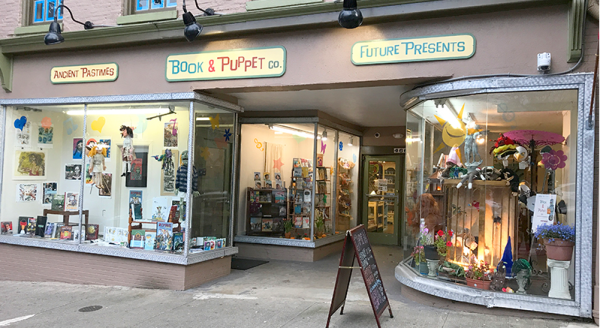
Indie Spotlight: Book & Puppet Company, Easton, PA

Sue Cowing for Mixed-up Files: Another new independent bookstore catering to kids!  Today we’re talking with Andy Laties and Rebecca Midgal, Co-founders of Book & Puppet Company in downtown Easton  Pennsylvania (www.bookandpuppet.com).
MUF: Most independent book shops are founded on their owners’ passions, which is what makes each one unique. How did your passions for books and puppets combine to give Easton its first bookstore?
Rebecca: Andy and I first began doing improvisational puppetry together at Bank Street Bookstore in New York City. It has been such a fruitful collaboration, we wanted to take it to the next level by putting a puppet theater in our own bookstore.
MUF: Book & Puppet has another, out-of-this-world founder, Boingustopheles. Tell us a bit about him.
Rebecca: Boingustopheles is our beloved founder, a philanthropic robot from the Intergalactic megalopolis of Mikmukdukporp who believes in the healing power of comedy and humor. We are very grateful that Boingustopheles has chosen to locate a store on this planet. Boingustopheles thinks that everything we humans do is hilarious. We haven’t had the heart to break it to him that most of the “jokes” are actually serious. Perhaps he would find that even funnier, however.
MUF: What atmosphere do you aim to create at Book & Puppet Co.? If a middle-grade reader comes into your shop looking for her or his next good book (or puppet) what happens?
Andy: This store is a fun and funny place to hang out—the large selection of fiction for middle-readers kind of sneaks up on kids. It’s not the first thing they notice. We are very low-key with middle-graders. They need to feel respected, and free to examine the books. After a little while, I check in very casually to see if I can provide any advice. I’ve been a children’s bookseller for decades, so I’m able to identify what most kids would be interested in, once they’re comfortable opening up to me about their current reading.

MUF:How do you choose what books to carry in your shop?
Andy: When I’m considering whether to buy a book, I imagine which customer would choose it. When it comes to children’s literature, I serve children, parents, teachers, grandparents—I need books for all of them. This bookstore also caters to adult readers: I do the same thing there—I visualize my customers and try to select books they would like.
MUF:As middle-grade authors, we’d love to know what titles new or old, fiction or nonfiction you find yourselves recommending to this age group these days?
Andy: I love to turn young people on to Joan Aiken, whose Wolves of Willoughby Chase books were a precursor to Steampunk. I recommend Tom’s Midnight Garden by Philippa Pearce whenever possible. I recommend series that compare to Harry Potter—I often pitch Maile Meloy’s Apothecary series and John Stephens’ The Books of Beginning series. I recommend the Family Fletcher series by Dana Alison Levy to kids who like contemporary family stories. For nonfiction I gravitate to Steve Sheinkin—I love his Jim Thorpe biography Undefeated in particular. And I enjoy showing kids and parents Jazz Day—The Making of a Famous Photograph by Roxane Orgill.

MUF: Tell us about some of the regular activities at Books & Puppets, including puppet shows for all ages. Both of you are also graphic novelists and share your skills in workshops at the store. Do you have workshops and events coming up that would appeal to ages 8-12?
Rebecca: Our puppet shows are great for kids of all ages, and children ages 8-12, if they can be induced to come, seem to enjoy them a good deal. We also have arts and crafts project for older kids.
MUF: You also put on some events aimed and political and social action. Any coming up?
Rebecca: We just had an info-shop event about the feminist revolution in Rojava, Syria, and we plan to do more programs like that in the future. On an ongoing basis, Mangled Myths, our weekly improvisational puppet shows for grownups, often include political satire.
MUF:If a family from out of town came to visit your shop, would there be family-friendly places in the neighborhood where they could get a snack or meal after browsing? And if they could stay a little longer, are there nearby sites or activities they shouldn’t miss?
Rebecca: This is a fantastic place for families to visit. We are right in downtown Easton, PA, close to the Easton Public Market, an indoor, indie-style food court that is a destination in the region. The Public Market was established in 2016 as a year-round home for the vendors who congregate every Saturday, April through December, at our eagerly anticipated Farmers Market, which is the oldest one in the country. There are many dining options in the neighborhood, notably the State Café right around the corner from us, and nearby Terra Café, both of them frequented by families.
We are only two blocks from the Crayola Experience, which is a popular family destination that draws visitors from throughout the nearby states, and the State Theater is across the street from us, offering national acts including many family-friendly shows. Also close by are the Sigal Museum, the Canal Museum and other historic attractions. Easton has frequent weekend outdoor festivals in the Summer and Fall, such as the Bacon Fest and the Riverside Arts Festival.
We stand at the gateway to the Lehigh Valley and the Poconos, offering a wealth of arts festivals, outdoor adventures and other amusements. All this makes Easton a great family vacation destination.
MUF: You have said that, contrary to the conventional assumptions, now is a good time to open an independent bookstore. Why do you think so? You’re just getting started. What are your hopes and plans for Book & Puppet Company in the future?
Rebecca:  It’s true that this appears to be the time of the “retail apocalypse” with big stores and shopping malls closing, due to the growth of online retail. But everyone still wants to go out and enjoy our communities. Children especially need to be surrounded by books in order to get excited about reading—they can’t simply shop online. Independent bookstores can be successful if we serve as gathering places for neighbors. Many of the new crop of bookstores have raised start-up money using crowdfunding websites, which enable local supporters to participate and show their enthusiasm.
Our hope is that Book & Puppet Company becomes an anchor for community life in Easton, playing a part in the city’s economic and cultural revival. We hope to run bookfair fundraisers in local schools, host authors and performers, and support the reading practice of our neighbors for many years to come.

Thanks Andy and Rebecca for introducing us to your lively shop!  Readers, if you’ve visited Book & Puppet or would like to, please add your comments.