Posts Tagged historical fiction

Re-Engaging Disconnected Readers

Amy Vatne Bintliff is a teacher and researcher who has taught language arts and reading in traditional and alternative programs in Minnesota and Wisconsin. She has developed a wide array of programming for students who struggle with school. A passionate advocate for human rights and multicultural education, she believes strongly in listening to the voices of adolescents.

Amy VB

Amy is a recipient of the 2014 Teaching Tolerance Award for Excellence in Teaching and the author of Re-Engaging Disconnected Youth: Transformative Learning Through Restorative and Social Justice Education (Peter Lang Publishing 2011).
bintliff cover

I sat down to chat with Amy, who is working on a new edition of the book, adding a new chapter about her recent work with middle school students.

What turns kids away from reading?

For many students, the hectic schedules that they lead turn them away from reading.  They are so busy with athletics, jobs, etc. that they just don’t build in the time.  And then when they do have time to read in class, they often feel sleepy.  That makes sense, right?  We know that most adolescents need more sleep. Feeling that they just aren’t good at reading also causes disengagement.  I find that many students get one MAP score or STAR score back that is low, and their self-esteem just tanks.  No matter how much I tell students that those scores don’t represent their complete lives as a reader, they internalize those scores and carry a feeling of defeat with them.  That turns students away.

Why do you think books with social justice themes are appealing to students and how do you use them in the classroom?

I began using human rights education and social justice education early on in my career partly because that’s where my own passions are.  But then I began really observing how active my students were when they were discussing or debating themes of injustice.  Nearly every young person I have taught has felt the sting of injustice in some way.  At the start of the year, we begin debating what is meant by the word “justice” and “injustice”.  We look at modern texts, such as opinion editorial pieces, plus brief excerpts by philosophers, such as Aristotle.  Then we read about people like Martin Luther King Jr., Mark Twain, Septima Clark, and others involved in social change.  We also each write a personal essay, journal or poem about times injustices have impacted us.  I also directly teach my students different frameworks depending on the text and student interest.  A few of the frameworks are:

Generally, students are presented with the frameworks and then have time to discuss them, choose an article, standard or stereotype that they want to explore more deeply, and present a group or individual project.

I then find some strong examples from literature, usually our class reads aloud to start with, so that we can explore with new eyes.  We then use the frameworks to analyze literature, current events, and our own responses to them.  Students begin to actively engage with text because they have a new vocabulary to back up their thinking.  When we get to Close Reading activities, students can say, “I found a gender stereotype here” or “What’s happening is going against the message of the Universal Declaration of Human Rights”.  They feel empowered.  They also feel moved by the very human stories involved in the work.  Finally, we create service projects that allow students choice.  For example, last year, my students chose to teach Teaching Tolerance’s Anti-bias Standards to 4th graders.  The service portion of a reading classroom engages them and helps lessen the feelings of sadness, anger and helplessness often associated with reading about social justice themes.

What is the role of diverse books in engaging young people?

Diverse books allow students to create imagined dialogue with people outside of their normal daily interactions.  These imagined dialogues decrease fear and build connections.  It builds capacity, teaches background knowledge, and allows students to reflect on how they are similar or different from narrators or main characters.  Diverse books also teach students that one person’s story does not represent a whole race, gender, etc.  As a teacher, I reiterate that each time we explore a piece of literature.

 What are some of your favorite books to reach disconnected students? 

The graphic novels, March Book One and March Book Two by John Lewis, Andrew Aydin and Nate Powell are fantastic!  Students who never read full books in the past completed both.  What I love about these graphic novels is that they tie to other social justice texts or current events.  Even though the books may take some students only a matter of days to read, there are many weeks worth of connections and discussions to stem from the graphic novels.  I love that the history re-connected not only struggling readers, but also students who generally weren’t enjoying traditional history texts.

march 2 March 1

I have had great success with the novel Ninth Ward by Jewell Parker Rhodes.  There is so much to talk about in this book such as bullying, coming of age, poverty, and equality.

ninth ward

I also love poetry books.  Some of my favorites poets for middle school students are Naomi Shihab Nye, Walter Dean Myers and Gary Soto. Paul Janeczko’s book Reading Poetry in the Middle Grades has some good teacher resources.  Also, many of the poets have lesson plans on their websites.

Reading Poetry

In a classroom with students at a range of reading levels, how do you both challenge advanced readers and engage those that are struggling?

I think one of the key things is to engage students with concepts and philosophies that are challenging no matter what their reading level.  If the theme of a story, such as injustice, is carefully selected, students can work with partners, or solo, on the text.  You then need to create space for dialogue so that all students have equal opportunities to share their thinking.  I also help students select books that match their interests and push students to new levels when they are ready.  My reading students select their books of choice and I build in time for independent reading in a comfy part of the classroom.  I work with three rotating stations:  guided reading where I teach new strategies, a writing station and an independent reading station.

In your video (embedded below), you talk about including physical activities in the reading classroom. Can you elaborate on that?

Movement is essential when working with reading students!  I have a whole array of brief “brain games” that I use between station rotations.  I play the game with them, so we build trust by laughing, setting game goals, and getting blood flowing to the brain.

Where can our readers find out more?

Teaching Tolerance’s Appendix D–A tool for selecting diverse texts

The Advocates for Human Rights—Free resources and lessons

The Howard Zinn Education Project—History resources that are great to use with historical fiction

Booklists from Teaching for Change and the Cooperative Children’s Book Center

Jacqueline Houtman is the author of the middle-grade novel The Reinvention of Edison Thomas (Front Street/Boyds Mills Press 2010) and coauthor, with Walter Naegle and Michael G. Long, of the biography for young (and not-so-young) readers Bayard Rustin: The Invisible Activist (Quaker Press 2014).

Blue Birds: Insights from Caroline Starr Rose

BlueBirds_CVCaroline Starr Rose is a former history teacher and author of the starred novel in verse, May B. Her new historical middle grade novel Blue Birds (G.P. Putnam’s Sons/Penguin Group USA, 2015) is set in 1587. It’s the honest and gripping story of Alis, one of the unwelcome English settlers on Roanoke Island. Kimi, a member of the Roanoke tribe, has lost both her father and her sister to violent attacks from the colonists. Despite language and mistrust, the two girls find friendship.

MUF: History clearly inspires you. When do you turn from research to story?

CSR: I am not an author who is oozing with plots and characters. Instead I start with an era or event that I want to explore, and I trust ideas will start to grow out of what I’m learning and from the “what if” questions I pose. I need to immerse myself in my study until I feel confident with the material. By the time I start thinking of story, it feels like a natural outgrowth of the history I’ve learned.

MUF: Alis is a brave girl, but also of her time, with chores and children to watch. And yet she is drawn outside of the protection of the settlement to the friend she has made. Tell me about building the tension Alis feels between the two worlds.

CSR: A large part of Alis stems from my exploration of my own experiences as a girl and teen. I moved back to the U.S. at the age of six, after three years in Saudi Arabia. I knew little about my own country or culture and was very much an outsider. My fifteenth year I spent on exchange in Australia. Again, when I came home, what was supposed to be familiar was actually foreign. I wanted to watch a similar tension grow in Alis, wanted her to be drawn into a new world but also come to see her own culture as an outsider might.

MUF: You really capture Alis’ joy in the natural world. I loved the wood carving and learning the word for blue bird, iachawanes. What was your inspiration?

CSR: Author Lucy Maud Montgomery was the inspiration behind Alis’s love of nature. Readers will know her as the author of the Anne Shirley and Emily Starr books. While both these characters deeply love nature, I would argue L.M. Montgomery was even more under its spell. (I’ve read her five-volume journal twice now and plan to do so every ten years. They’ve become a huge part of my writing and reading life.)

Iacháwanes was tricky. I wanted to find an animal indigenous to the Outer Banks that both girls might have encountered and that also had a known Algonquian counterpart. Because the Algonquian dialect the Roanoke and Croatoan spoke is now dead, there were a limited number of words to pick from. The eastern blue bird — iacháwanes — is actually the third bird I picked! When I found Governor John White’s beautiful watercolor (see here), I knew this was the bird my girls connected over.

MUF: You remain true to the terrible and violent history of what happened to both Native people and the white settlers but in a way that won’t frighten young readers. Did you struggle with that?

CSR: An unvarnished picture of history, one that doesn’t try to explain the ugly parts away, is always most impactful. I was worried some of these heartbreaking events might frighten young or especially sensitive readers, but at the same time I knew I couldn’t hide from what really happened. These young characters couldn’t, and I couldn’t do that to my readers, either. That said, I’m happy my publisher chose to label the book as “10 and up” rather than the typical middle grade 8-12.

MUF: There is a demand for diverse books, and yet it’s hard to write across cultures. How did you address describing the Roanoke experience?

CSR: Honestly, it was a very challenging, sometimes scary experience. I’m a non-Native author. I’ve written about two tribes that no longer exist, groups who left no written record and are the subject of very few reference materials. Have I gotten things wrong in some places? I’m almost positive I have. But I tried my very, very best to work with what I knew, as was absolutely my responsibility. It was also important to find a reader from the Lumbee tribe (possibly the modern-day descendants of the Croatoan) who was able to vet my work.

Ultimately, I had to trust my life experiences — I’ve been a girl, I know how profoundly friendship can shape a person — gave me a measure of authority to write about a character far different from me. Writing is a risky endeavor. There’s no room for playing it safe.

MUF: Verse expresses beautifully the connection between Alis and Kimi, especially when there are so few words they share in common. Why did you choose to write in verse?

CSR: I knew from the start this book would be in verse, partly because that’s what I’m comfortable with, partly because I find it such a great way to write historical fiction. Verse gives a reader immediate access to a character and her world. The extraneous is stripped away.

Once I realized the story needed to be told in both girls’ voices, verse added another layer of communication through stanza and line placement on the page. As the girls are drawn together, the words are, too. Verse is magical this way.

MUF: You have a picture book out soon too! Will you continue to write novels in verse?

CSR: Yes! Over in the Wetlands releases this July. Though my next historical novel, a story about the Klondike Gold Rush, is written in prose, I definitely will write verse again. I’m learning to listen to the best way a story can be told. Ideally I figure this out before I begin drafting!

March New Releases

I don’t know about you, but I’m excited to SPRING into March! There are so many wonderful books releasing this month, and I’m honored to have one of my own  among them!

(Listed In Order of Release Date)

The Imaginary by A.F. Harrold; illustrated by Emily Gravett (March 3) 

Rudger is Amanda Shuffleup’s imaginary friend. Nobody else can see Rudger-until the evil Mr. Bunting arrives at Amanda’s door. Mr. Bunting hunts imaginaries. Rumor has it that he even eats them. And now he’s found Rudger.

Soon Rudger is alone, and running for his imaginary life. He needs to find Amanda before Mr. Bunting catches him-and before Amanda forgets him and he fades away to nothing. But how can an unreal boy stand alone in the real world?

Flunked by Jen Calonita (March 3)

RlunkedFull of regret, Cinderella’s wicked stepmother, Flora, has founded the Fairy Tale Reform School with the mission of turning the wicked and criminally mischievous into upstanding members of Enchantasia.

Impish, sassy 12-year-old Gilly has a history of petty theft and she’s not too sorry about it. When she lifts a hair clip, she gets tossed in reform school-for at least three months. But when she meets fellow students Jax and Kayla, she learns there’s more to this school than its sweet mission. There’s a battle brewing and she starts to wonder: can a villian really change?

The Box and the Dragonfly (The Keepers #1) by Ted Sanders (March 3)

KeepersArtifacts. Miseries. Mysteries . . .
From the moment Horace F. Andrews sees the sign from the bus–a sign with his own name on it–everything changes. The sighting leads him underground to the House of Answers, a hidden warehouse brimming with peculiar devices. But there he finds only questions. What is this curious place? Who are the strange, secretive people who entrust him with a rare and immensely powerful gift? And what is he to do with it?


Ms. Rapscott’s Girls by Elise Primavera (March 10)

MsRapscott'sGirls

Fans of Mary Poppins will love this whimsical tale of a boarding school for children of very busy parents, where an extraordinary headmistress teaches them life lessons about courage, adventure, friendship . . . and the importance of birthday cake.
Nestled inside a lighthouse, Great Rapscott School for the Daughters of Busy Parents takes its motto from Amelia Earhart: Adventure is worthwhile in itself. Headmistress Ms. Rapscott couldn’t agree more, but her students, who are shipped to the school in boxes, could use a little convincing. Still, despite their initial reluctance, the students are soon soaring through the sky and getting lost on purpose. In addition to learning what birthday cakes are and how best to approach a bumbershoot tree, the students also manage to learn a little something about strength and bravery.

Little Miss Evil by Bryce Leung, Kristy Shen (March 10) LittleMissEvil

When you live in a volcano, ride to school in a helicopter, and regularly see your dad on the news with the caption “EVIL GENIUS” underneath his picture, it takes a lot to rattle you. Until you get a message that says: We have your father. Deliver the NOVA in 24 hours or we will kill him. But telling him to stop building weapons is like telling Michelangelo to stop painting. And that’s why thirteen-year-old Fiona has a flamethrower strapped to her arm. After all, who’d mess with a girl who can throw fireballs? Apparently, these guys. Big mistake.

Catch You Later, Traitor by Avi (March 10) CatchYouLater,Traitor

Brooklyn, New York, 1951.
Twelve-year-old Pete Collison is a regular kid who loves Sam Spade detective books and radio crime dramas, but when an FBI agent shows up at Pete’s doorstep accusing his father of being a Communist, Pete finds himself caught in a real-life mystery. Could there really be Commies in Pete’s family? At the same time, Pete’s class turns against him, thanks to similar rumors spread by his own teacher; even Kat, Pete’s best friend, feels the pressure to ditch him. As Pete follows the quickly accumulating clues, he begins to wonder if the truth could put his family’s livelihood–and even their freedom–at risk.

Roller Girl (A Graphic Novel) by Victoria Jamieson (March 10) RollerGirl

For most of her twelve years, Astrid has done everything with her best friend Nicole. But after Astrid falls in love with roller derby and signs up for derby camp, Nicole decides to go to dance camp instead. And so begins the most difficult summer of Astrid’s life as she struggles to keep up with the older girls at camp, hang on to the friend she feels slipping away, and cautiously embark on a new friendship. As the end of summer nears and her first roller derby bout (and junior high!) draws closer, Astrid realizes that maybe she is strong enough to handle the bout, a lost friendship, and middle school… in short, strong enough to be a roller girl.

Nightbird by Alice Hoffman (March 10) Nightbird

Twelve-year-old Twig’s town in the Berkshires is said to hide a winged beast, the Monster of Sidwell, and the rumors draw as many tourists as the town’s famed pink apple orchards. Twig lives in the orchard with her mysterious brother James and her reclusive mother, a baker of irresistible apple pies. Because of a family secret, an ancient curse,Twig has had to isolate herself from other kids. Then a family with two girls, Julia and Agate, moves into the cottage next door. They are descendants of the witch who put the spell on Twig’s family. But Julia turns out to be Twig’s first true friend, and her ally in trying to undo the curse and smooth the path to true love for Agate and James.

Molly Pepper and the Night Train by Courtney King Walker (March 13) ???????????????????

Hidden somewhere in the fog of the San Francisco bay lies Blue Rock Island, home to the bay area’s two best-kept secrets: Bell’s Bluff, the old, abandoned prison on one side of the island, and the Night Train, a mysterious train ride on the other. When twelve-year-old Molly Pepper receives a secret invitation promising a night of magic and adventure aboard the Night Train, she is skeptical. In her experience, most promises prove too good to be true. The fact that she lost her mom is proof enough.

Still, Molly gives hope another chance. Together with her loyal friend, Noah Wonderly, they sneak out of the house and follow a string of clues leading to the Night Train. But when the train stops at Bell’s Bluff, Molly discovers the real reason she was invited. There, she starts to wonder if hope and magic not only fix broken promises; but make you believe in them again.

The Luck Uglies, Fork-Tongue Charmers by Paul Durham (March 17) TheLuckUglies

It’s not easy being the daughter of the High Chieftain of the Luck Uglies. Now an insidious new lawman in Drowning has declared Rye an outlaw, and she’s stuck on the strange and remote Isle of Pest. But the island quickly feels much less remote when the battle to control the future of the Luck Uglies moves to its shores. To defeat the Luck Uglies’ bitterest rivals, Rye must defy a deranged earl, survive a test meant to judge the grit of the fiercest men—and uncover some long-buried family secrets. And when Rye leads the charge to defend the island, she and her friends will meet an eerily familiar enemy. . .

In Todd We Trust by Louise GalvesInToddWeTrustton (March 17)

In the sequel to By the Grace of Todd, the Toddlians believe Todd has forgotten all about them. There’s only one solution to their problems: to find a new god! And so they decide to build a raft à la Noah’s ark in order to search for a more thoughtful deity. But who can the Toddlians turn to in their time of despair? And does Todd really not remember the miniature race generated by the dirt on his smelly sock? It will take more than divine intervention to save the Toddlians and mend their relationship with their neglectful creator.

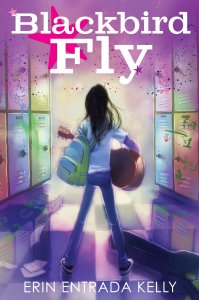
Blackbird Fly by Erin Entrada Kelly (March 24)

BlackbirdFly

Apple has always felt a little different from her classmates. Her mother still cooks Filipino foods, speaks a mix of English and Cebuano, and chastises Apple for becoming “too American.” It becomes unbearable in middle school, when the boys—the stupid, stupid boys—in Apple’s class put her name on the Dog Log, the list of the most unpopular girls in school. When Apple’s friends turn on her and everything about her life starts to seem weird and embarrassing, Apple turns to music. If she can just save enough to buy a guitar and learn to play, maybe she can change herself. It might be the music that saves her . . . or it might be her two new friends, who show how special she really is.

The Penderwicks In Spring by Jeanne Birdsall (March 24) ThePenderwicks2

Springtime is finally arriving on Gardam Street, and there are surprises in store for each member of the family. Some surprises are just wonderful, like neighbor Nick Geiger coming home from war. And some are ridiculous, like Batty’s new dog-walking business. Batty is saving up her dog-walking money for an extra-special surprise for her family, which she plans to present on her upcoming birthday. But when some unwelcome surprises make themselves known, the best-laid plans fall apart.

The Island of Dr. Libris by Chris Grabenstein (March 24) TheIslandofDr.Libris

What if your favorite characters came to life? Billy’s spending the summer in a lakeside cabin that belongs to the mysterious Dr. Libris. But something strange is going on. Besides the security cameras everywhere, there’s Dr. Libris’s private bookcase. Whenever Billy opens the books inside, he can hear sounds coming from the island in the middle of the lake. The clash of swords. The twang of arrows. Sometimes he can even feel the ground shaking. It’s almost as if the stories he’s reading are coming to life! But that’s impossible . . . isn’t it?

What books are you excited about SPRINGing into this month? Tell us about them in the comments!

LouGbiopicLouise Galveston is the author of By the Grace of Todd and its sequel, In Todd We Trust (Razorbill) www.bythegraceoftodd.com When she’s not shuffling through the mixed-up files on her messy writing desk, you’ll find Louise directing children’s theater, playing games with her big family, or up to her eyeballs in laundry.