
 We’re excited to welcome J.E. Thomas back to the blog. We so enjoyed her previous interview when Control Freaks released, and we’re looking forward to telling everyone about her newest book, The AI Incident.
Like her first book, this one is super funny and has standout characters, plus it’s a heartwarming story of Malcolm finding love and family. I love the publisher’s description of the book:
“The Wild Robot meets Restart when Colorado’s unluckiest foster kid battles a rogue AI robot at school.”
Doesn’t that make you eager to read more?
So, here’s another chance to spend time with the author.
J.E., thank you so much for agreeing to answer more questions for us.
Thank you so much for inviting me back!
First of all, I’m sure readers would love to know: What made you choose to write a novel about AI?
I’ve been a science fiction fan for as long as I can remember. For that reason, I never thought developing autonomous AI programs was an impossible feat. Instead, it was simply a technological advance that simply took a while to create.
Now that autonomous AI programs are here, I wanted to envision what happened next. Would the characteristics that make us human keep pace with technology, or would the line blur? Would we act based on the foreshadowing the sci-fi greats presented, or would we be caught unaware?
Exploring those concepts is so much fun. That said, I’ve read studies about today’s tweens reading less for pleasure and feeling high levels of anxiety and isolation, so even while I addressed some of the headier issues associated with AI, I wanted to do so in a hopeful way.
I should note that AI also has a presence in my debut novel, Control Freaks. In that case, it appears as a program called DougApp that scans the internet for information and writes papers based on prompts for one of the main characters’ stepbrother. Interestingly, I developed that manuscript a few years before ChatGPT hit the main stage.
That’s fascinating you were ahead of the curve with DougApp. Sometimes it’s hard to believe AI has come so far. I’m glad we have authors like you who are using their own creativity to come up with story ideas.
Speaking of that, how did you come up with the characters for this story?
Characters arrive without much fanfare in my imagination. One minute, I’m happily slurping ice cream; the next, my brain is packed with fictional people like Malcolm Montgomery, the unluckiest kid in Colorado foster care, and FRANCIS, a rogue AI computer.
I’ve had this process for as long as I can remember. I just accept it now, lol.
Once I had the skeleton concepts for Malcom, Tank, FRANCIS, Mrs. Bettye, and others, I started investigating their backstories.
Loneliness is a major theme in The AI Incident, so I did a lot of research about how loneliness presents in people from different backgrounds. For instance, how does it affect the way they walk, talk, or even breathe? How does it affect the way they view the world? And, importantly for all of the human characters in The AI Incident, how does loneliness affect their ability to open themselves to new, and potentially life-altering, situations?
You really went into detail on the research, and it shows in how realistic the characters seem. In addition to helping readers understand loneliness and be more understanding of others, what else do you hope readers will learn from this book?
There are two big lessons I hope readers take from The AI Incident. The first is that it’s important to question information. Just because a computer program says something—for instance, that the sky is purple—doesn’t mean that’s so. Computers can bring information to us instantaneously, but it’s important for us to ensure that it’s true. Interestingly, I’ve noticed that several AI programs have disclaimers now that say something along the lines of “AI can make mistakes. Please verify information before using it.” I think that’s a very good heads-up.
The other lesson is that there’s value in making human friendships and connections. It’s certainly faster and easier to respond “Okay” when an AI program says, “Let’s be friends,” but there’s still a lot to be said for taking the time and making the effort to have bonds with other human beings.
Do you have any thoughts about the future of AI?
I have so many thoughts! I’d love to share them… But I’m incorporating them in my next book.
Can’t wait to find out what they are and to read about the characters who’ll show them to us.
Did you have an interesting or fun experiences while writing or researching the book?
One of the most interesting experiences I had was a long interview with a retired social services caseworker. This person spent decades working with foster children in Colorado, and she shared incredible stories about her time managing care plans for hundreds of children.
I learned so much about how being untethered from a family impacts not only the children, but also the biological parents or guardians, foster parents, adoptive parents, and the adults in the foster care system who support them all.
Yes, it does. My sister was a caseworker, so I’ve heard some of those stories firsthand.
What was the most surprising thing you learned about yourself as you wrote this book?
As I mentioned, loneliness is one of the key themes in The AI Incident. While writing and editing this book, I allowed myself to explore memories of how I felt when I was deeply lonely. That’s how I realized the extent to which emotions seep into our thoughts, our dreams, our muscles and our bones. I gave many of those physical reactions to the book’s characters. I think I changed as much as they did by the story’s end.
Did you find this harder or easier to write than your previous book? And why?
I am extremely intimidated by a blank page. Writing the words “Chapter One” is very difficult for me. However, once I got started writing The AI Incident, I found the process of creating this book to be easier than creating my debut. I had more discipline. I had a writing schedule that I at least felt guilty about ignoring. I had more confidence, I guess. Also, I was paired with Levine Querido’s executive editor once again. This helped make revision my favorite part of creating this book.
We did ask you some questions about yourself last time, but if you don’t mind giving us another peek into your life, we have a few more.
Do you have any special childhood memories connected with books and/or writing?
I do! Both of these will definitely date me, but the first is reading under the blankets with a book illuminated by a flashlight when I was a kid. I was supposed to be sleeping, but I would get so immersed in whatever I was reading that I couldn’t bear to stop. I don’t hide under the covers these days, but I have been known to read through the night when I’m enraptured by a story.
The second is when I discovered that I didn’t have to be bound by the end credits of my favorite TV program, which was Star Trek. I would watch the reruns over and over after school. I watched them so much that I could recite the dialogue along with the actors.
At some point, I discovered that I could write fanfic featuring my take on these beloved characters. Not only did I enjoy that immensely, but my first published work was a Star Trek story.
Did you have any favorite subjects in elementary or middle school? And why did you like them?
I was definitely a fan of language arts in elementary and middle school. My imagination was like a wild pony trapped in a corral. When I had the opportunity to let it run free and create stories, I had a wonderful time.
What was your most difficult challenge during those years?
This may be surprising given that I incorporate science fiction in my work, but math and science were not easy for me. Physics was a disaster! I started college intending to become a veterinarian because I love animals, but I eventually had to admit that a job with deep roots in math and science wasn’t in the cards for me.
If you could be a fictional character from literature for one day, who would you be and why?
My answer to that question will change week to week, and likely hour by hour—but at this moment, I would swap places with Ryland Grace, the middle school teacher in Andy Weir’s Project Hail Mary. I would be the character near the end of the book, though. The edge of your seat escapades in the middle of the book are wonderful to read, but I wouldn’t want to deal with them in real life. The end of the book—which I won’t reveal because … spoilers—is something I would like to experience.
I’m sure readers would love to know: What are you working on right now?
I am excited to say that I have three projects underway: a YA anthology of, no surprise, science fiction short stories; an adult sci-fi novel; and an audio drama, which is a format I’m very excited to explore.
Can’t wait to see these books come out! I’m sure everyone will be eagerly awaiting the releases.
Thanks ever so much for being with us today. We wish you much success and happiness on your writing journey.
ABOUT THE BOOK: THE AI INCIDENT
Malcolm Montgomery is the new kid at Shirley Chisholm Charter Middle School. In no time at all, he’s been slapped with the weird kid label. Is it because he’s a foster kid who’s been in nine homes? Or maybe because he burps when he gets nervous…which is often? Malcolm has a plan to finally get adopted by a forever family before it’s too late. But then on Visiting Professionals’ Day, his school invites Dr. Alphonse Hatch, president of Hatch-ED—one of the fastest-growing artificial intelligence companies in the state—to give a presentation. Dr. Hatch brings his AI-powered robot, and events get set in motion that create…THE INCIDENT.
An irresistible MG novel about the role of AI in schools and in our lives…and what it means to be human.
ABOUT THE AUTHOR
J.E. Thomas grew up near Colorado’s Front Range mountains. She spent her early summers stuffing grocery bags with books at the local library, reading feverishly, then repeating the process week after week. J.E. has bachelors’ degrees in Mass Communications and Political Science, as well as a master’s degree in Public Communications. Her first book, Control Freaks, was a People Magazine Summer Must-Read and a “Best of the Best” pick by the Black Caucus of the ALA.


 How do you face life without a place to call home?
 December believes she is a bird. The scar on her back is where her wings will sprout, and one day soon, she will soar away. It will not matter that she has no permanent home. Her destiny is in the sky.
 Family has always been important to twelve-year-old Maggie: a trapshooter, she is coached by her dad and cheered on by her mom. But her grandmother’s recent death leaves a giant hole in Maggie’s life, one which she begins to fill with an assortment of things: candy wrappers, pieces of tassel from Nana’s favorite scarf, milk cartons, sticks . . . all stuffed in cardboard boxes under her bed.
 Carley uses humor and street smarts to keep her emotional walls high and thick. But the day she becomes a foster child, and moves in with the Murphys, she’s blindsided. This loving, bustling family shows Carley the stable family life she never thought existed, and she feels like an alien in their cookie-cutter-perfect household. Despite her resistance, the Murphys eventually show her what it feels like to belong — until her mother wants her back and Carley has to decide where and how to live. She’s not really a Murphy, but the gifts they’ve given her have opened up a new future.
 When Hollis is sent to Josie, an elderly artist who is quirky and affectionate, she wants to stay. But Josie is growing more forgetful every day. If Social Services finds out, they’ll take Hollis away and move Josie into a home. Well, Hollis Woods won’t let anyone separate them. She escaped the system before and this time, she’s taking Josie with her. Still, even as she plans her future with Josie, Hollis dreams of the past summer with the Regans, fixing each special moment of her days with them in pictures she’ll never forget.
 Twelve-year-old Nova is eagerly awaiting the launch of the space shuttle Challenger — it’s the first time a teacher is going into space, and kids across America will watch the event on live TV in their classrooms. Nova and her big sister, Bridget, share a love of astronomy and the space program. They planned to watch the launch together. But Bridget has disappeared, and Nova is in a new foster home.
 For a kid bouncing from foster home to foster home, The Book of Changes is the perfect companion. That’s why Marin carries three pennies and a pocket-sized I Ching with her everywhere she goes. Yet when everything in her life suddenly starts changing—like landing in a foster home that feels like somewhere she could stay, maybe forever—the pennies don’t have any answers for her.
 Saddled with an unfortunately long name by her eccentric mom, Carolina Agnes London Indiana Florence Ohio Renee Naomi Ida Alabama Lavender just goes by Cal to keep things simple. Cal Lavender is perfectly happy living her anonymous life, even if she does have to play mother to her own mother a whole lot more than an eleven-year-old should. But when Cal’s mom has one of her “unfortunate episodes” in the middle of the public library, authorities whisk her off and escort Cal to a seat in the back of a police car.

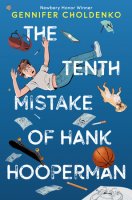 I’ve been a fan of Gennifer Choldenko since I first read Al Capone Does My Shirts (a 2005 Newbery Honor Book). I also had the pleasure of attending a writing revision session she was giving at a national writing conference.
 About the Author
