Posts Tagged fantasy

An interview with author Delia Sherman on her latest middle grade fantasy

imgres-1Congratulations to Delia Sherman on the recently published The Evil Wizard Smallbone, and thanks for joining us here at the Mixed Up Files of Middle Grade Authors.

How did you come up with the idea for this book?
It began with a short story I wrote for an anthology called Troll’s Eye View, edited by Ellen Datlow and Terri Windling. The theme of the anthology was to retell a classic fairy tale — from the point of view of the villain. As I always do when I want to build a good, juicy fairy tale retelling, I went to Fairy Tales From Many Lands, a book I’ve had ever since I can remember. I’ve long wanted to retell the story of “The Wizard Outwitted,” a Russian fairy tale full of shapeshifting and trickery and wizard’s duels (because, I ask you, who doesn’t love a good wizard’s duel?), so I did that. In 3500 words. Which didn’t actually leave me room for the wizard’s duel. Or, indeed, many of the things I wanted to say. So I thought some more about Nick’s training and development and went to the Blue Hill Fair (the very same fair Wilbur attended with Fern in Charlotte’s Web), where I talked to a trapper about gray wolves and coyotes in Maine and to a pig-farmer about pigs, and it all came together somehow.

There’s quite a bit of shape-shifting in this novel, and the descriptions are so vivid. Did you research wolves and coyotes, for example, to capture them so well or perhaps you have observed or spent time with these animals?
It was all research. My terrible secret is that I’m horribly allergic to all animals, and can’t have one and breathe at the same time. Which is why I suppose I almost always end up putting animals in my books—they’re guaranteed to be hypoallergenic. But I digress. I read a lot about wolves and spiders and rats and coyotes (and some other animals that I ended up cutting out because the book was getting too long. Nick turned into a crow once. I was sorry to see that go.) But I think my best source ended up being nature video on You Tube, where I learned what a rat sees and what the fox says, pretty much first hand.

What was the hardest thing about writing about wizards?
Figuring out the magic. I didn’t want it to be “Alakazam, wave my hand, you’re a frog”-type magic. And I didn’t want it to be too formulaic and scientific. I wanted it to seem as if it could really work and still be mysterious and wonderful. So I read about folk magic (think horseshoes for luck and salt to keep evil away) and formal magic (pentagrams and chants) and mixed them with things I personally think are cool (books that talk back to you and magical snow-blowing).

What was the easiest thing writing about wizards?
Stuff that is magic as well as used to do magic, like Smallbone’s coat and hat, Fidelou’s pelt-cape, enchanted bookstores and talking books. I’m sure I borrowed many of them from folk lore, from old fairytales, from books I read as a kid and don’t even remember reading, but they all felt as if they just showed up when they were needed, demanding to be added. So I did.

Are you a plotter or a pantser?
A little bit of both. When pantsing leaves me without anywhere to go, I plot for awhile until I can see my way forward, and then I go back to making it up as I go along. That’s the first draft, though. For all other drafts (Evil Wizard took seven), I have to make a plan, or I just make things worse.


There are so many surprises and unexpected reveals. How did these plot twists come about?

Now that I come to think about it, it has to be fairytales again. You read enough of them, you realize that one of the patterns is this: The hero has an adventure, which leads to another adventure, which develops a side-quest, which gets him embroiled in another adventure altogether. I guess I’ve read so many fairy tales over the years that that kind of thinking is just part of the way my mind works.

How much were you aware of both following the wizard apprentice tale type and how much did you consciously deviate from it?
Well, I was working off a fairy tale, and I have seen Disney’s “The Sorcerer’s Apprentice” and read The Sword in the Stone, although the Wart is not really Merlin’s apprentice. Setting the story in modern (more or less) Maine was a big deviation, as was Nick’s original complete lack of interest in being a wizard—or even believing that magic exists. I think what really happens when I retell a fairy story is that at some point the story I’m writing takes off from its roots and grows into something slightly different. Except for the wizard, the shape-changing, and the wizard’s duel, there are not really a lot of similarities between Nick’s story and the original.

This is set during a hardscrabble winter in New England, and it’s very cold and described so well. Is this a climate/area you know first-hand?
I began to write this story when I started staying at my friend’s house on the coast of Maine. I’ve never been there in winter, mind, but I’ve read books set there (also in Finland, which is very like Maine in many ways). I spent one of the coldest, darkest, and most uncomfortable years of my life in an inland town a long time ago, and I lived in Massachusetts for a long time, some of it in a house heated by a wood stove. So I do know plenty about snow, wind, cold, and even chopping wood.

Why did you write this book?
I haven’t the foggiest notion. All the time I was writing it, I kept thinking maybe I should be working on something else, that it wasn’t really the kind of book I write, that Nick was difficult and I don’t know anything about motorcycles or small towns (I grew up in New York City, after all). And yet, I kept working at it. I guess the real answer is that I’m a lot more like Nick than I thought.

The wizards in this novel are quite idiosyncratic. How did you come up with the idea for such a grumpy wizard (SmallBone) as well as his nemesis (Fidelou, the wolf wizard).
There are lots of grumpy wizards in literature. Even good wizards like Gandalf and Merlin and Dumbledore and Chrestomanci can be plenty crabby and short-tempered. Another thing wizards have in common is that they tend to be loners. You don’t read much about wizards with lots of friends and family (except in Harry Potter). So I just took that crabbiness to its logical extreme. Fidelou, on the other hand, is only interested in power. He wants it all, no matter what he has to do or who he has to hurt to get it. That, in my opinion, is what real evil is.

The main character, 12 year-old Nick Reynaud, can’t really read at the beginning of the novel. One of the main changes is that he learns to read and grow in confidence as well as security. How did the choice for Nick to be such a struggling reader come about?
Well, he says he can’t read; he can actually read perfectly well, and has a taste for science fiction and fantasy, just like his Mom. Still, I suspect he hasn’t read much until he gets to Evil Wizard books, partly because Uncle Gabe doesn’t have any books in the house and partly because he can’t see the point of the books he’s expected to read in school. He’s indignant when the bookshop gives him E-Z Spelz For Little Wizardz, but he reads it because he really, really wants to learn magic. I guess I believe that having a reason to read something is more motivating than just being told that it’s good for you.
imgres

Hillary Homzie is the author of the Queen of Likes (Simon & Schuster MIX 2016), The Hot List (Simon & Schuster MIX 2011) and Things Are Gonna Be Ugly (Simon & Schuster, 2009). She can be found at hillaryhomzie.com and on her Facebook page.

A Chat With Author Kelly Barnhill

Book jacket for The Girl Who Drank the Moon. Some books grab you from the first moment you see their gorgeous cover. Such was the case the first time I saw Kelly Barnhill’s beautiful middle-grade fantasy, The Girl Who Drank the Moon.

Anticipation grew even more when Barnhill and her publisher released two prequels to the story last month on Entertainment Weekly (read Part 1 and Part 2 for a taste of Barnhill’s storytelling). So I was delighted to have the opportunity to chat with Kelly and to help her celebrate the release of The Girl Who Drank the Moon.

Hello Kelly, welcome to From the Mixed-Up Files! Which middle-grade books did you love when you were younger?

A: I wasn’t much of a reader before fifth grade. Like at all. I knew that one should read, and I was very good at pretending to read, but the ability to sink into a page just wasn’t there for me. What I did love was listening. My parents read to us all the time, and I can remember listening to Grimm’s fairy tales, and later C.S. Lewis, and later Tolkien, and later Dickens. I also —thanks to a garage sale purchase of a Fisher Price orange plastic record player — loved checking out books on records from the library. Because, once upon a time, that was a thing. I listened to Treasure Island and Kidnapped and Just So Stories and both Jungle Books. Later, when I started seeking books out on my own, I loved weird things. L. Frank Baum, particularly. And Roald Dahl. And Daniel Pinkwater. And Diana Wynne Jones. And Ursula K. LeGuin. And Andre Norton. You don’t have to scratch my skin very deeply to find the undercurrent of those writers, pulsing in my veins.

Q: Which came first, the story itself or the prequel?

A: Oh, the story. For sure. But one thing that I didn’t realize when I started writing the story was how much Xan’s unremembered history would come to play in the way the action unfolded. There is much that I couldn’t include in the story itself, simply because Xan had chosen not to remember it — because memory is dangerous, as is sorrow. Or so Xan thinks. Anyway, the idea of her as a child in the company of a bunch of irascible magicians and scholars — many of whom do not have her best interests at heart — intrigued me. And so some of the cut pages and a bunch of the notes started swirling around until a story emerged.

Q: Last year, you wrote a novella for adults called The Unlicensed Magician. Can you talk a little bit about the differences between writing for adults and for children? Which do you prefer? Should we expect more adult stories from you in the future?

Writing a novella, I feel, is a bit like the Spanish Inquisition — no one expects it. I have written and published quite a few short stories for grown-ups that have appeared in a variety of journals. I like writing short stories; I like the muscle of it and the precision needed. It’s an entirely different skill set from what is required for a novel. And while I’ve written a few short stories for kids, the vast majority of them have been for adults. I’m not entirely sure why this is. Maybe my “adult fiction voice” is just more narrow than my “children’s fiction voice.” Or something.

When I started “The Unlicensed Magician,” I assumed I was writing a short story. And then 30,000 words poured out over the course of a couple days — just like that. This was a muscle that I didn’t know I had, and when I finished, I was tired and sore and had no idea what to do with the thing. I’m glad it’s found an audience, and that people seem to like it. As far as the intended audience goes — man. I don’t know. I will think and think and think about a story — just the story — and have no idea if it is a kid’s story or an adult’s story or just a weird story that only I would like. I don’t really know that until I’m done. Really, all I think about is the story itself — what the experience is, what the language feels like, what the big ideas are underpinning the whole thing. I don’t think about audience until the very end.

Author Kelly Barnhill

Author Kelly Barnhill

Q: Like you, I attended my first nErDcamp this year. Can you talk a little bit about the experience and what it meant to you as a writer and former teacher?

A: nErDcamp is magic, plain and simple. I have been fighting for so long — first as a teacher and then as a parent — for reading instruction in schools that is humane and empathetic and inspiring and challenging and ultimately joyful. Reading instruction and encouragement that helps young minds to be more than they are through the power of radical empathy in books. And I have found myself thwarted and frustrated at every turn. Coming to nErDcamp felt like coming home. So many joyful teachers! So many joyful book pushers! So many joyful writers and readers and kids! It was one of the most wonderful experiences of my life.

Q: You teach writing to adults and children and you mentioned on your web site that a big part of that involves “un-teach(ing) what they have already learned.” Can you elaborate on that?

A: When we learn to write, we learn there are rules, and when we actually write, we throw those rules away. So often, my students come to me already stuck in particular boxes of what they think “good” writing is, and is not, and what kind of writer they think they are, and are not. And primarily, I think a lot of kids and adults have learned over the years that their ideas just aren’t good enough. That they don’t have a story to tell. That an idea for a story is something that happens to other people — special people. This is balderdash. All of us are built out of stories. I have to un-teach them the lie in order to teach them the truth.

Q: What books are on your nightstand right now?
A: A DARKER SHADE OF MAGIC, by V E Schwab. And after that, I have some marvelous Murakami waiting for me. There is something about summer that simply begs for Murakami. After that, I plan to read MR. FOX, by Helen Oyeyemi and a few Diana Wynne Jones books that are due for a re-read.

***

Oh, how I loved A Darker Shade of Magic and so did both of my children (readers, please note that it is technically adult, although I let my 10 & 11 year old read it!). Thanks so much for your time, Kelly, and best of luck with your new book.

THE GIRL WHO DRANK THE MOON releases today from Algonquin Young Readers.

June New Releases

A couple of new series launch, others continue — and many, many delightful new stand-alone books. All in time for summer reading purchases and your library hold lists. Here we go:

The Education of Ivy Blake by Ellen Airgood
ivy blakeIvy has loved living with her best friend, Prairie, and being part of Prairie’s lively, happy family. But now Ivy’s mom has decided to take her back. Ivy tries to pretend everything is fine, but her mom’s neglect and embarrassing public tantrums often make Ivy feel ashamed and alone. Fortunately, Ivy is able to find solace in art, in movies, and from the pleasure she finds in observing and appreciating life’s small, beautiful moments. And when things with her mom reach the tipping point, this ability gives her the strength and power to push on and shape her own future.

dungeoneersThe Dungeoneers by John David Anderson
In an effort to help make ends meet, Colm uses his natural gift for pickpocketing to pilfer a pile of gold from the richer residents of town, but his actions place him at the mercy of a mysterious man named Finn Argos, a gilded-toothed, smooth-tongued rogue who gives Colm a choice: he can be punished for his thievery, or he can become a member of Thwodin’s Legions, a guild of dungeoneers who take what they want and live as they will.

enemies and endingsOf Enemies and Endings by Shelby Bach
Conclusion to the Ever After series. The whole fairy-tale world is on high alert. The Snow Queen and her minions are targeting Characters, and Ever After School is the only safe refuge left. Rory Landon knows a final confrontation is inevitable, and she worries about the safety of her family and friends–particularly Chase, who has been acting very strange lately. Will Rory be able to count on Chase when she needs him most? Can she put an end to the Snow Queen’s terrible reign once and for all? It’s time for Rory to find out if her tale ends in happily-ever-after.

ruby on the outsideRuby on the Outside by Nora Raleigh Baskin
Eleven-year-old Ruby Danes is about to start middle school, and only her aunt knows her deepest, darkest, most secret secret: her mother is in prison. Then Margalit Tipps moves into Ruby’s condo complex, and the two immediately hit it off. Ruby thinks she’s found her first true-blue friend–but can she tell Margalit the truth about her mom? Maybe not. Because it turns out that Margalit’s family history seems closely connected to the very event that put her mother in prison, and if Ruby comes clean, she could lose everything she cares about most.

circus mirandusCircus Mirandus by Cassie Beasley
Even though his awful Great-Aunt Gertrudis doesn t approve, Micah believes in the stories his dying Grandpa Ephraim tells him of the magical Circus Mirandus: the invisible tiger guarding the gates, the beautiful flying birdwoman, and the magician more powerful than any other the Man Who Bends Light. Finally, Grandpa Ephraim offers proof. The Circus is real. And the Lightbender owes Ephraim a miracle. With his friend Jenny Mendoza in tow, Micah sets out to find the Circus and the man he believes will save his grandfather. The only problem is, the Lightbender doesn’t want to keep his promise. And now it’s up to Micah to get the miracle he came for.

book scavengerBook Scavenger by Jennifer Chambliss Bertman
For twelve-year-old Emily, the best thing about moving to San Francisco is that it’s the home city of her literary idol: Garrison Griswold, book publisher and creator of the online sensation Book Scavenger (a game where books are hidden in cities all over the country and clues to find them are revealed through puzzles). Upon her arrival, however, Emily learns that Griswold has been attacked and is now in a coma, and no one knows anything about the epic new game he had been poised to launch. When Emily and her new friend James discover an odd book that might have a copy of the new game, they , which they rush from clue to clue, desperate to figure out the secret at the heart of Griswold’s new game–before those who attacked Griswold come after them, too.

wand and seaThe Wand & the Sea by Claire M. Caterer
Holly and Ben are back, hoping to again join Everett and return to Anglielle, the land ruled by a ruthless king and sorcerer who have outlawed magic.
But when they arrive, Anglielle is not what they expect: Their friends are imprisoned and the alliance is scattered. Ruthless King Reynard and the sorcerer Raethius are determined to find the very Adepts they exiled in the first place. But why? It’s up to Holly and the boys to sail to the Isle of Exile and find the Adepts first, but that means enlisting the help of the Water Elementals–and a pirate captain with a secret agenda.

i text dead peopleI Text Dead People by Rose Cooper
Annabel Craven’s worried she’ll be friendless and phoneless at the Academy. But when she finds a mysterious phone in the woods near the cemetery, one of her problems is solved . . . and another one is just beginning. Someone won’t stop texting her. And that someone seems . . . dead. How is Annabel supposed to make friends when her phone keeps blowing up with messages from the afterlife? And what will happen if she doesn’t text back?

raising rufusRaising Rufus by David Fulk
Martin stumbles across an egg, which is remarkable in itself … but then a week later he finds himself taking care of a Tyrannosaurus rex. As the summer unfolds, Martin finds it harder and harder to keep Rufus hidden from rest of the world.  Can Martin save Rufus from his parents, his neighbors, and most importantly, the owner of the town carnival? With the help of his best friend, Audrey, and his science teacher, Mr. Ekhart, Martin must uncover his inner hero and find Rufus a home, even if it means losing the one thing he’s come to really care about.

mothman's curseMothman’s Curse by Christine Hayes
Josie may live in the most haunted town in America, but the only strange thing she ever sees is the parade of oddball customers that comes through her family’s auction house each week. When she and her brothers discover a Polaroid camera that prints pictures of the ghost of local recluse John Goodrich, they are drawn into a mystery dating back over a hundred years. A desperate spirit, cursed jewelry, natural disasters, and the horrible specter of Mothman all weave in and out of the puzzle that Josie must solve to break the curse and save her own life.

sign of the catThe Sign of the Cat by Lynne Jonell
Duncan is very smart. He also has a most unusual gift. So why does his mother encourage him to be perfectly average and insist he only get mediocre grades ? His special talent is the ability to talk to cats–but Duncan longs more than anything for academic success. When Duncan rebels and gets a perfect test score, people start taking notice of him. And it turns out that some of those people may not have the best intentions . . . not by a long shot.

nooks and cranniesNooks & Crannies by Jessica Lawson
Tabitha Crum, who never goes anywhere without her pet mouse Pemberley, receives one of six invitations to the country estate of wealthy Countess Camilla DeMoss. Upon the children’s arrival at the sprawling (and possibly haunted) mansion, it turns out the countess has a very big secret–one that will change their lives forever. When children beginning disappearing, one by one. Tabitha takes a cue from her favorite detective novels and, with Pemberley by her side, takes on the case to rescue the other children, who might just be her first real friends.

unlikely adventures mabel jonesThe Unlikely Adventures of Mabel Jones by Will Mabbitt
Kidnapped, Mabel is forced to serve aboard “The Feroshus Maggot” with the strangest crew you ll ever meet. And the captain an odious wolf named Idryss Ebenezer Split won t let her go until she helps the pirates unlock the treasure they seek.
Mabel’s voyage takes her across the Greasy Pole of Certain Death, into the belly of a whale, and underground to a decrepit crypt. And she does it all in pajamas

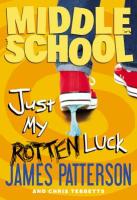
just my rotten luckJust My Rotten Luck by James Patterson and Chris Tebbetts
In this seventh Middle School episode, Rafe heads back to the place his misadventures began: the dreaded Hills Village Middle School, where he’s now being forced to take “special” classes and ends up on the school’s football team–alongside his main tormenter, Miller the Killer. Rafe has grand plans for a better year, including a super-secret art project. And he may just have to deal with something completely new: popularity.

spacejackersSpacejackers by Huw Powell
As a baby, Jake Cutler was separated from his family and left on the planet Remota, deep in the seventh solar system. Eleven years later and Jake isn’t like other boys-he has purple eyes and carries a secret within himself that could change the entire universe. When Remota is attacked by ruthless space pirates on the hunt for Jake, he manages to escape. But now he’s on the run with a bounty hunter and the suspicious-looking crew of a spaceship called the “Dark Horse.” Forced to contend with zero-gravity, shipwrecks, black holes, and countless enemies, Jake must discover the truth about his past before he is hunted down and caught.

crown of threeCrown of Three by J.D. Rinehart
First in series. Toronia, a kingdom composed of three realms, is wracked with civil war. King Brutan rules with an iron fist. Cruelty and suffering abound. The kingdom’s only hope is a prophecy that the king will have triplets who will one day rebel and take over the throne. Separated at birth and scattered throughout the realms, the triplets face a desperate fight to secure their destiny. Will they survive long enough to rule?

woundaboutWoundabout by Lev Rosen
Siblings Connor and Cordelia and their pet capybara are sent to the precariously perched town of Woundabout to live with their eccentric aunt. Woundabout is a place where the mayor has declared that routine rules above all, and no one is allowed to as questions–because they should already know the answers. But Connor and Cordelia can’t help their curiosity when they discover a mysterious crank that fits into certain parts of the town, and by winding the crank, places are transformed into something beautiful. When the townspeople see this transformation, they don’t see beauty–they only see change. And change, the mayor says, is something to fear. With the mayor hot on their trail, can Connor and Cordelia find a way to wind Woundabout back to life?

everyday etiquetteCassidy’s Guide to Everyday Etiquette (and Obfuscation) by Sue Stauffacher
Eleven-year-old Cassidy has just inherited a gift from her late great-grandmother. Unfortunately, that gift turns out to be a summer trapped in etiquette school. What good are manners, anyway, for a girl who dreams of living life on the road as a hobo er, knight of the road ? As if trying to remember to keep her elbows off the table isn t bad enough, Cassidy’s best friend, Jack, suddenly seems more interested in doing chores for the new teenage girl who’s moved in next door than in fishing with Cassidy down by the river. Not even her classic epic pranks seem to be saving Cassidy from having her worst summer ever. It’s time to face facts: growing up stinks.

golden capeAttack of the Alien Horde by Robert Venditti
When twelve-year-old Miles Taylor unexpectedly inherits a golden cape that gives him amazing superpowers, his life instantly changes: he becomes a superhero. For real. With some help from a new friend named Henry, Miles does his best to protect his city. But his skills and courage are about to be put to the ultimate test–an alien horde is working its way toward Earth, with their sights set on the golden cape…and total domination. An adventure story with humor — and comics.

survival strategiesSurvival Strategies of the Almost Brave by Jen White
It’s easy to be brave when your eight-year-old sister, Billie, looks up to you as her protector. Twelve-year-old Liberty feels it’s her job to look after Billie once they are sent to live with their father, whom they haven’t seen since they were very young. Dad is unpredictable on his best days, but when he abandons the girls at a gas station in the middle of nowhere, Liberty’s courage is truly put to the test.

Descriptions and book cover images from IndieBound.