
So you want to be an astronaut! What’s next? According to Chris Hadfield, who spent two tours aboard the International Space Station, you need to get a good education. Learn new things. Fortunately, we’ve got a list of books for that.
ASTRONAUTS:

Cutting-edge Astronaut Training, by Karen Latchana Kenney
This book shows how astronauts train for space missions, what type of gear they need, and the technology they use. Readers visit the Neutral Buoyancy Lab in Houston and learn how astronauts aboard the International Space Station used a 3-D printer to manufacture a wrench needed for urgent repairs.
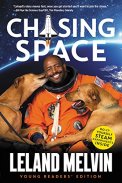
Chasing Space Young Readers’ Edition, by Leland Melvin
Astronaut Leland Melvin knows how to solve problems, whether on the football field or aboard the space shuttle. He shares a personal and realistic journey through astronaut training and space travel. Includes hands-on STEAM experiments at the back.

Lost in Outer Space: The Incredible Journey of Apollo 13, by Tod Olson
Written like an adventure novel, this is a true story about the mission to the moon that nearly ended in tragedy. Two hundred thousand miles from Earth, an explosion rips through the spacecraft. Readers follow along with astronauts in space and mission control on the ground as they race to fix the problem.

From Farmworker to Astronaut: My Path to the Stars, by José M. Hernandez
When he was ten years old, José M. Hernandez watched astronauts walk on the moon. From that point, he knew he wanted to go to space. Encouraged by his father (You can do this, m’ijo!), José made a plan for school, college, and beyond. Rejected 11 times from the astronaut program, he didn’t give up and finally made it aboard the Space Shuttle.
NASA:

Countdown: 2979 Days to the Moon, by Suzanne Slade; illustrated by Thomas Gonzalez
Getting to the moon began with a dream – an outrageous idea – that we could land a man on the moon and bring him safely back to Earth. The challenge: to do this in a decade. Written in verse, this book documents the Apollo program, providing full spreads to highlight the astronauts for each mission.

Above and Beyond: NASA’s Journey to Tomorrow, by Olugbemisola Rhuday-Perkovich
NASA was established in 1958, and in that time it has launched spaceships, shuttles, telescopes, and space probes. It’s landed men on the moon and rovers on planets. Packed with photos and profiles of lesser-known contributors to the space program.
 The Apollo Missions for Kids: The People and Engineering Behind the Race to the Moon, with 21 Activities, by Jerome Pohlen
Each of the seven chapters focuses on a specific aspect of rocket science. Sidebars profile scientists, engineers, and mathematicians involved in the Apollo missions. Hands-on activities include orbital mechanics, engineering the lunar lander skin, and replicating an experiment done on the moon.

Moon Mission: The Epic 400-year Journey to Apollo 11, by Sigmund Brouwer
Relive the Apollo mission as one of the astronauts. Experience all of the life-or-death challenges and near disasters, that occurred or were predicted, in the centuries long quest to walk on the moon. Each chapter is broken into three stages (like a rocket) and is chock full of history, STEM, and a science mystery to solve.
WOMEN IN SPACE:

Reaching for the Moon: The Autobiography of NASA Mathematician Katherine Johnson, by Katherine Johnson
Written in an engaging, authentic voice, 100-year-old Katherine Johnson weaves history, segregation, civil rights, and African American culture into a conversational discussion of her life as a mathematical prodigy and computer at NASA.

Galaxy Girls: 50 Amazing Stories of Women in Space, by Libby Jackson; illustrated by students from the London College of Communication
Fifty stories of amazing women around the world essential to our missions to the moon and space. Includes female astronauts, mathematicians, engineers, physicists, test pilots, and aerospace psychophysiologists. As well as a timeline and “your own mission” plan.

To Fly Among the Stars: The Hidden Story of the Fight for Women Astronauts, by Rebecca Siegel
History remembers the Mercury 7 as America’s first space heroes. But there were 13 female pilots (air racers, test pilots, and flight instructors) who secretly completed the same astronaut tests. A look at the systemic sexism they battled to prove their right to become astronauts. Includes historic photos, glossary, and notes.
STEM Tuesday book list prepared by:
 Sue Heavenrich writes about science for children and their families, from space to backyard ecology. Bees, flies, squirrel behavior—things she observes in her neighborhood and around her home—inspire her writing. A long line of ants marching across the kitchen counter generated one of her first articles for kids. When not writing, you can find her committing acts of science from counting native pollinators to monitoring water quality of the local watershed.
 Maria is a children’s author, blogger, and poet passionate about making nature and reading fun for children. She’s been a judge for the Cybils Awards from 2017 to present. And a judge for the #50PreciousWords competition since its inception. Her poems are published in The Best Of Today’s Little Ditty 2017-2018, 2016, and 2014-2015 anthologies. When not writing, critiquing, or reading, she bird watches, travels the world, bakes, and hikes. Visit her at www.mariacmarshall.com


 Today we’re interviewing Sara Latta, author of
  Sara Latta: Thanks for having me on your blog! Body 2.0 explores the ways in which engineering, science, and medicine are coming together to make some remarkable advances in the fields of tissue engineering and regenerative medicine, neuroscience, microbiology, and synthetic biology. I begin the book with a brief history of biomedical engineering—arguably the first known example of which was a wooden toe found on an ancient Egyptian mummy—but primarily the book focuses on cutting-edge research and the scientists at the forefront of the research. That was important to me; much of the work I write about hasn’t even reached clinical trials. I wanted to show readers that they could jump into this research at a very exciting time.
 Your host is


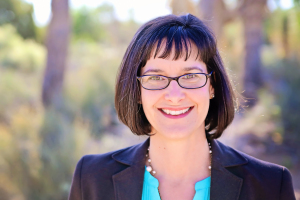 Kirsten W. Larson used to work with rocket scientists at NASA. Now she writes books for curious kids. She’s the author of