Posts Tagged cross-curricular

STEM Tuesday — Epic Achievements and Fantastic Failures– In the Classroom

This week explore the importance of bringing epic achievements and fantastic failures to your classroom. Let the stories of people persisting in the face of seemingly impossible odds inspire your students to consider how STEM might figure into their everyday lives and future careers. And remember, managing failures is part of the arc of success. Set-backs and disappointments help STEM professionals improve, invent, and innovate their way to their dreams.

Create a “Dream Big” Bulletin Board. Before introducing this month’s books to students, ask students to respond to these prompts:

  • Think about the technology around you—everything from paper plates to bandages to medicine to transportation systems and more. All of these things were figured out by people. Which technologies impress you the most? Why? What else can you think of that’s a big-deal achievement in science, technology, engineering, or math?
  • Scientists explore the unknown and try to describe and explain the world and universe around us. What’s the most amazing scientific discovery you know of? What big questions do you wonder about that science might answer someday?
  • What’s the most amazing discovery or invention you can imagine making?

After students complete index cards or journal entries in response to the selected prompt, give them time to exchange ideas about their “big dreams” with each other. Encourage them to think bigger and bigger as they talk. After several minutes, ask students to consider their answers as a group:

  • What common themes can you find across different achievements and dreams? (For example, several ideas might relate to discovering a cure for disease or inventing a way to travel quickly from place to place.)

Post student ideas on a “Dream Big” bulletin board and refer to it as a context that will help them connect to any of the tales of success or failure in the books from this month’s STEM Tuesday list. As students read the books, ask them to identify the “big dream” behind each success, and motivating the people in the stories to overcome failures along the way.

Is it Failure or Just Practice for Success? In many quarters, failure has a bad reputation. Sure, we all feel like celebrating when things go right, but it’s important to understand that if we are going to achieve anything — epic or everyday — we are likely to encounter bumps, mistakes, hiccups, set-backs, and mess-ups along the way. The better we can accept failures and learn from them, the more we will learn and achieve. You can help students explore this idea with one of these engineering design challenge “launchers,” which focus on the engineering design process and how it embodies a growth mindset. After students test their first design ideas, challenge them to improve the performance of their designs. Lead reflection on how students’ final (and usually improved) designs evolved from the designs’ initial shortcomings and set-back (failures). Be explicit that in many ways, failure is something to embrace—as a chance to learn and explore in new directions.

Support Independent Bookstores - Visit IndieBound.orgConnect students’ experiences with design failures with highlights from a TED Talk and an interview with Astro Teller. Teller, the “Captain of Moonshots” at X, a Google company featured in Google It: A History of Google, discusses his own view of success and failure, and the importance of committing to projects that may or may not succeed. Speaking of moonshots…


Support Independent Bookstores - Visit IndieBound.orgMap the Ups and Downs along the way to an epic achievement, such as figuring out how to achieve powered flight or landing people on the Moon. You’ll find these stories in Countdown, Rocket to the Moon, and Epic Fails The Wright Brothers: Nose-Diving into History. To map the vicissitudes of these or any other accomplishments, begin by drawing a horizontal timeline across a piece of paper near the middle. Label the line with each chapter, episode, or student-identified turning point. Ask students to make a mark above or below each label indicating the degree to which the episode seems like an “up” or “down” moment (when people were meeting Support Independent Bookstores - Visit IndieBound.orgwith success or failure/setback); then connect the dots. Students can also keep similar timelines in their journals representing their experience of projects in science, technology, engineering or math. Encourage them to focus on the relationship between achieving and navigating through—and learning from—failures.


Support Independent Bookstores - Visit IndieBound.org

Combined with hands-on activities and opportunities for student reflection, stories of STEM successes and failures can’t fail to inspire and engage students. How do you help students identify their own, personal “moonshots”? What do you do to foster risk-taking? Drop us a line in the comments suggestion below!


As a co-founding consultant at Blue Heron STEM Education and a partner in STEM Education Insights, LLC, STEM Tuesday contributor Carolyn DeCristofano, MEd, supports the development of high-quality, research-based STEM education resources that inspire students and teachers alike. An acclaimed author of STEM books for kids, including A Black Hole is NOT a Hole and Running on Sunshine: How Solar Energy Works, she enjoys bringing the joy of STEM, creativity, and writing to school groups.

STEM Tuesday– Taking a Look at Climate Change/Earth Science– In the Classroom

Tough Texts

As I discussed in last week’s In the Classroom blog, science text is tough because it is often dense–there are lots of ideas crammed into just a few sentences. Students often think of reading as an all-or-nothing proposition: either they read through and get it (success!) or they read through and didn’t (failure!). Academic text is more complicated than that. Just as they couldn’t unzip a duffle bag and instantly perceive everything inside, they won’t be able to understand most academic texts on the first read-through. They have to be like the guards at the stadium and unpack (or at least riffle through) the things inside the duffel bag.

In this month’s blog, I am going to walk through a set of unpacking tools that readers might use to work through a passage from Inside Biosphere 2: Earth Science Under Glass by Mary Kay Carson.

Before using this passage with your class, you should do a quick book-talk, explaining that the Biosphere 2 is a gigantic (multi-acre!) laboratory that reproduces several earth biomes in ways that allow scientists to control environmental variables such as the temperature, rainfall, wind, and the organisms present. One of the biomes is a tropical rainforest. Joost van Haren studies this biome.

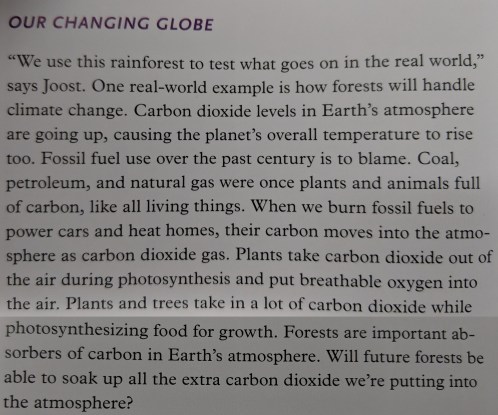
Then present them with this passage from pages 24-25.

Highlight these strategies as you work through the passage with your students:

Chunking

Focus in on this sentence:

Coal, petroleum, and natural gas were once plants and animals full of carbon, like all living things.

There are actually three ideas in this sentence, that I have marked with slash marks (/) below.

Coal, petroleum, and natural gas were once plants and animals / full of carbon, / like all living things.

If your students are familiar with all three ideas, the sentence will be easy to read. But if some of these ideas are new, they may need to linger on them a moment, and think through what is being said and how it relates to their prior knowledge about fossil fuels.

This strategy is called chunking. Students tend to pause and think at points predetermined by the author: at commas, periods, or the ends of paragraphs. Sometimes, a reader needs to slow down and process smaller chunks of text. As Ruth Schoenbach explains in Reading for Understanding, nobody eats a pizza in one bite. Everyone has to break the pizza down, bit by bit, but different people take different sized bites.

Sketching/ Diagramming

This passage offers a whole series of causes and effects, a cascade of consequences. A quick sketch of the relationships between ideas could help keep them straight. This was my sketch through the text:

Look for surrounding supports

Many science ideas are easier to understand in diagram form, so when you encounter tough text, check surrounding pages for a diagram or illustration. In this case, some of the information in this paragraph is summarized in a diagram of a tree interacting with the environment on page 24.

Build your background

Sometimes, tough text is tough because the writer of the text assumes you already know something that you don’t already know. If you’ve tried to unpack the text, and its still tough, you may need to step back a level–not a “reading level” so much as a “knowledge level.” Read someone else’s account of the ideas, especially one aimed at a less knowledgeable audience, and see if that gives you the background for the more sophisticated text. Another book off this week’s list addressed some of these ideas in simpler form. Show students this passage from page 5 in Out of the Ice by Claire Eamer.

What information does this paragraph contribute to their understanding?

Skip it

Let students know that sometimes, its ok to just skip past a section of tough text! This can feel very freeing for struggling readers. It depends on your purpose for reading–I chose this passage because it gets at an important idea for Earth Science. But what if you are reading this because you want an overview of Biosphere 2? Or you are planning to visit, and want to know what to expect? Or you’re looking for an idea for a science project? You might not need to understand this particular section of text. In this particular book, there is a wealth of interesting information. You could skip this paragraph and still glean all kinds of great ideas from the book. Indeed, it may be that reading further clarifies this set of ideas for you.

(And as a side note make sure your students know that it can be ok to blame the author. Sometimes, text is tough because it is not well-written (not the case here, but sometimes)! Struggling readers tend to assume that reading struggles are all their fault. But many times, the fault lies with writer for not expressing ideas clearly.)


Jodi Wheeler-Toppen is a former science teacher and the author of the Once Upon A Science Book series (NSTA Press) on integrating science and reading instruction.  She also writes for children, with her most recent book being Dog Science Unleashed: Fun Activities to do with Your Canine Companion. Visit https://OnceUponAScienceBook.com for more information on her books and staff development offerings.

STEM Tuesday– Taking a Look at Climate Change/Earth Science– Book List

Climate change. It’s all around us. Warming air temperatures. Warming seas. Melting ice and rising sea levels. Dangerous storms and wildfires. The following list takes a look at climate and weather from multiple angles.

Support Independent Bookstores - Visit IndieBound.org Hopping Ahead of Climate Change: Snowshoe Hares, Science, and Survival by Sneed B. Collard III

Sneed Collard focuses in on one of the species impacted by climate change — the snowshoe hare. Readers will uncover how a warmer planet will have consequences on each and every one of us through this fascinating study of just one Arctic creature.


Support Independent Bookstores - Visit IndieBound.orgInside Biosphere 2: Earth Science Under Glass by Mary Kay Carson; photographs by Tom Uhlman

Mary Kay Carson investigates one of the world’s most interesting experiments in this Scientists in the Field starred title. This unique desert lab replicates area on Earth so that scientists can explore the large scale impact of climate change.

Support Independent Bookstores - Visit IndieBound.org Geoengineering Earth’s Climate: Resetting the Thermostat (a Green Earth honoree) by Jennifer Swanson

Can scientists reset Earth’s thermostat? Jennifer Swanson explores a radical new technology to try to cool the planet in this important STEM title.


Support Independent Bookstores - Visit IndieBound.org Out of the Ice: How Climate Change Is Revealing the Past by Claire Eamer; illustrated by Drew Shannon

As the planet warms new discoveries are taking place. In this middle-grade picture book, Claire Eamer introduces readers to the treasures that have been locked in ice in Earth’s cryosphere.


Support Independent Bookstores - Visit IndieBound.org Coming March 2019 – Tornado Scientist: Seeing Inside Severe Storms by Mary Kay Carson; photographs by Tom Uhlman

Tornados are featured in this upcoming title by Mary Kay Carson. Follow scientist, Robin Tanamachi and her team as they try to save lives across America’s heartland.


Support Independent Bookstores - Visit IndieBound.org Eye of the Storm: NASA, Drones, and the Race to Crack the Hurricane Code by Amy Cherrix

Amy Cherrix takes readers right into the danger zone in this exploration of hurricanes. In a world of increasingly severe storms, this book offers readers a look into how they are studied and data is collected.


Support Independent Bookstores - Visit IndieBound.org How Could We Harness A Hurricane? by Vicki Cobb

This NSTA Best STEM Book is another to add to your hurricane science shelf. Vicki Cobb shares how scientists explore ways to weaken hurricanes. It’s a great book to get readers asking questions just like scientists.


Support Independent Bookstores - Visit IndieBound.org We Are The Weather Makers: The History of Climate Change by Tim Flannery, adapted by Sally Walker

Discover this young reader’s edition of the adult title, The Weather Makers. Published by Candlewick Press in 2009, you can still find this informational title online and in libraries.


Support Independent Bookstores - Visit IndieBound.org The Next Wave : The Quest to Harness the Power of the Oceans by Elizabeth Rusch

Travel with the author and a team of scientists to the Pacific Northwest to explore the potential renewable energy of the oceans. This is another great read in the Scientists in the Field series.


Support Independent Bookstores - Visit IndieBound.org Weather: An Illustrated History: From Cloud Atlases to Climate Change by Andrew Revkin and Lisa Mechaley

This beautifully illustrated history of weather is a must for readers of all ages. Everything from the history of Groundhog Day, London’s Great Smog, the Paris Agreement, and the invention of air conditioning can be found inside.  It’s a great resource for budding meteorologists and climate scientists. Whether preparing a report and prepping for a trivia contest, readers will come away more knowledgeable about the issues and history of our planet.


STEM Tuesday book lists prepared by:

Nancy Castaldo has written books about our planet for over 20 years including, THE STORY OF SEEDS: From Mendel’s Garden to Your Plate, and How There’s More of Less To Eat Around The World, which earned the Green Earth Book Award, Junior Library Guild Selection, and other honors. Nancy’s research has taken her all over the world from the Galapagos to Russia.  She strives to inform, inspire, and educate her readers. Nancy also serves as the Regional Advisor of the Eastern NY SCBWI region. Her 2018 multi-starred title is BACK FROM THE BRINK: Saving Animals from Extinction. Visit her at www.nancycastaldo.com

Patricia Newman writes middle-grade nonfiction that inspires kids to seek connections between science, literacy, and the environment. The recipient of a Sibert Honor for Sea Otter Heroes and the Green Earth Book Award for Plastic, Ahoy!, her books have received starred reviews, been honored as Junior Library Guild Selections, and included on Bank Street College’s Best Books lists. New:  Eavesdropping on Elephants: How Listening Helps Conservation, an NSTA Outstanding Science Trade Book. During author visits, she demonstrates how her writing skills give a voice to our beleaguered environment. Visit her at www.patriciamnewman.com.