
Posts Tagged books

STEM Tuesday – Diseases and Pandemics — Book List

From the first sneeze to the last wheeze, these books explore diseases and the scientists who study them.


All in a Drop: How Antony van Leeuwenhoek Discovered an Invisible World by Lori Alexander; illus by Vivien Mildenberger

When Antony van Leeuwenhoek read a book showing plants and insects as seen through a microscope, he decided to build his own. Antony is considered the “father of microbiology” and his work with microscopes laid the foundation for (100 years later) understanding that microscopic germs were responsible for disease.


Science Comics: Plagues: The Microscopic Battlefield by Falynn Koch

Imagine Jules Verne meets Miss Frizzle. In this book, a scientist uses interactive technology to communicate with bubonic plague and yellow fever germs. Readers learn how bacteria and viruses invade our bodies, elude our defenses, and how immunity works. There’s a good explanation of vaccinations and virus mutation (why we need a flu shot every year…).


Outbreak: Disease Detectives at Work by Mark P. Friedlander, Jr.

What happens when a strange new illness affects entire swaths of people all at once? You call on the “disease detectives” – epidemiologists – to investigate. In this book you’ll learn about the history of plagues, ancient and modern, as well as how epidemiologists study diseases such as Lyme disease, SARS, and AIDS. This book has already been updated twice; I predict in another couple years we’ll see a newer edition that includes Covid-19.


Outbreak! Plagues That Changed History by Bryn Barnard

Here’s an extensive evaluation of the causes and human reactions and interactions (from the 1300’s to the present) to bubonic plague, smallpox, yellow fever, cholera, tuberculosis, and the 1918 influenza pandemic. This book examines how these diseases changed societies and what it will ultimately take to eliminate cholera worldwide. It also looks at how wealth, bias, and prejudice continue to affect governmental reactions to microbial evolution.


Plagues, Pox, and Pestilence by Richard Platt, illus by John Kelly

In an ironic twist, a lab-coated rat, Professor Ratticus, and his cockroach and mosquito assistants lead the reader through a comprehensive look at diseases and epidemics. Comic-like illustrations (like war rooms mapping the spread of germs) and a browseable nonfiction format combine with entertaining graphics, facts, and history to provide a great overview of the world’s worst epidemics and illnesses.


Bubonic Plague & Yellow Fever
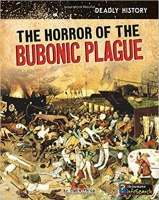
 

The Horror of the Bubonic Plague (Deadly History series) by Claire Throp

This book provides a concise overview of the history of bubonic plague from the Sixth century to present. Readers learn about causes and cures and some historical context. Some things will sound familiar: the use of quarantine and lockdowns, wearing masks and protective clothing, peddling fake cures, and suffering economic losses. It ends with mention of where plague still exists, but forgets to include the U.S.


The Plague (Deadliest Diseases of All Time) by Lawrence Andrews

Andrews provides a straightforward examination of the origin of the bubonic plague, methods of transmission, historic effect around the world, and its continued existence. He explains why the plague still affects 1,000 to 2,000 people a year, including within the U.S., and the race to limit its spread and find a way to eliminate the disease.


Bubonic Panic: When Plague Invaded America by Gail Jarrow

Written as a gripping medical “who-done-it,” this book introduces the ‘phantom killer” and explores the earliest plague pandemics through 1722. When this menace resurfaces in China, India, and Honolulu in the late 1890’s and then San Francisco in 1900, scientists scramble to identify the cause and find a cure, public health officials fight to finish it, and politicians hurry to hide it. This fascinating tale of how the plague settled into American and continues to infect a handful of people each year, includes a “frequently asked questions” section, timeline, and author’s note.


An American Plague: The True and Terrifying Story of the Yellow Fever Epidemic of 1793 by Jim Murphy

This book dramatically examines another “invisible stalker.” Using both first-hand witness and medical accounts, newspaper clippings, and contemporary images, it follows yellow fever’s arrival and spread throughout Philadelphia. Detailing the social, political, and medical conditions and struggles to combat this disease, this book examines the changes that the plague brought to modern medicine and the fear that it could reappear.


Typhoid Fever 


Terrible Typhoid Mary: A True Story of the Deadliest Cook in America, by Susan Campbell Bartoletti

This book is not for the squeamish – but if you don’t wash your hands after using the toilet and eat cookies that fell to the floor (5-second rule!) then you should be OK. Mary Mallon cooked for some of the wealthiest families in New York and was well- known for her hand-cranked ice cream topped with fresh fruit. Somehow, her families came down with typhoid fever. George Soper was the epidemic detective on the hunt to find the person making people sick. At the center of it all the question of civil rights and asymptomatic carriers.


Fatal Fever: Tracking Down Typhoid Mary, by Gail Jarrow

When typhoid fever breaks out in New York, medical detective George Soper traces the outbreak to Mary Mallon. His job: to prevent her from infecting others. But Mary refuses to comply with quarantine and other medical directives. After all, she isn’t sick. So she continues cooking and passing on the disease. Questions of personal freedom versus public health are once again relevant as we deliberate quarantines, lockdowns, and contact tracing.


Flu Pandemic


Influenza: How the Flu Changed History, by Barbara Krasner

In 1918, people didn’t know the exact cause of the flu. But they knew the germs spread through the air. Some families sealed up their windows, and public health officials ordered people to wear masks. From initial outbreak to development of a vaccine to future epidemics, this book provides a good overview of the flu.


The 1918 Flu Pandemic: Core Events of a Worldwide Outbreak (What Went Wrong?) by John Joseph Micklos Jr.

Tracking the spread and undulation of the three waves of the 1918 Flu, from March 1918 to June 1919, this book explores the potential causes, actions that facilitated its expansion (such as WWI, armistice celebrations, and soldier’s returns), and lack of a cure that resulted in over 40 million deaths worldwide. Published in 2016, one of the critical thinking questions at the end asks how well the world may be prepared for another flu pandemic.


Fever Year- The Killer Flu of 1918 : A Tragedy in Three Acts by Brown, Don

Presented in a graphic novel format, this book tracks the course of the 1918 flu from Camp Funston, Kansas around the world. Many images look eerily familiar – empty streets and masks. A very accessible examination of the politics and science involved in battling the spread and ultimate containment of this flu. Additionally, it comments on current scientist’s desire to discover why this flu was so deadly, by recreating it.


STEM Tuesday book list prepared by:


Sue Heavenrich writes about science for children and their families, from space to backyard ecology. A long line of ants marching across the kitchen counter inspired her first article for kids. When not writing, she’s committing acts of citizen science in the garden. She blogs about science for kids and families at archimedesnotebook.blogspot.com.


Maria Marshall is a children’s author, blogger, and poet passionate about making nature and reading fun for children. She’s been a judge for the Cybils Awards from 2017 to present. Her poems are published in The Best Of Today’s Little Ditty 2017-2018, 2016, and 2014-2015 anthologies. When not writing, critiquing, or reading, she bird watches, travels the world, bakes, and hikes. Visit her at www.mariacmarshall.com/blog.


Author Spotlight: Summer Rachel Short… plus a Giveaway!

Today, let’s give a warm Mixed-Up welcome to Summer Rachel Short, author of the debut middle-grade novel, The Mutant Mushroom Takeover.

Described by Kirkus as “Packed to the gills with fun,” and by School Library Journal as “A fun debut novel with an action-packed climax that will leave readers eager to scope out the weirder side of nature,” the book is out now from Simon & Schuster Books for Young Readers.

About The Mutant Mushroom Takeover

Ever since Magnolia Stone’s scientist dad left Shady Pines to find a new job, Maggie’s been stuck in her gramma’s mobile home with her grumpy older brother, Ezra. Now she’s on a mission to put her family back together by winning the Vitaccino Junior Naturalist Merit Award.

When Maggie and her best friend, Nate, a wannabe YouTube star and alien conspiracy theorist, scout out a rare bioluminescent fungus, Maggie is certain she’s a shoo-in to win. But after animals around town start sprouting unusual growths and Ezra develops a bluish glow and hacking cough, Maggie wonders what they’ve really stumbled onto.

As things in Shady Pines become stranger and more dangerous, and conversations with her dad get complicated, Maggie must use her scientific smarts and Nate’s impressive knowledge of all things supernatural to put things back in order and prevent these peculiar glowing mushrooms from taking over their home.

Q&A with Summer Rachel Short

MR: So glad to have you with us, Summer. Welcome to the Mixed-Up Files!

SRS: Thanks so much for having me! I’m so glad to be here!

MR: So, I stayed up late into the night reading The Mutant Mushroom Takeover and it really gave me the heebie-jeebies! It also made me rethink my love of mushrooms. 🙂 What inspired you to write about bioluminescent fungus–and the “weird” side of nature–in the first place?

SRS: Thank you! I do hope you’ll be able to resume your love of mushrooms–once you’ve given your produce a solid once over, of course!

Things that are a little weird have always fascinated me, because they spark my curiosity and make me ask “how” and “why.” One of my first inspirations for this book was an old documentary on fungi that I stumbled upon on YouTube. There was an ominous voiceover, creepy soundtrack, and time-lapse video of fungi unfurling and spewing their spores on unsuspecting hosts. It was all so bizarre, and such an unknown world to me, that I wanted to know more. I kept researching, and eventually the bits and pieces coalesced into a story idea.

Maggie and Nate: The Dynamic Duo

MR: The novel’s protagonist, Magnolia “Maggie” Stone, is a STEM-savvy eleven-year-old aspiring naturalist. She’s brave, smart, and committed to discovering the truth about the mutant fungus. Her best friend, Nate, a wannabe YouTube star and alien conspiracist, is loyal to Maggie’s cause and hysterically funny. What allowed you to create such nuanced—and incredibly realistic—characters as Maggie and Nate? Also, do you have a favorite?

SRS: Thank you for saying that, Melissa. I love all my characters, particularly the main pair, Maggie and Nate. But in terms of who was the most fun to write, it’s probably some of the side characters, like Nate, and my villain. One thing I focus on when creating characters is paying attention to their dialogue. I read it out loud and then play it back to myself using the text-to-speech function on my computer. It gives me a feel for how the characters may sound to others.

MR: In the novel, Maggie’s older brother, Ezra, displays weird symptoms after coming into contact with the bioluminescent fungus. When Maggie and Nate go into the forest to investigate, they wear hazmat suits made from garbage bags, and wear protective goggles, to keep themselves safe. This sounds eerily similar to precautions taken during the coronavirus. Am I reading too much into this?

SRS: I didn’t know about coronavirus at the time I wrote those scenes, but there are some similarities in how the problem is tackled. Since the kids don’t have access to fancy hazmat suits, they improvise and create their own makeshift suits using household items. It was fun to brainstorm what a couple of kids without a lot of money could come up with on the fly to protect themselves from mutant spores.

Extra, Extra! Read All About It!

MR: Before writing The Mutant Mushroom Takeover, you were a science reporter for a newspaper, covering such diverse topics as nanotech tweezers, poultry farm pollution, and the nighttime habits of spiders and snakes. What was the strangest story you ever covered?

SRS: The nanotech tweezers is still one of my favorites. The professor I interviewed was working on a project at NASA at the time and was very excited about all the possibilities in the field of nanotechnology. The project focused on the creation of laser tweezers that would allow scientists to manipulate things like atoms and molecules without damaging them. It’s been a number of years, so I’m sure the science has continued to grow. It would be interesting to find out what can be done with nano-particles in 2020. Perhaps something that could end up in a middle-grade mystery?

MR: Can you tell Mixed-Up Files readers a bit about your path to publication? Smooth sailing or bumpy terrain? Or something in between?

SRS: It’s probably somewhere in between. I started writing fiction many years ago, in college, with hopes to one day write a novel. But then I started my professional life, had kids, and life got busy. I put the dream on the back burner for a long time. Then, about five years ago, it was like a switch flipped and I started writing again; this time with more intention and focus. I felt determined to see things through, and approached the goal with more drive than I’d previously had.

It took about two years of writing–including finishing and querying a different manuscript–before I got the idea for The Mutant Mushroom Takeover. I entered an early draft of the manuscript into a writing contest called Pitch Wars, and selected to be a mentee in the fall of 2018. Boosted by the advice from my mentors, I spent that winter revising the book. In early 2019, I landed my agent, Alyssa Eisner Henkin, and that summer we sold the book to Simon & Schuster. Now, about a year later, The Mutant Mushroom Takeover is out in the world!

Tips for Multitaskers

MR: I read that you have three kids. How do you balance your parenting responsibilities with your writing? It must be a herculean feat, especially in these difficult days of Covid. Any tips to share with other multitasking writers? 

SRS: It can be challenging at times. When I’m on deadline, I try to squeeze writing in whenever I can–early mornings, afternoons, late at night. Otherwise, when I’m drafting or working at a more usual pace, I carve out a window of a couple of hours most days and head to a quiet room in the house to work. Thankfully, my kids aren’t tiny anymore so they’re able to be independent for a bit.

The process isn’t always picture perfect. My house gets messy and sometimes our meals aren’t as great as I’d like. But the busyness comes and goes in waves, so I try to have grace with myself and not feel too guilty about dusty furniture or laundry in need of folding.

MR: What’s next on your writing agenda, Summer? Care to share a bit about your latest project?

SRS:  I’m currently revising the sequel to The Mutant Mushroom Takeover, which is set in Yellowstone National Park and features a brand new mystery for Maggie and Nate to solve. I won’t say too much, but there are large reptiles involved! The book is slated to release Fall 2021, and I hope to do a cover reveal in the next few months. (I’ve seen a sneak peek and it’s gorgeous!)

MR: Oh! Last thing. No MUF interview is complete without a…

Lightning Round!

Preferred writing snack? Dark chocolate.

Coffee or tea? Coffee with cream and cinnamon.

Favorite mushroom? Shiitake.

Favorite song? “West Coast” by Imagine Dragons.

Zombie apocalypse: Yea or nay? Nay, unless they’re the really slow kind.

Superpower? Snap my fingers and the house cleans itself.

Favorite place on earth? The Redwood Forest.

You’re stranded on a desert island, with only three items in your possession. What are they? Well, my husband is building a boat in our garage, so if I can take that then I’ll just make it a relaxing day trip to the island and have my other two items be a book and a snack.

MR: Thank you for chatting with me, Summer—and congratulations on the publication of The Mutant Mushroom Takeover. I thoroughly enjoyed it, and I know MUF readers will too!

SRS: Thanks so much for having me!

And now…

A GIVEAWAY!!!

For a copy of The Mutant Mushroom Takeover, comment on the blog–and, if you’re on Twitter, on the Mixed-Up Files’ Twitter account–for a chance to win! A winner will be chosen at midnight EST, 10/30. Good luck… and may the best mushroom win!

SUMMER RACHEL SHORT Summer lives in North Texas with her charming husband, three hilarious kids, a fluffy kitty, and a big yellow dog. Before spinning tales about mutant mushrooms, she once worked as a science reporter for her university’s newspaper, where she wrote on topics like nanotech tweezers, poultry farm pollution, and the nighttime habits of spiders and snakes. For fun, she enjoys exploring new places with the family, playing tennis, and dreaming up ideas for her next book. Learn more about Summer on her website and follow her on Facebook, Instagram, and Twitter.

STEM Tuesday — Sustainable Living — Interview with Authors Sue Heavenrich & Chris Mihaly

Welcome to STEM Tuesday: Author Interview & Book Giveaway, a repeating feature for the fourth Tuesday of every month. Go Science-Tech-Engineering-Math!

Today we’ve the pleasure of interviewing Christy Mihaly and Sue Heavenrich, co-authors of Diet for a Changing Climate: Food for Thought. Kirkus called it an “optimistic introduction for those who want to ‘take a bite out of climate change'” by eating bugs, weeds, and invasive species!

Mary Kay Carson: What is Diet for a Changing Climate about? 

Chips topped with roasted Japanese beetles are the perfect snack while reading Diet for a Changing Climate.

Sue Heavenrich: Between climate chaos, habitat loss, poverty, and hunger, we’re facing a bunch of environmental and societal challenges. It can feel overwhelming, so we wanted to provide some tools for kids and their families to help meet these challenges.

Christy (Chris) Mihaly: We humans sit at the top of the food chain. So we wanted to discuss rethinking what we consider food. What if we ate “invasive” species, like periwinkles and lionfish?

Sue: What if we substituted crickets and other insect protein for meat? Or, instead of spraying dandelions with poison, we ate them?

Chris: The fact is, if enough of us changed what and how we eat, we can improve the health of our communities and our planet.

MKC: How did the two of you come to write it?

Sue: I started thinking about eating insects many years ago while in my garden. I was knocking Japanese beetles off my bean plants and into a bucket of soapy water. When I looked at the thick layer of beetle bodies bound for the compost pile, I bemoaned the waste of all that insect protein. My next thought was: I wonder if they are edible. Soon I discovered that not only are many insects edible, but people all over the world eat them. I began scribbling ideas for a children’s “field guide to eating insects.”

Chris: Around that same time I was interviewing a local environmental activist for a magazine article. This young woman was an entomophagy (insect-eating) advocate who hosted public bug-munching dinners at which she emphasized the environmental and nutritional benefits, as well as the tastiness, of eating insects. I began researching the topic and learned about the UN’s longstanding advocacy of entomophagy – and I was hooked. We’ve been critique partners for many years. The summer of 2014 we both attended a nonfiction conference. I told Sue about a proposal I’d submitted to one of the conference editors: “Entomophagy ABC’s.”

Sue: I’m like, “No way! I’m working on an entomophagy book.” We decided to collaborate.

MKC: I have to ask, how many of the critters in the book have you personally eaten?

Chris: We begin the book by presenting more traditionally palatable food items: dandelions and other weeds, lionfish filets and other tasty invasive animals. As for eating insects, I’m a more recent (though willing) convert. I’ve done the crickets and the beetles, and a few others.

Sue: I remember picking chokecherries and elderberries with my mom in Utah. When I was in high school I discovered Euell Gibbons (Stalking the Wild Asparagus) and field guides on edible plants. I experimented, cooking up dandelion greens and mashing – and leaching – acorns for pancakes. Now I gather wild greens for quiche and purslane and edible flowers for salads. Eating insects happened by accident, and usually while camping. While working on the book, I began integrating bugs into my diet. Those little green caterpillars on the broccoli? Extra protein for the stir fry. A carpenter ant invasion became an opportunity to experiment with frittata recipes. Hint: they are sweeter than I expected! And those Japanese beetles? A friend taught me how to roast them and sent me a good recipe for marinade.

Chris: Sue dedicates the book to her husband, who, she notes “does not know about the ants in the frittata yet.” Hah.

MKC: What challenged or most surprised you both while researching the book?

Chris: We were surprised by how many people already eat invasive species and insects. We hadn’t realized the extent of entomophagy and invasivore Facebook groups, websites, associations, restaurants, courses, conventions, cooking events, and more. We also were struck by the grave environmental and economic problems presented by invasive plant and animal species—as well as by industrial farming.

Sue: A major challenge was the recipes. Dandelions and weeds weren’t a big deal, but eating crickets and Japanese beetles took a leap of faith. So we reached out to more experienced folks who shared their recipes, and then we tested a few. The other thing was an ethical conundrum. I love insects, so we spent a lot of time discussing and researching humane ways to catch and kill bugs. Freezing turns out to be the best, and easiest, way.

MKC: To whom did you imagine yourself writing to while drafting the book?

Sue: As we worked on this book I thought about what 6th-grade me would have wanted to know. We also wanted to include hands-on activities to get readers engaged.

Chris: We wanted to counteract the feelings that so many kids (and adults) have of being powerless in the face of climate change. So we show that changing what you eat can make a difference.

MKC: How does co-authoring a book work, exactly?

Sue and Chris practice what they write about!         • CHRISTY MIHALY (at right) studied law and environmental policy, and practiced environmental law for twenty-plus years. She writes for kids about science, history, government, nature, technology, and other stuff. Her most recent release is Free for You and Me: What Our First Amendment Means. www.christymihaly.com                                                            • SUE HEAVENRICH (left) has a master’s degree in biology. She has studied ants and cockroaches, and now collects data on pollinators as a citizen scientist. Sue writes about nature and books at ArchimedesNotebook.blogspot.com and her picture book, 13 Ways to Eat a Fly comes out in February.

Sue: From the beginning, we viewed this book as a joint project. I think the most important thing is that each of us was willing to put our ego aside and focus on creating the best work we could. It helps that both of us are familiar with collaboration, me as a biologist and Chris as an environmental lawyer.

Chris: When you think about writing with a colleague, at least before covid-19, there’s a good chance you imagine meetings at the local café. Since we live 345 miles apart, we used email and phone. We scheduled regular conversations to go over plans, set goals and deadlines, and keep the lines of communication clear.

Sue: We made lists and divvied up tasks. We wrote alternating chapters, and then shared first drafts of chapter sections via email. Then each of us revised what the other wrote. This helped us develop a consistent voice for the entire book. I remember thinking that by collaborating we could each do half the work.

Chris: Ha! I figure that doing it together required twice the work that writing solo would have required. But we feel our book is all the better for it.

Sue: All those phone calls played another important role, too. They gave us a chance to get to know each other on a more personal level. Drinking coffee and talking about the dog, the dishes, the kids… and then the BOOK. We did some of our best brainstorming over phone lines.

MKC: Why do you choose to write STEM books?

Sue: I write about STEM for kids and their families to encourage them to go outside and explore the world. To solve a problem, to try something and, if it doesn’t work, figure out what happened and how to fix it. STEM, for me, is just an excuse to play. I was lucky to have parents who supported my curiosity. They sent me to science camp, took us to national parks, rock hunting, star-gazing … and tolerated the skeleton collection I had in the garage. In fourth grade I begged for a microscope for Christmas – and got one!

Chris: I have always loved nature. One reason I write STEM is to share that love with kids. My background is in environmental science and policy – I tend to want to jump to that next step, taking action to help the earth. That’s what Sue and I did with this book—exploring concrete ways that kids who care about the environment can act on their concern.

Win a FREE copy of DIET FOR A CHANGING CLIMATE

Enter the giveaway by leaving a comment below. The randomly-chosen winner will be contacted via email and asked to provide a mailing address (within the U.S. only) to receive the book.

Good luck!

Your host is Mary Kay Carson, author of Wildlife Ranger Action Guide, The Tornado Scientist, Alexander Graham Bell for Kids, Mission to Pluto, and other nonfiction books for kids. @marykaycarson