STEM Tuesday– Robotics and Artificial Intelligence — Interview with Author Darcy Pattison
Welcome to STEM Tuesday: Author Interview, a repeating feature for the last Tuesday of every month. Go Science-Tech-Engineering-Math!
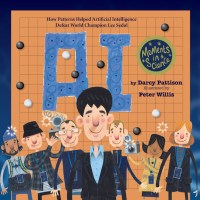
Today we’re interviewing Darcy Pattison, author of A.I.: How Patterns Helped Artificial Intelligence Defeat World Champion Lee Sedol. It’s a fascinating look at the use of artificial intelligence and how a common board game was used to demonstrate that, in some cases, a computer might possess superior skill levels.
Kirkus Reviews calls it, “An enthralling, contemporary tale of man versus machine.”
Christine Taylor-Butler: Darcy, you’ve been in the business for quite a while and you’ve written everything from science fiction and fantasy to contemporary stories and science. When did you know you wanted to become a writer? Were there detours along the way?
Darcy Pattison: I have always been a reader! In sixth grade, I read THE LORD OF THE RINGS (the Harry Potter of my day), and even then, I thought about being on the flip side of the story. I wanted to write stories that people love to read. But I also grew up questioning everything so science writing is a natural fit for me, too.
CTB: You’ve been published by a number of trade publishers. What lead you to create Mims House?

Darcy: In the last twenty years, publishing has changed because of technology. The introduction of ebooks and print-on-demand services means that publishing a book is a low-cost investment up-front. It meant I could publish the books that I was passionate about and bring them to market myself. I had a long history in the industry and knew what pitfalls to avoid and where to focus attention. It’s been a hard journey, but I’m thrilled to be still publishing books of my heart.
Darcy: A.I.: How Patterns Helped Artificial Intelligence Defeat World Champion Lee Sedol was written when I got interested in A.I. I’m always looking kid-friendly ways to approach a topic. When I realized this story featured a world champion board game player, I thought it would appeal to kids. This game was actually a pivotal game in the development of A.I Before this, programmers tried to write rules for artificial intelligence programs. For example, they might write a rule on how to identify a photo of a cat.
Sample rules:
A cat has a round face and triangular ears.
A cat has a tail.
It worked up to a point. But what if the cat is curled up sleeping? Or perhaps, it’s stretched out to run hard as it chases a rat? It required too many rules to deal with all the positions a cat might take, and all the exceptions to the rules.
Instead, artificial intelligence today works because we provide thousands of images to a computer program, a big dataset. Each image is labeled either CAT or NOT CAT. The program analyzes the images and creates its own mathematical formula for identifying a cat.

The AlphaGo program was the first time such an A.I. program was used to challenge a human in a complicated board game. Amazingly, it won four out of five times. Also amazing—Lee Sedol, the world champion, found a way to defeat the A.I. once. The series of games redefined our relationship to A.I.
Note to readers: A documentary about the AI program and the match with Lee Sedol can be found on Youtube: AlphaGo: The Movie.


CTB: The illustrations are so fun, as is the layout of the book. How did you find that illustrator?
Darcy: Yes, Peter Willis is amazing! He has illustrated ten books with me now because his distinctive digital collages are fun and funny for kids. I first saw his portfolio on Behance.net, the Adobe social media program where artists display portfolios. Look for more about Peter Willis and his work here: https://mimshousebooks.com/blogs/books/willis1


CTB: There’s a lot of concern now about AI eventually being able to do more than play games. But I love that you explain that even the phones in our pockets are partially fueled by AI technology. For example, I’m a frequent user of “Siri” and my Mac laptops as far back as OS9 were voice activated and had a digital assistant. Did you have any “aha!” moments when researching this book?
Darcy: It was fascinating to dig into the discussion of A.I. technology. Understanding the difference in the two types of approaches to A.I. helps me make decisions about how I choose to use A.I. The rules-based approach was ultimately unusable because there are too many exceptions to any rule. When A.I. analyzes big datasets, though, it can mathematically account for exceptions. It’s a brilliant solution that means A.I. can tackle a wide variety of questions. For example, from a photo, it can predict if a mole is likely to be cancerous. Or, it can help create a chemical formula for a new medicine.
One problem with A.I. is that need for big datasets. Where will programmers find the data to feed into the program? Current lawsuits revolve around the allegedly illegal use of their copyrighted or patented information. Artists object to their copyrighted images being used to train A.I., and authors object to their copyrighted novels and writings being used to train A.I.
For me, that “aha” moment was understanding how current A.I. works. It’s easier to see how the programs can help my work or fit into a lesson plan when I understand that it’s trained on selected big datasets.
CTB: Your book ran into a roadblock at the US Copyright office. In scanning the text the office assumed the book was illustrated by A.I. rather than a real person. Can you tell our readers a bit about that experience?
Darcy: The US Copyright has decided to check books to see if a book might include text or images created by A.I. I applaud this careful look at the books! However for my A.I. book, they asked if A.I. had been used to create the book. Just because the topic of the book is artificial intelligence doesn’t mean I used A.I. to create it! After I answered their question, they came back again and asked about this specific page of the book.

Here, the illustrator Pete Willis is demonstrating that some common objects are or are not based on A.I. programing. We know that artificial intelligence can be used for some cell phones, robots, and video games. But cats, ice cream and board games are not based on A.I. The US Copyright office specifically asked, though, if the images labeled “A.I.” had been created using an A.I. program.
“No,” I answered, “Peter Willis illustrated the entire book, even those labeled A.I.”
They accepted my answer and the book’s copyright was approved without any further questions.
CTB: I love that you call yourself, “Queen of Revisions” in your biography. Do you have any advice for young writers who might want to follow in your footsteps?
Darcy: Over the years, I have learned that I need to revise many times. When kids ask me how many revisions I do for a project, I answer, “Until it’s right.”
It’s not a matter of getting it right in three tries. It’s getting it right that matters.
If you want to write, read! Read everything you can, putting information and language into your memories so that when you need it, the words are there to draw upon.
CTB: Thanks for being such a gracious guest. What’s up next? Any projects or books you’d like readers to watch for?
 Darcy: Peter Willis and I are collaborating on a new book, MAGNET: How William Gilbert Discovered that Earth is a Great Magnet. The story goes back to the middle of the 1600s when scientists were first figuring out what a magnet was. Gilbert gathered lodestones, natural magnetic stones, from around the world: from Greece came red and black lodestones; from Spain came white lodestones; Chinese lodestones were dark blood-red, while Ethiopian lodestones were amber or yellowish.
We follow the natural phenomena of stones that attract other stones as scientists start to unravel and make sense of the strange properties of the stones. Look for the book in April, 2024.
*****
 Darcy Pattison is the author of science books for kids, writes award-winning fiction and non-fiction books for children. Five books have received starred PW, Kirkus, or BCCB reviews. Awards include the Irma Black Honor award, five NSTA Outstanding Science Trade Books, three Eureka! Nonfiction Honor book (CA Reading Assn.), two Junior Library Guild selections, two NCTE Notable Children’s Book in Language Arts, a Notable Social Studies Trade Book, an Arkansiana Award, and the Susannah DeBlack Arkansas Children’s History Book award. She’s the 2007 recipient of the Arkansas Governor’s Arts Award for Individual Artist for her work in children’s literature. Her books have been translated into ten languages. Always active, before her tenth birthday, she (almost) climbed the Continental Divide, turning back at the last twenty yards because it was too steep and great climbing shoes hadn’t been invented yet. She once rode a bicycle down a volcano in Bali, Indonesia and has often hiked the Rockies. She recently hiked New Zealand’s backcountry for a taste of Kiwi life, and then strolled the beaches of Australia. On her bucket list is kayaking the Nā Pali Coast of Hawaii and eating curry in Mumbai. Follow her: @FictionNotes on Twitter and @DarcyPattison on Instagram.

Photo by Kecia Stovall
Your host is Christine Taylor-Butler, a graduate of MIT and author of Save the… (Tigers, Blue Whales, Polar Bears) with Chelsea Clinton and many other nonfiction books for kids. She is also the author of the STEM-based middle grade sci-fi series The Lost Tribes. Christine was appointed as an MLK Visiting Scholar for the 2023-2024 academic year at MIT focused on STEM and children’s literacy. Follow @ChristineTB on Twitter/X, @ctaylorbutler on Bluesky or @ChristineTaylorButler on Instagram. She lives in Missouri with a tank of fish and cats that think they are dogs.