Get cozy this fall and cuddle up with one of these amazing new books.
October 6th
By Tahlor Mejia
Front Desk meets Stephen King! In this perfectly frightening middle grade read, a twelve-year-old boy moves into a creepy motel where breaking the rules doesn’t just mean getting kicked out—it means disappearing for good.
Dylan has a bad feeling about the Good Night Motel. Ever since he and his mom got kicked out of their apartment, their new living arrangements have given him a serious case of the creeps. The roof is sagging; the wallpaper is peeling. The weird twin owners have painted-on smiles like Victorian dolls, and the handyman always seems to be lurking.
And, of course, there are the Rules. Break three, and you’re out for good.
Dylan couldn’t care less until he’s cornered by a kid who claims to know the truth about this place. The real truth. You see, when people break the rules, they don’t just get kicked out of the motel. They disappear.
And Dylan and his mom could be next.
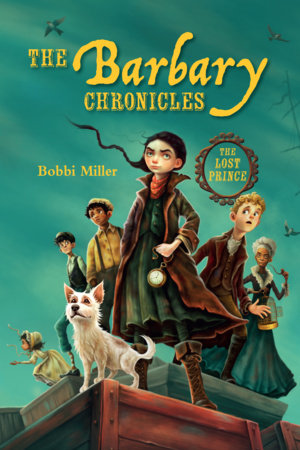
Eleven-year-old Jack London holds her own among rascals, ruffians, and thieves in this rollicking adventure story set in 1870s San Francisco.
Oliver Twist meets Deadwood in this action-packed novel for ages 9 to 12 set against the backdrop of San Francisco’s notorious Barbary Coast.
No one plays the game like Jack London. Only eleven years old, she can pickpocket and flummox any unsuspecting rube who wanders into the muck of the Barbary Coast.
All Jack’s skills are tested when one of her own falls ill and she pinches a gold pocketwatch to pay for a doctor. The watch belongs to the richest man in San Francisco, and it plunges Jack into a whole world of trouble. She soon finds herself on the run from rival gangs, corrupt coppers, and the ruthless, self-proclaimed King of the Barbary Coast.
Jack may be little, but she’s clever and bold. With the help of a devoted stray dog, a kidnapped prince, and the scummiest ex-best friend ever, she’ll do everything she can to save her town and her found family.
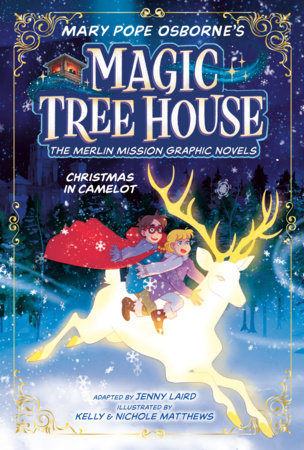
By Mary Pope Osborne
Magic. Danger. Legend. For the first time in a full-color graphic novel, regular kids, Jack and Annie, travel in the Magic Tree House to King Arthur’s Camelot for Christmas in this graphic novel adaptation of a beloved chapter book classic!
When Jack and Annie receive an invitation to spend Christmas Eve in Camelot–a magical place that exists only in myth and fantasy–they know they are in for their biggest adventure yet. What they don’t know is that the invitation will send them on a quest to save Camelot from a curse. Can they succeed even though Camelot’s greatest knights have failed?
For the first time in graphic novel–live the adventure again with new full-color vibrant art that brings the magic to life!
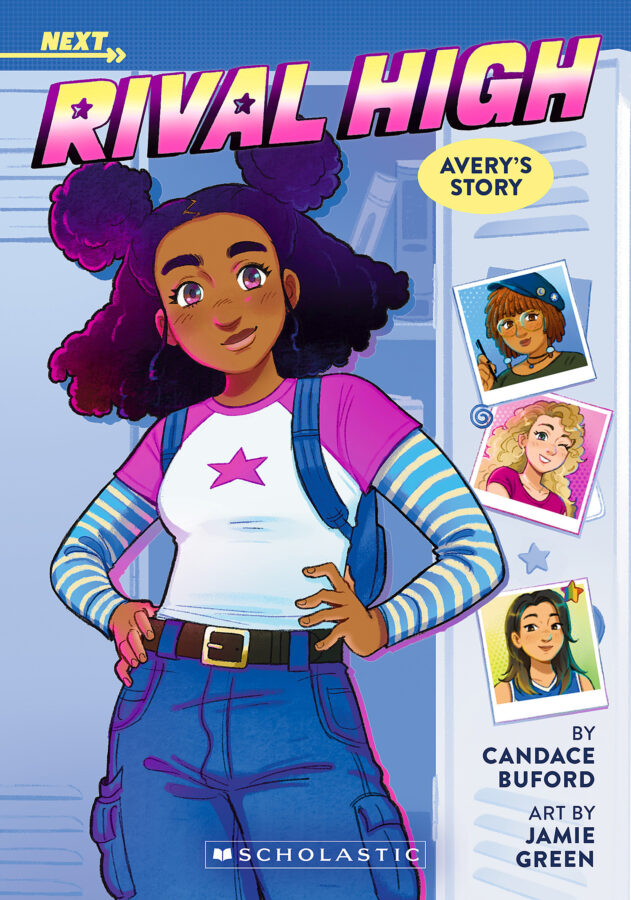
By Candace Buford, Illustrated by Jamie Green
Avery Jones is ready for a fresh start, and what better time than the first day at a new school? That’s where she meets Madison (the influencer), Teresa (the genius), and Corinne (the athlete). Each one is so unique and cool, all Avery wants to do is impress them.
So when she sees an opportunity to twist the truth a little, she takes it. After all, a little white lie never hurt anyone … right?
But when Avery’s new school merges with her old school, she finds herself in way over her head juggling two lives — and her new friends are starting to get suspicious. Will Avery be able to fix things before her friends figure out the truth?

By Leslie Adame
Secrets, magic, and danger collide in the second book of Leslie Adame’s thrilling middle grade fantasy series, as Chloe must master her newfound powers to stop a destructive sorcerer — perfect for fans of Amari and the Night Brothers and Witchlings.
After saving her parents from the clutches of an evil sorcerer, Chloe Vega just wants a normal year at her magical academy. But when you wield legendary new powers, danger is never far behind.
Her enemies will stop at nothing to use her to reveal the Agents of Magic to the rest of the world. And with their secret society on the brink of discovery, the agency begins to question whether Chloe is their best weapon—or their greatest risk.
When Chloe’s powers spiral out of control, the cost isn’t just their chance at victory, it’s the people she loves. Can she master her powers in time or will she lose everything?

This love letter to libraries and librarians throughout history is a fascinating look at how these beloved institutions have long helped communities and why they are more essential than ever.
While most of us have been to a library, not everyone knows how important libraries have always been – or just how broad the definition of a library can be. This book explores these topics in lively prose, covering everything from the history of libraries and their functions to unusual libraries, such as secret or traveling libraries, and special libraries created for certain purposes or to serve specific communities. And what ties it all together is a simple but powerful message: everyone everywhere deserves access to information and stories – and to a library!
In this one-of-a-kind book, award-winning author Joyce Grant takes readers on a whirlwind tour of libraries and their long history as meeting spots for community members, places of refuge in times of conflict and change and safe spaces that protect both people and access to information. Also included are profiles of many real-life librarians who have found creative ways to meet the public’s needs. This timely book provides an engaging, accessible overview and contextualization of relevant issues such as equal access to information, freedom to read, censorship and inclusion – particularly significant today as libraries in North America face new challenges. Together with Chanelle Nibbelink’s fresh and quirky illustrations, the text invites readers to think about what libraries mean to them – and why that’s worth protecting. A “design your own library” prompt, author’s note, list of resources and a glossary are also included.
October 13th

By H.E. Edgmon
In a fantastical version of the United States filled to the brim with magic and dragons, the tween prince of Texas must compete in a notoriously dangerous scavenger hunt in Realmsweep by Stonewall Honoree H.E. Edgmon.
Rowdy Buckner, the twelve-year-old prince of Texas, has a problem. More than anything, he wants access to the transfiguration tonics that will transform him from head to toe into the prince he is, in a body that feels more his own. His parents are skeptical–not because they aren’t supportive, but because they don’t believe that self-absorbed, spoiled Rowdy is responsible enough to be trusted with such powerful magic just yet.
In order prove himself, Rowdy signs up to compete in Realmsweep, a notoriously dangerous scavenger hunt held across the Allied Lands every five years, and sends his personal guard to assemble a team. The resulting ragtag crew of preteens isn’t exactly impressive at first glance, but they’re all Rowdy has. With them, he’ll face off against everything from monstrous creatures to the monstrosity of humans, and maybe, if he’s lucky, become the person he so desperately wants to be.

By Janae Marks
From New York Times-bestselling author Janae Marks comes a heartfelt middle-grade novel about a tween who uncovers a deep family secret after she moves into her estranged half-brother’s guardianship following their mother’s accident.
Addy Thompson’s life is untangling: Her mom is in a coma following a car accident, and now she’s in the custody of her estranged half-brother—although Julian feels more connected by DNA than real family. On top of that, her two best friends, Thea and Luz, are fighting, and she’s not sure she’s ready for her first ever swim meet. Addy feels helpless in the middle of everything.
As Addy gets to know Julian better, more questions arise. Why haven’t they spent time together before now? And why won’t he visit their mom in the hospital? When Addy discovers an old journal in her mom’s closet, it sends her on a journey to uncover the truth.
But revealing the past comes with big feelings and bigger secrets, and when Addy gets Thea and Luz involved in her scheme, the ties of their friendship stretch to their limit. Even worse, Julian refuses to talk about their mom, and Addy’s search for the truth threatens their growing relationship.
All Addy wants is to knit the people she loves back together. But what if she’s the one tearing them apart?
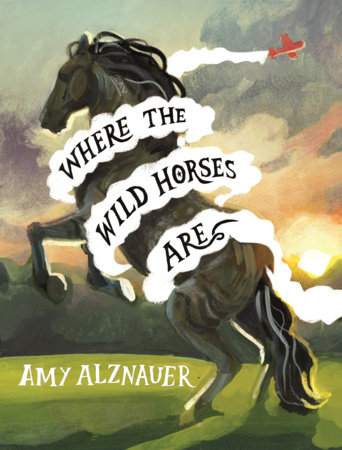
Twelve-year-old Nash is a self-proclaimed cowboy. She sleeps with her riding boots on, takes lessons at the local barn, and reads True Grit for life advice. There’s just one thing missing— a horse of her own.
Enter the Extreme Mustang Makeover contest, a chance to receive and tame a newly-captured mustang for the summer. Signing up will guarantee Nash one hundred days with a horse; and if she wins, she can use the prize money to bring him home for good. It’s the miracle Nash has been waiting for.
But Nash’s attention is divided when her cousin Benny arrives to stay for the summer. While Nash and Benny were once like sisters, the six years since Nash moved away have driven a wedge between them. Benny is everything Nash isn’t: gentle and well-behaved, and Deaf like Nash’s parents are. Sometimes she wonders if they’d rather have a daughter like that than a headstrong cowboy CODA like Nash.
A brave girl and a horse no one believes can be tamed: it’s a tale as old as time, brought to sizzling new life through Nash’s one-of-a-kind voice. Amy Alznauer weaves cowboy bravado, growing pains, and Deaf culture inspired by life in her Deaf-hearing family into a debut middle grade novel that will lasso you tight by the heart.
October 20th
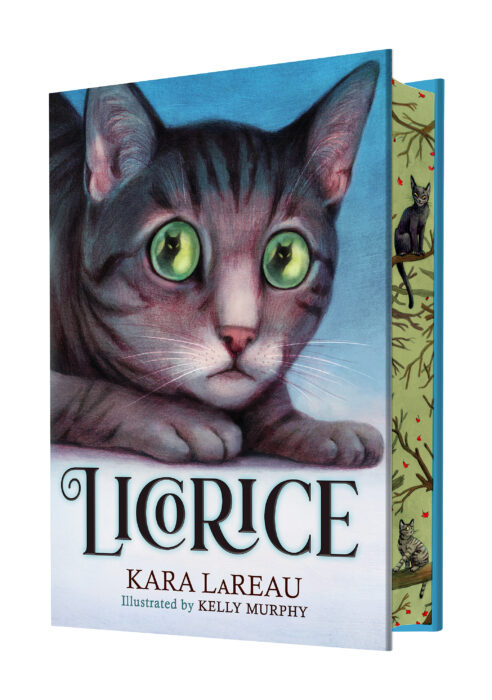
By Kara LaReau, Illustrator Kelly Murphy
In her cage at the Mount Charles Animal Shelter, Kitty has no other choice but to be the captive audience of the opinionated Bunny Van Hopper. But it’s better than the woods. Kitty can still remember the rain that came and swept everything… everyone… away. Here, at least she has food and company, even if Bunny’s words scare her.
And then Max appears at the shelter. Max has adopted all sorts of pets over the years. Rumor has it that he treats all of his pets with care and kindness. And of all the animals at the shelter, he actually chooses her-a scrawny and scared kitten. Kitty is going to be home at last. But she can’t seem to get Bunny’s words out of her head as Max takes her away in her carrier…
“You’re going to regret this! I just know it!” Bunny Van Hopper cries. And perhaps Bunny is right…
There is a scent lingering in the house on 5 Manderley Lane. The scent rises from every chair leg, every carpet fiber, every throw pillow, even inside the bathtub. Everything smells like Licorice. It is the strongest upstairs in Max’s room, almost overpowering. If the smell isn’t enough, Duchess, the family’s old parrot, won’t let Kitty forget that she is a replacement. And soon, Kitty finds herself trapped in the long shadow of the cat that came before her. But is it just a shadow? Or is there something really there on the other side of it…haunting her…
Licorice is a fantastically kid-friendly book full of mystery and suspense, for fans of Kate DiCamillo, Katherine Applegate, and Aaron Reynolds.”
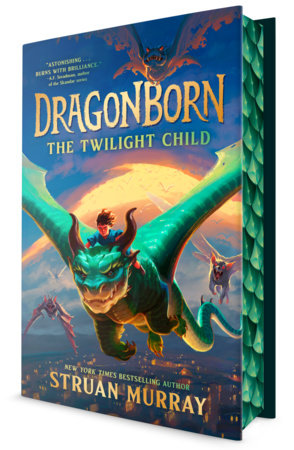
*This stunning book features a dragon-scale edge, full-color illustrated endpapers, a foil scene on the case, foil on the jacket, and an interior map*
“Their fate rests in the hands of the Twilight Child.”
Having discovered her true identity as dragon, Alex Evans must embark on a dangerous quest to stop Drak Midna and his war against humanity.
When tragedy strikes the island of Skralla, Alex and her friends journey north to the heart of Scotland, where dark plots are in motion, and humans and dragons fight side-by-side against a rising storm of ancient demons.
Sinister forces are growing stronger every day, and as friendships fall apart and enemies old and new strike from the shadows, Alex must master her own fearsome power, and unravel a mystery that might just be the key to victory: the legend of the Twilight Child.

By Frances O’Roark Dowell
When a sixth grader discovers a mysterious, sometimes-there-sometimes-not house in the woods, it throws into question everything she believed—and everything she didn’t—in this immersive speculative mystery from acclaimed author Frances O’Roark Dowell. Perfect for fans of Kate DiCamillo!
Sarah T. doesn’t believe in a lot of things anymore:
That her best friend is still her best friend now that her best friend has a new best friend.
That her dad still loves her as much as he used to, now that he has a new baby and a new wife.
She isn’t even sure she believes in magic, when once upon a time she believed that anything was possible.
But when she follows a pair of beckoning squirrels up up up a leafy driveway to a clearing in the woods, and a house falls on her head? A house that seems like it could be from an old-time movie? Sarah T. definitely believes something strange is going on.
So does the new kid in her class, a boy genius who has scientific theories about time travel…even though he’s not so good with cell phones or computers. For the first time in a long time, Sarah T. feels like she’s got somebody on her side. But what happens when the house falls on her head again—and this time the new kid’s standing right next to her?

Three mechanically created siblings set out to uncover the truth behind their inventor mother’s disappearance in this whimsical mystery adventure from renowned social media storytellers Tristan Tales and Luke Pounder. Perfect for fans of The Swifts and A Series of Unfortunate Events.
In the town of Blissburg, everything is perfect. The lawns are trimmed to an identical length, the streets shine without a speck of dust, and everyone lives in harmony … or do they? High above the town, in the fantastical workshop known as the Observatory, order dissolves into wacky weirdness. This is the home of the extraordinary Cogsworth siblings—Orion, Scorpius, and Lyra—who were created by the genius inventor Dr. Eliza Cogsworth.
The Cogsworths have never stepped foot outside their secluded haven, but when Dr. Cogsworth disappears under mysterious circumstances, they are thrust into the real world, where their wires, cogs, and goggles stick out like sore thumbs. As the siblings dive deeper into the search for their mother, they uncover a sinister plan beneath the town’s perfect facade. The clock is ticking. Can the Cogsworths find their mother and save the town before time runs out?
Packed with explosions, inventions, and a hilarious robot sidekick, The Cogsworths is a thrilling adventure about embracing your differences and having the courage to stand against conformity in a world obsessed with uniformity.

By Allie Millington
From the New York Times-bestselling author of Olivetti, here is the story of a magical—and lifechanging—correspondence.
Trunk No. 3, a worn, wrinkled suitcase with a secret, was perfectly fine with staying closed forever. Until she’s stolen by a despondent boy with plans to run away. When a strange note appears in the trunk, however, an accidental correspondence begins to throw everything off course—and toward something, someone, entirely unexpected.
Eleven-year-old Earl Grey has been raised at the Repertorium—a rare library that holds once-forgotten items, each with a tangible memory tied to their very being. She longs to discover life outside of the library, and to find answers about her Before. Little does Earl Grey know that the mysterious pen pal she starts writing to will lead to a life-changing friendship and the unraveling truth of her past.
New York Times-bestselling author Allie Millington weaves together a poignant, uniquely delivered story about connection, worth, and seeing more in the seemingly ordinary—including ourselves.
October 27th

By Daniel Nayeri
A groundbreaking hero’s journey from National Book Award and Newbery Honor winner, Daniel Nayeri! A young boy, a mouse, and a dog set out to find their purpose in this fairy tale adventure told in an innovative visual format that offers a one-of-a-kind reading experience.
This is the tale of a boy named Nothing the Younger, who lives in a city on the mountaintop of a far-off and long-lost country. Everyone calls him Ing, and while he has no parents, he does have two friends: a dog, Pöppy, and a mouse, mOmO. When King Cyrus calls for a hero to find and defeat the Giantess ravaging the countryside, the king’s son, the Wander Prince, answers the call and Ing decides to follow. Along the journey, Ing (and his friends) must traverse the Land of the Dead, survive an encounter with the terrifying wimmelworm, and discover the truth of his mother and father . . . so that he may find what he’s been seeking all along—his best purpose.
The text on each page snakes, climbs, jumps, and explodes into shapes and forms that unravel the story. This Is a Door is full of fun surprises and poignant musings that flip the classic hero’s journey on its head—all in an artistic and inventive package that is a wonder to behold.

A middle-grade short story anthology featuring disabled kids, written by disabled writers, and edited by #1 New York Times-bestselling author Marieke Nijkamp. Featuring beloved contributors, like Samira Ahmed and Natalie Lloyd.
Imagine the boundless experiences of disabled kids: A Deaf Southerner who solves local mysteries. A young diabetic plant mage encountering magical mishaps. A girl with epilepsy discovering a hidden world in her grandmother’s garden. A chronically fatigued gamer saving the day—and their team—during an epic VR space race.
From juvenile arthritis to asthma and from wheelchairs to neurodiversity, Boundless: 17 Stories Starring Disabled Kids writes disability back into the mainstream narrative of the commercial genres we love, with an inclusive and intersectional lens.
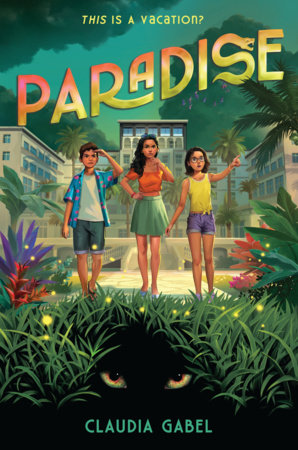
In this suspenseful series launch, adventure and mystery abound during a multigenerational family trip to an exclusive resort.
Cousins Sam, Lily, and Jordan meet up on family vacation every year. This year, their grandmother is paying for them to stay at Paradise, an exclusive tropical resort!
Paradise offers a gorgeous beach, multiple pools, all-you-can-eat buffets, and any adventure you can imagine. The kids can come and go as they please, while their parents zone out at the beach. It’s supposed to be fire.
But in this place where the other guests all seem like billionaires and celebrities, the cousins start acting like people they’re not. They test new identities, break some rules, and start to mingle with other kids who should raise red flags.
Pretty soon the trio is beginning to see another side of this gleaming resort.
And as the resort’s many secrets come into focus . . . family secrets start coming to the surface, too.