
Posts Tagged book lists

STEM Tuesday– Radio/UV Waves and Applied Physics — Author Interview

Welcome to STEM Tuesday: Author Interview, a repeating feature for the last Tuesday of every month. Go Science-Tech-Engineering-Math!
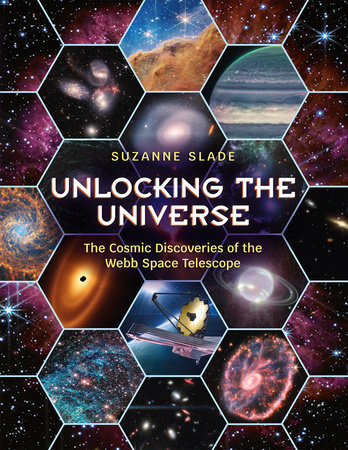
Today we’re interviewing Suzanne Slade, author of Unlocking the Universe: The Cosmic Discoveries of the Webb Space Telescope. Unlocking the Universe transports readers to NASA for an up close look at how the James Webb Space Telescope was designed, built, tested, and deployed. The behind the scenes photographs and wonderous space images will leave you agape in wonder!

Unlocking the Universe has been named:

  • Junior Library Guild Selection
  • NSTA 2025 Best STEM Book
  • New York Public Library Best Books for Kids

Plus, you can watch a goose-bump inducing book trailer here.

And now, let’s launch into the interview!

Emily Starr: I’ll start with the obvious. The Webb images are breathtaking! What was your involvement in choosing which images to include?

Ring Nebula

Ring Nebula

Suzanne Slade: I started writing this book before Webb had released any space images, so it was super exciting when its first image, a gorgeous galaxy cluster, was unveiled on July 11, 2022. After that, I waited with bated breath for each new spectacular image.

I wanted the book to share a variety of Webb space images, such as nebulas, galaxies, dying stars, nurseries where stars were being born, and more. For example, this image of the Ring Nebula (left) revealed new details of a dying star at the center that gives us a glimpse of what could happen to our Sun. (But nobody panic. The Sun has billions of years left!)

To be honest, there were so many gorgeous images that it was excruciating to decide which ones would make the cut. Near the end of the project, we did manage to squeak in some extra ones on the cover montage, in the back matter pages, and in the end sheets.

Emily Starr: This month, the blog is helping readers explore radio/UV waves and applied physics. Physics concepts can sometimes seem difficult and complicated to children (and some adults!) – like the electromagnetic spectrum. What are your considerations when thinking about how to make advanced science easy for kids to understand?

Suzanne Slade: There are many things to consider when writing about complex science topics for children. Here are a few I implemented in this book.

James Webb Space Telescope

James Webb Space Telescope

Near the beginning of the book some basic science/space terms are defined within the text, such as “nebula” and “exoplanet,” to help readers ramp up on the topic.

Sidebars with colorful infographics helped explain more complicated topics (like the electromagnetic spectrum.)

As we know, a picture is worth a thousand words. So we made the decision to use photos, instead of illustrations, for the entire book. As I poured through hundreds of potential photos to show readers how the Webb telescope was designed and built, I carefully selected interesting ones that would draw the reader in.

Two page spread showing the Webb Space Telescope's primary mirror

Two page spread showing the Webb Space Telescope’s primary mirror

I also looked for photos which shared bits of information not covered in the text. For example, the book explains how Webb’s large primary mirror, which collects distant light in space, is made up of 18 hexagonal shaped gold panels. The photos in the spread at the left show how the panels are assembled into the primary mirror plus more, such as the size of the mirror relative to the workers, the precise way the panels fit together, how the workers and many components were protected from dust contamination, etc.

Emily Starr: Small blocks of layered text also make the book very accessible to younger readers. How did that format come about?

Suzanne Slade: The design layout, which includes the layered text you mention, was a collaborative effort between myself, the editor, and the spectacularly creative book designer. We tried a few different ideas before arriving at the book’s final design. One fun aspect about creating this book, which is not common in most book projects, was that I was able to meet with the editor and book designer in person can discuss the layout. Fortunately, I live north of Boston part-time, and the publisher, Charlesbridge, is located in Watertown near Boston.

Emily Starr: What was your process for contacting experts and conducting interviews at NASA? Was the agency receptive and helpful?

Suzanne Slade: It can be challenging to know who to contact at NASA or other agencies when working on science books, and these smart experts are very busy people. As luck would have it, one of my high school acquaintances, Dr. Jonathan Gardner, is the Deputy Senior Project Scientist for the JWST. I reached out to him, and he kindly agreed to answer questions and vet the manuscript, which was extremely helpful. I had worked with a NASA engineer, Sandra Irish, on a previous project. She was enthused about this book topic and happy to share her expertise. There are also great online interviews which were helpful as well.

Emily Starr:  The JWST was such a long and complicated project that I’m sure you sifted through piles of research. How did you decide what details to include in the book?

Suzanne Slade: I could write volumes about research and the difficult process of deciding which information to include in a book and what seems best to leave out. The short answer is: I try to include some content that readers can easily understand or may already be familiar with, along with new information that will expand their understanding of the topic and hopefully inspire them to want to learn even more. I prioritize facts and random information nuggets I feel young readers will find fascinating.

Orion Bar

Orion Bar

Emily Starr: As an educator who teaches students to expect and even celebrate failures, I appreciated the section about testing and setbacks. Why was it important to you to include those details?

Suzanne Slade: I’m a mechanical engineer who used to work on rockets and car braking systems, so I understand a big part of engineering and science is trial and error, or mistakes and re-designing. I think it’s important for readers to understand that progress in science is built on failures. As a storyteller, I also know that a happy ending is more satisfying when the journey to get there was filled with challenges that needed to be overcome.

Emily Starr: Many of your books delve into interesting space-related topics. What do you hope readers understand about space by reading your work?

Suzanne Slade: Basically I hope they catch a glimpse of the enormity of space, and the many mysteries and unanswered questions about our cosmos we have yet to understand. I’d also be pleased if my books inspire readers to pursue their dreams of a career in a space related field, such as a researcher, teacher, engineer, explorer, or citizen scientist.

Emily Starr:  Are you working on other space-related projects in the near future? (Actually, we would be happy to learn about any of your upcoming projects!)

Suzanne Slade: In celebration of the 50th anniversary of the first moon landing, I wrote Countdown: 2979 Days to the Moon and Daring Dozen. Since then, I’ve been thinking about the many talented women who made the Apollo missions possible. So I wrote a book about the sharp, dedicated women who helped engineer, stitch, design, plan, and execute the Apollo moon missions. Of course, thousands of women worked on those missions, so it was difficult to decide how many women to feature. In the end, I decided to share the stories of twelve women to mirror the twelve men who’ve walked on the moon so far. This exciting book, titled Women on a Mission, releases in October 2025. I can’t wait!


Sibert Honor author Suzanne Slade has written more than 150 children’s books. As a mechanical engineer who worked on rockets, many of her titles are about space and women in STEM. Some recent titles include The Universe and You, Mars Is: Stark Slopes, Silvery Snow, and Startling Surprises, June Almeida, Virus Detective!, The Woman Who Discovered the First Human Coronavirus, and A Computer Called Katherine: How Katherine Johnson Helped Put America on the Moon (NSTA Best STEM Book). Her title, Astronaut Annie, soared to the ISS and was read by astronaut Anne McClain for Story Time From Space.


Emily Starr

As a former fourth grade teacher and founder of StarrMatica, a STEM publishing company, Emily Starr has developed award-winning K-5 science curriculum and professional learning materials for 20 years. She is a member of the Iowa State Science Leadership Team, a peer reviewer for the National Science Teaching Association’s journal Science and Children, and a frequent presenter at state and national education conferences. Her debut middle grade nonfiction book will be released in 2025 from the Iowa Ag Literacy Foundation.


STEM Tuesday– Radio/UV Waves and Applied Physics — Writing Tips and Resources

Catch a Wave!

(This post was originally a STEM Tuesday Spin-Off guest post for the Middle Grade Book Village blog. It fits with this month’s theme of Radio/UV Waves – Applied Physics so I’m recycling it for my Writing Tips & Resources post.)

In STEM Tuesday Spin-Off, we look around at the things in life we often take for granted. We peer behind the curtain, search underneath the hood for the STEM principles involved, and suggest books and/or links to help build an understanding of the world around us. The common, everyday thing will be the hub of the post, and the “spin-offs” will be the spokes making up our wheel of discovery. As our former STEM Tuesday Writing Tips & Resources partner, Heather L. Montgomery often says, we’ll “Go deep!” on a common subject and take a look at its inherent STEM components. 

Today, we will take a closer look at something that is always with us and affects the life of the average 8-14-year-old.

Waves!

Shalom Jacobovitzderivative work: Brocken Inaglory ([[User talk:Brocken Inaglory|talk]]) [CC BY-SA]

The Hub: Waves

Waves, dude! They’re awesome. Riding a wave, either on a board or by body, is exhilarating. Throwing a rock into a calm lake or pond to watch the wave patterns is pretty entertaining and tossing in another rock or two to watch the wave patterns interact takes it to a whole new level. 

Wave motion is pretty cool. The waves created by a sheet flapping in the breeze or the waves generated with a length of rope or a Slinky toy give us hours of entertaining observation. Waves provide both satisfaction from their aesthetic and their physical principles. In short, waves rock!

As cool as the above waves are, there are multitudes of waves in constant motion around us every day and we don’t even need to hit the beach to enjoy them. We notice some of these waves, while others we don’t notice. Yet these waves profoundly affect our modern life every second of every day.  

In today’s Catch a Wave Edition, we’ll talk about these sound and electromagnetic waves and introduce some spin-off resources to learn more and dig deeper into STEM. There are waves all around us, light waves, sound waves, radio waves, microwaves, other electromagnetic waves, and, may I add, waves of middle-grade academic enthusiasm.

Spoke 1: Sound Waves

Sound waves are mechanical waves created by the vibration of a source. The vibrations create longitudinal waves consisting of regions of high pressure and low pressure called compressions and rarefactions that mimic the source vibration. A sound wave must travel from one place to another in a medium and cannot move through a vacuum. 

Sound wave in a cylinder. via Wikimedia Commons.

Transverse Waves

The remaining Spin-Off Spokes are all transverse waves of the electromagnetic spectrum. One of the amazing things about electromagnetic waves is they are a single physical phenomenon that can be separated into types by the characteristic properties associated with their frequency and wavelength.

This image has an empty alt attribute; its file name is em-spectrum-nasa_-wikimedia-commons.jpg

This image has an empty alt attribute; its file name is longitudinal-and-transverse-waves-1.png

Electromagnetic wave shape is the more familiar wave shape of crests and troughs, called a sine wave. Transverse waves of the EM spectrum travel at the speed of light in a vacuum.

Spoke 2: Radio Waves

We are all familiar with radio. Turn it on, crank it up, and dance down the hallway on the way to the lunchroom. Radio rocks! Let me tell you, that box that plays our favorite tunes is only a mere sliver of the pure awesomeness of radio waves. Radio waves are the do-it-all, blue-collar, workman of the physical world. Sound, data, and video can be pulsed (modulated) onto a radio wave carrier, transmitted great distances through an antenna, and received by another antenna. A receiver then separates (demodulates) the original signal from the carrier wave and transmits it to an output device.

Let’s say I want to play my wicked new surf guitar solo to a friend who lives six hours away. First, I create the sound into a microphone by playing my new jam. The microphone transforms the vibration of the longitudinal sound wave from the guitar strings into an electromagnetic wave which then gets pulsed/modulated onto a radio wave or microwave. The message on the carrier wave is sent by my antenna great distances at the speed of light until it reaches my friend’s antenna. The antenna catches my message, and the electromagnetic wave is decoded/demodulated from the carrier and sent to a speaker where it is transformed back into a sound wave. Next thing you know, my friend is rocking out to my surf guitar solo. All is good in the world.

A low-frequency message signal (top) may be carried by an AM or FM radio wave.

Look around your school or classroom, there are probably devices on the ceiling or on a table all around that are constantly modulating and demodulating data for your computers and Wi-Fi networks. MOdulating and DEModulating, MOdulating and DEModulating, MOdulating and DEModulating. (Isn’t “modem” an exceptional portmanteau of “modulator-demodulator”?) Did you know that’s what your modem does? Radio waves and microwaves are the carriers of modern life. Technology doesn’t go anywhere without them.

Spoke 3: Microwaves

Microwaves do more than make popcorn or heat up that frozen burrito. With higher energy and higher frequency wave than a radio wave, a microwave can penetrate obstacles that radio waves can’t. Some of the non-food functions of microwaves overlap with the functions of radio waves and the daily utility of these may surprise you. Wi-Fi, Bluetooth, GPS, satellite radio, amateur radio, weather radar, and some broadcasting and communications transmissions, to name a few, are all microwaves. See what I mean? Microwaves make life better, and the bag of popcorn popped in two minutes is truly a bonus.

A satellite dish receives satellite television over a Ku band 12–14 GHz microwave beam from a direct broadcast communications satellite in a geostationary orbit 35,700 kilometers (22,000 miles) above the Earth.

Spoke 4: Infrared Waves

Infrared is such a cool sounding word, science fiction level cool in my book. In reality, though, it simply means “below red”. Infrared waves are often associated with heat, especially the longer wavelength end of the spectrum. These heat waves are given off by fire, heat lamps, and the sun. On the opposite end, the shorter infrared wavelengths don’t give off much heat but do function in one of mankind’s greatest inventions—the remote control! Automatic doors, heat sensors, and night-vision technology are just a few ways we interact with infrared waves in our daily life. Now, where did I put that TV remote?

IR thermography helped to determine the temperature profile of the Space Shuttle thermal protection system during re-entry.

Spoke 5: Visible Waves

We are all familiar with the visible spectrum of electromagnetic waves. They’re the ones we can see and account for the rainbow of colors detected by our eyes. The different frequencies of visible waves are either absorbed or reflected by an object. If the reflected waves are at the longer wavelengths of the visible spectrum, 625-740 nm, the light is red. If the reflected waves are at the shorter end of the spectrum, 380-450 nm, the reflected light is violet. Everything we can see and the multitude of colors originate from the electromagnetic waves of the visible spectrum. You may also have heard about fiber-optic cables used for communication. Fiber optics contain light waves that carry data much like radio and microwaves. Without the visible wave spectrum, we would spend most of our time in the dark.

Spoke 6: Ultraviolet Waves

If the word “infrared” wasn’t cool enough for you, may I present “ultraviolet”? In reality, it’s just an awesome way to say “beyond violet”. Besides the level of word coolness, ultraviolet waves themselves are pretty dang awesome. UV waves are emitted by high-temperature objects, like stars, and help astronomers learn more about how the galaxies are put together. Just as “beyond violet” suggests a deeper shade of purple, ultraviolet waves have their own dark side. UV rays emitted by our sun are the cause of sunburns and prolonged exposure to ultraviolet radiation can cause cancer by changing our DNA.

Of course, there are also the UV rays of lower frequencies emitted from a blacklight bulb which we all know make the school dances spectacular events for white clothing clad individuals.

NASA image of Mira’s bow shock & hydrogen gas tail in ultraviolet, rendered in blue-visible light.

ROUGE WAVES?

There are two additional wave types in the electromagnetic spectrum. These waves, however, are ones you don’t want to expose yourself to regularly. 

X-rays are high-energy waves naturally produced by high-temperature sources, like the sun’s corona. We may be more familiar with medical imaging equipment that uses the power of X-rays to view bone structure. There’s a good reason the radiology technician wears a lead apron for protection while performing X-rays—too much exposure to X-rays can cause serious health problems.

The second waves to avoid are gamma waves. Gamma waves are such high frequency/short wavelength they can pass through the space of a single atom! Unfortunately, they can also destroy living cells. Gamma waves are mainly formed by high-energy objects in space and are absorbed by the Earth’s atmosphere. Lightning, nuclear explosions, and radioactive decay are sources on Earth that can produce gamma rays.

Franquet T., Chung J.H. [CC BY (https://creativecommons.org/licenses/by/4.0)]

Wrap-Up

The final waves needing recognition are the waves of middle-grade enthusiasm and, in particular, the waves of middle-grade enthusiasm for STEM. Keep riding the STEM wave and asking questions about how our world works.

Hopefully, I’ve given you at least six good reasons to appreciate the physical phenomenon of waves. They may not be the easiest thing in the world to understand but they are fascinating.  

Next time you switch on a radio or the TV or get your sprained ankle x-rayed at the hospital, think about all the invisible and visible waves swirling around us every second of every day. Appreciate the STEM-tastic wave and remember this:

Be curious. 

Think about the world around you.

Figure out what makes it tick and work to make it a better place.

CATCH A WAVE!!!

Mike Hays has worked hard from a young age to be a well-rounded individual. A well-rounded, equal-opportunity sports enthusiast, that is. If they keep a score, he’ll either watch it, play it, or coach it. A molecular microbiologist by day, middle-grade author, sports coach, and general good citizen by night, he blogs about sports/life/training-related topics at www.coachhays.com and writer stuff at www.mikehaysbooks.comTwo of his science essays, The Science of Jurassic Park and Zombie Microbiology 101,  are included in the Putting the Science in Fiction collection from Writer’s Digest Books. He can be found roaming Bluesky under the guise of @mikehays64.bsky.social and @MikeHays64 on Instagram.


The O.O.L.F Files

This month on the Out Of Left Field (O.O.L.F.) Files, we take a trip around the internet to further investigate the awesomeness of radio and ultraviolet waves. 

National Radio Astronomy Observatory 

The University of Central Florida’s Astronomy coursebook chapter, The Electromagnetic Spectrum.

NASA’s Hubblesite

Studious Guy

Middle School, Experiment with Radio Waves Science Projects

GCSE Physics

  • Radio Waves #65

  • Visible and UV Light #67


Sydney Taylor Book Award Blog Tour: MG Notable Winners + Q&A!

Today it’s our privilege to shine the Mixed-Up Files spotlight on the MG Notable Book winners of the Sydney Taylor Book Award. Presented by the Association of Jewish Libraries since 1968, this prestigious award — bestowed annually and named in memory of Sydney Taylor, author of the classic All-of-a-Kind Family series — recognizes books for children and teens that exemplify high literary standards while authentically portraying the Jewish experience.

Gold medals are presented in three categories: Picture BooksMiddle Grade, and Young Adult. Honor Books are awarded silver medals, and Notable Books—including the three MG titles featured below—are named in each category.

And now, without further ado…

The Sydney Taylor Book Award MG Notable Book Winners

  • Max in the House of Spies: A Tale of World War II by Adam Gidwitz
  • Benji Zeb Is a Ravenous Werewolf by Deke Moulton
  • Things That Shimmer by Deborah Lakritz

Max in the House of Spies: A Tale of World War II by Adam Gidwitz (Dutton Children’s Books)

Max Bretzfeld doesn’t want to move from Germany to London, where he’s alone for the first time in his life. But not for long. Max is surprised to discover that he’s been joined by two unexpected traveling companions, one on each shoulder, a kobold and a dybbuk named Berg and Stein.

Germany is becoming more and more dangerous for Jewish families, but Max is determined to find a way back home–and back to his parents. He has a plan to return to Berlin. The problem is, it involves accomplishing the impossible: becoming a British spy.

Benji Zeb is a Ravenous Werewolf by Deke Moulton (Tundra Books)

Benji Zeb has a lot going on. Not only does he have a lot of studying to do—for school as well as for his upcoming bar mitzvah—he’s nervous about Mr. Rutherford, an aggressive local rancher who hates Benji’s family’s kibbutz and wolf sanctuary. Plus, Benji hasn’t figured out what to do about Caleb, Mr. Rutherford’s stepson, who’s been bullying him at school, despite Benji wanting to be friends (and maybe something more). To complicate matters, secretly, Benji and his family are werewolves who are using the wolf sanctuary as cover for their true identities.

Things come to a head when Caleb shows up at the kibbutz one night . . . in wolf form. He’s a werewolf too, unable to control his shifting, and he needs Benji’s help. Can anxious Benji juggle all of these things along with his growing feelings toward Caleb?

Things That Shimmer by Deborah Lakritz (Kar-Ben Publishing)

In the spring of 1973, Melanie Adler desperately wants to be accepted by the Shimmers, the popular kids in her class. But the secret of her mother’s PTSD stands in the way. As hard as she tries, Melanie can’t act as effortlessly confident and fun as the Shimmers. She’s convinced no one knows what it’s like to have a parent who’s afraid of everything–until Dorit Shoshani moves to town. Clever, independent Dorit understands Melanie’s home life thanks to her own family’s struggles. The girls become fast friends. But when the Shimmers finally start to pay attention to Melanie, she’s torn between her bond with Dorit and her chance at popularity.


And now, a Q and A with the Notable Winners!

ADAM GIDWITZ

MR: I won’t embarrass you by listing your numerous book-related awards and accolades (who can count that high? 😀), but having Max in the House of Spies chosen as a Sydney Taylor Award Notable book must be particularly meaningful for you as a Jewish author, telling Jewish stories. 

AG: It is. Most anyone who writes from the perspective of a certain cultural group struggles with a certain ambivalence: we want to do something new, something daring; and yet we also want acceptance from our group. With Max in the House of Spies, and perhaps even more with the conclusion of the duology, Max in the Land of Lies, I am taking certain risks—talking honestly about antisemitism in England and Germany, but also complicating every character, the good guys and the bad guys alike—all while telling a rip-roaring spy story. To have the committee recognize the quality of what I’m trying to do is very gratifying indeed.  

MR: Max in the House of Spies is the first book in a duology, and it’s your first work of historical fiction, set during World War II. What prompted your decision to focus on this time period? Also, without giving away any spoilers, what will Max be up to in book #2? 

AG: A close family friend, the late music critic Michael Steinberg, was on the Kindertransport as a boy. His story fascinated me, and I have long wanted to explore the story of the Kindertransport. When COVID hit, and it felt like we were living in a wilderness of lies, fervently defended by the people in power and millions of average Americans, I wanted to explore how a nation could commit itself to lies. It felt like the perfect opportunity to return to Michael’s story. So in the first book, Max is in England, trying to be trained as a spy so he can go back to Germany to look for his parents. In the second volume, he’s back, and while he’s on his mission he is also learning: why? Why are you Nazis? Why do you hate me? (Or would you, if you knew who I really was?). It’s both a spy novel and a novel of ideas—or of questions. 

MR: And finally, Adam, what are you working on now? 

AG: I’m spending a lot of time sharing Max in the Land of Lies with the world right now. But my next book will be a graphic novel adaptation of some of the scary, funny fairy tales I tell on my podcast, Grimm, Grimmer, Grimmest. Look for that in 2027. 

DEKE MOULTON

Author Deke Moulton

MR: This is not your first Sydney Taylor Book Award: Don’t Want to Be Your Monster won the Honor category last year. How does it feel to be a two-time winner? 

DM: It’s definitely surreal! I think as any author knows, the ‘second book syndrome’ fears are so real—even as I was writing Benji Zeb, I worried that it wasn’t going to be successful, that I wouldn’t be able to capture the same kind of magic, that everything good I had writing-wise was spent in my first book. So it’s a weird headspace to be in to see that second book doing well, and in ways that Don’t Want To Be Your Monster didn’t. Benji’s also got a running in the Cybils Awards and the inaugural Pedro and Daniel Intersectionality Award. It’s ‘validating’ as the kids say.

As a Jewish author, I think it’s even more humbling. I feel like there’s only certain Jewish stories that break out of our group—sadly, it seems like non-Jewish readers are mostly interested in Holocaust books or books where our Jewishness is less observed. So to have Benji Zeb – about a Modern Orthodox boy who is struggling with anxiety and queerness – get this kind of recognition. . . humbling doesn’t begin to explain how I feel. It’s empowering to know our stories, Jewish stories, is being received out in the world.

Getting a notable award from the Sydney Taylor Book Award committee felt so validating as well. In Don’t Want To Be Your Monster, I had queer characters, but they weren’t my main two, one of which is a Jewish character. For Benji Zeb, I sometimes worried that there was going to be something that wasn’t going to land right. I’m religious, and queer, and those are two identities that are often in great conflict—to put that into a book and put that out into the world, you never know how it’s going to be received. Well, I suppose now I know!! It’s just . . . it fills me up with a lot of warmth and contentment. Knowing that I took a huge risk, really put a lot of vulnerability in my words, and it landed. It was received. It’s hard to explain how much that means to me.

MR: The Sydney Taylor Book Award is named after Sydney Taylor, the beloved children’s author of the All-of-a-Kind Family series. If you read the series as a child, do you remember your reaction to the books, and to Taylor’s beautifully rendered characters? 

DM: I actually didn’t read the books as a child! When I was growing up I hated ‘slice-of-life’ contemporary books (which is ironic because I feel like the older I get, the more I appreciate those). I’ve read the All-of-a-Kind Family books as an adult and adore them—but as a kid, all I wanted to read was fantasy. When I first started to write, I didn’t make any of my characters overtly Jewish because I just didn’t see any Jewish characters in fantasy or adventure books. I just didn’t think that’s where we belonged—Jewish characters only belonged in the ‘real world’ of contemporary/historical fiction. It wasn’t until I read Sofiya Pasternack’s Anya and the Dragon that I realized, ‘Wow, there can be a fantasy book with dragons in it, where the main character didn’t have to be Jewish, and that character can still be Jewish just because.’ It blew my mind. I wrote Don’t Want To Be Your Monster like, two months after reading it.

MR: Both of your MG novels feature fantastical characters, like vampires and werewolves, along with a hearty dose of Jewish folklore. What is it about the supernatural that excites you as a writer? And Jewish folklore?

DM: I love the openness to explore what you can do with those kinds of creatures. For a ‘realistic book with humans’ you really are limited, but once you start to play with creatures like vampires or werewolves or X-Men mutants or whatever –you get to have fun with who your characters are. Like, my vampires, I had all the old tropes and ‘rules’ and got to play with which ones I wanted to use (like getting burned in the sunlight) and which ones I wanted to explore more (like why vampires drink blood). It’s just really fun.

I loved being able to meld two passions: Jewish folklore and the more mainstream horror creatures with Benji Zeb. I honestly had no idea that we even had our own werewolf myth until I started researching for this book—a friend suggested I look into Jewish werewolf mythology, and I was like, “Huh, why didn’t that even occur to me?” Even with the excitement to write Jewish characters, even with the ability and the encouragement of my publishing team—I still have work to do, unpacking my own upbringing that tells me we aren’t there.

MR: What’s next on the writing horizon for you, Deke? 

DM: So much!! I have a short story out now in the anthology S’more Spooky Stories with Owl Hollow Press. It’s an anthology of spooky stories that all take place in different National Parks and the proceeds go to the National Park Foundation. So, I’m really happy that that’s in the works.

I’ve got something out on submission, and a proposal out, and books with my agent. So who knows what will be out next, or what will be picked up or not. That’s the strange fun of publishing—it’s a mystery until it’s out on paper!

(For more on Deke Moulton, check out this interview from the Mixed-Up Files archives.)

DEBORAH LAKRITZ

MR: Although this is not your first book to win a prestigious award—your picture book Say Hello, Lily was a PJ Library selection—I’m guessing that having Things That Shimmer chosen as a Sydney Taylor Award Notable book is particularly meaningful for you as a Jewish author, telling Jewish stories. Can you elaborate?

DL: Yes, having Things That Shimmer chosen as a Sydney Taylor Notable book is a tremendous honor! First, it is a story that is emotionally very true and that includes some of the most resonant experiences I had growing up: coming of age in a family that had experienced a serious trauma, navigating a highly charged and socially stratified middle school, and learning what true friendship actually means. One of the things I’m most proud of about is that Things That Shimmer is a very Jewish story that has deep universal themes about friendship and identity, but the Jewish aspect is “normalized.” No one is struggling about being Jewish, no one is experiencing isolation, discrimination, or antisemitism. It’s just a story that has very Jewish elements (the Yom Kippur War, Jewish/Israeli central characters, scenes at synagogue on High Holidays, a friend’s bat mitzvah), that all enhance the story and make it uniquely Jewish, but don’t necessarily define the story.

MR: Rumor has it that All-of-a-Kind Family was your favorite book series as a child. What was it about the series that resonated with you so deeply? 

DL: Although I couldn’t have put it into words at the time, the All-of-a-Kind series allowed me to see myself, or at least something very familiar to me, that I wasn’t seeing in other books. Up until that point, any Jewish books I had read were didactic, usually about a holiday, and didn’t invite me to turn the page to see “what happens next.” With Sydney Taylor’s books I was invested in the characters and their personalities, their desires, their dreams, and their conflicts. And of course, there are all of the sensory details that just live on in my imagination: sneaking ginger snap crackers and chocolate babies in bed, sucking on a scrap of salty lox or tasting a paper cone filled with steaming chickpeas from street vendors, discovering hidden buttons while helping Mama dust the furniture. So many wonderful details! Also, it has been thrilling to learn how any of my fellow Jewish kidlit colleagues were similarly smitten by these books!

MR: Although you’re not a kidlit newbie—you’ve written several picture books—Things That Shimmer is your first MG novel. What prompted your decision to write for a middle-grade audience? Also, did you encounter any particular challenges along the way?

DL: It’s funny, I had the idea for Things That Shimmer from the moment I walked into my first class on writing for children back in the mid-1990’s. At that point I was raising a brood of children and the idea of committing myself to writing seriously for publication was out of reach. Thankfully, my wonderful teacher, Gretchen Mayo, who was a local author, didn’t let me talk myself out of keeping my dream alive. She encouraged me to keep reading award-winning, acclaimed children’s books, and to write whenever I could. I decided that writing picture books was probably a more realistic goal at that point, and it was in that class that I first drafted Say Hello, Lily. I’ve studied the craft of picture book writing and I can honestly say I find it much more challenging than writing novels for kids. The toughest part about it is just keeping at it and believing that you’ll get to the end. And then, of course, you’ll probably start all over and revise it and rewrite pages and pages of it. Some people are just quicker, but I can’t rush the process!

MR: What are you working on now, Deborah? 

DL: Well, I’m querying a Jewish young adult novel right now (my wonderful agent, Susan Cohen of Writers House retired), as well as working on several Jewish-themed picture books. I’m itching to write another middle-grade novel, and I even have a basic outline of it in my head, so that may be happening sooner than later!

CONGRATULATIONS TO ADAM GIDWITZ, DEKE MOULTON, AND DEBORAH LAKRITZ… THE MG NOTABLE BOOK WINNERS!

Bonus!

For lovers of Sydney Taylor’s beloved All-of-a-Kind Family series, check out The All-of-a-Kind Family Companion, which includes a host of thought-provoking discussion questions, produced by the Association of Jewish Libraries in celebration of the one hundredth birthday of author Sydney Taylor, born October 30, 1904.