

Welcome to STEM Tuesday: Author Interview, a repeating feature for the last Tuesday of every month. Go Science-Tech-Engineering-Math!
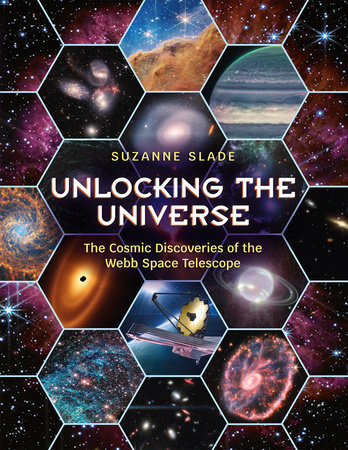
Unlocking the Universe has been named:
- Junior Library Guild Selection
- NSTA 2025 Best STEM Book
- New York Public Library Best Books for Kids
Plus, you can watch a goose-bump inducing book trailer here.
And now, let’s launch into the interview!
Emily Starr: I’ll start with the obvious. The Webb images are breathtaking! What was your involvement in choosing which images to include?

Ring Nebula
Suzanne Slade: I started writing this book before Webb had released any space images, so it was super exciting when its first image, a gorgeous galaxy cluster, was unveiled on July 11, 2022. After that, I waited with bated breath for each new spectacular image.
I wanted the book to share a variety of Webb space images, such as nebulas, galaxies, dying stars, nurseries where stars were being born, and more. For example, this image of the Ring Nebula (left) revealed new details of a dying star at the center that gives us a glimpse of what could happen to our Sun. (But nobody panic. The Sun has billions of years left!)
To be honest, there were so many gorgeous images that it was excruciating to decide which ones would make the cut. Near the end of the project, we did manage to squeak in some extra ones on the cover montage, in the back matter pages, and in the end sheets.
Emily Starr: This month, the blog is helping readers explore radio/UV waves and applied physics. Physics concepts can sometimes seem difficult and complicated to children (and some adults!) – like the electromagnetic spectrum. What are your considerations when thinking about how to make advanced science easy for kids to understand?
Suzanne Slade: There are many things to consider when writing about complex science topics for children. Here are a few I implemented in this book.

James Webb Space Telescope
Near the beginning of the book some basic science/space terms are defined within the text, such as “nebula” and “exoplanet,” to help readers ramp up on the topic.
Sidebars with colorful infographics helped explain more complicated topics (like the electromagnetic spectrum.)
As we know, a picture is worth a thousand words. So we made the decision to use photos, instead of illustrations, for the entire book. As I poured through hundreds of potential photos to show readers how the Webb telescope was designed and built, I carefully selected interesting ones that would draw the reader in.

Two page spread showing the Webb Space Telescope’s primary mirror
I also looked for photos which shared bits of information not covered in the text. For example, the book explains how Webb’s large primary mirror, which collects distant light in space, is made up of 18 hexagonal shaped gold panels. The photos in the spread at the left show how the panels are assembled into the primary mirror plus more, such as the size of the mirror relative to the workers, the precise way the panels fit together, how the workers and many components were protected from dust contamination, etc.
Emily Starr: Small blocks of layered text also make the book very accessible to younger readers. How did that format come about?
Suzanne Slade: The design layout, which includes the layered text you mention, was a collaborative effort between myself, the editor, and the spectacularly creative book designer. We tried a few different ideas before arriving at the book’s final design. One fun aspect about creating this book, which is not common in most book projects, was that I was able to meet with the editor and book designer in person can discuss the layout. Fortunately, I live north of Boston part-time, and the publisher, Charlesbridge, is located in Watertown near Boston.
Emily Starr: What was your process for contacting experts and conducting interviews at NASA? Was the agency receptive and helpful?
Suzanne Slade: It can be challenging to know who to contact at NASA or other agencies when working on science books, and these smart experts are very busy people. As luck would have it, one of my high school acquaintances, Dr. Jonathan Gardner, is the Deputy Senior Project Scientist for the JWST. I reached out to him, and he kindly agreed to answer questions and vet the manuscript, which was extremely helpful. I had worked with a NASA engineer, Sandra Irish, on a previous project. She was enthused about this book topic and happy to share her expertise. There are also great online interviews which were helpful as well.
Emily Starr: The JWST was such a long and complicated project that I’m sure you sifted through piles of research. How did you decide what details to include in the book?
Suzanne Slade: I could write volumes about research and the difficult process of deciding which information to include in a book and what seems best to leave out. The short answer is: I try to include some content that readers can easily understand or may already be familiar with, along with new information that will expand their understanding of the topic and hopefully inspire them to want to learn even more. I prioritize facts and random information nuggets I feel young readers will find fascinating.

Orion Bar
Emily Starr: As an educator who teaches students to expect and even celebrate failures, I appreciated the section about testing and setbacks. Why was it important to you to include those details?
Suzanne Slade: I’m a mechanical engineer who used to work on rockets and car braking systems, so I understand a big part of engineering and science is trial and error, or mistakes and re-designing. I think it’s important for readers to understand that progress in science is built on failures. As a storyteller, I also know that a happy ending is more satisfying when the journey to get there was filled with challenges that needed to be overcome.
Emily Starr: Many of your books delve into interesting space-related topics. What do you hope readers understand about space by reading your work?
Suzanne Slade: Basically I hope they catch a glimpse of the enormity of space, and the many mysteries and unanswered questions about our cosmos we have yet to understand. I’d also be pleased if my books inspire readers to pursue their dreams of a career in a space related field, such as a researcher, teacher, engineer, explorer, or citizen scientist.
Emily Starr: Are you working on other space-related projects in the near future? (Actually, we would be happy to learn about any of your upcoming projects!)
Suzanne Slade: In celebration of the 50th anniversary of the first moon landing, I wrote Countdown: 2979 Days to the Moon and Daring Dozen. Since then, I’ve been thinking about the many talented women who made the Apollo missions possible. So I wrote a book about the sharp, dedicated women who helped engineer, stitch, design, plan, and execute the Apollo moon missions. Of course, thousands of women worked on those missions, so it was difficult to decide how many women to feature. In the end, I decided to share the stories of twelve women to mirror the twelve men who’ve walked on the moon so far. This exciting book, titled Women on a Mission, releases in October 2025. I can’t wait!
 Sibert Honor author Suzanne Slade has written more than 150 children’s books. As a mechanical engineer who worked on rockets, many of her titles are about space and women in STEM. Some recent titles include The Universe and You, Mars Is: Stark Slopes, Silvery Snow, and Startling Surprises, June Almeida, Virus Detective!, The Woman Who Discovered the First Human Coronavirus, and A Computer Called Katherine: How Katherine Johnson Helped Put America on the Moon (NSTA Best STEM Book). Her title, Astronaut Annie, soared to the ISS and was read by astronaut Anne McClain for Story Time From Space.

As a former fourth grade teacher and founder of StarrMatica, a STEM publishing company, Emily Starr has developed award-winning K-5 science curriculum and professional learning materials for 20 years. She is a member of the Iowa State Science Leadership Team, a peer reviewer for the National Science Teaching Association’s journal Science and Children, and a frequent presenter at state and national education conferences. Her debut middle grade nonfiction book will be released in 2025 from the Iowa Ag Literacy Foundation.


 Janet Slingerland is the author of more than 20 books for young readers. To find out more about Janet and her books, check out