
Math

STEM Tuesday– Math– In the Classroom


What’s the story of math? It’s more than logical equations, patterns, and exact answers. These STEM Tuesday books tell of math’s history, its use, and how it integrates into the lives of fictional characters. Bring the story of math into the classroom with these fun activities.


A Quick History of Math

by Clive Gifford, illustrated by Michael Young

This book chronicles the history of math, beginning with the Lebombo bone (the very first mathematical object in the world) all the way to the present day. Readers will learn how to count like an Egyptian using hieroglyphs and how to do matha-magic with magic squares. It’s fun and engaging, and also packed with jokes, graphics, and activities.


Classroom activity: Reenact the history of math with micro-performances in the classroom. Have students research a moment of math history from the book. Then ask them to create a little skit to act out that moment. Some examples could be:

  • An Ancient Egyptian store where the cashier adds up purchases using heiroglyphs
  • Be a Babylonian math teacher and teach the class to add
  • Host a Chinese magic squares game show
  • Stage a short counting story play using Mayan math

Encourage students to create visuals, add math jokes, and interact with their audience. See how creative they can be!


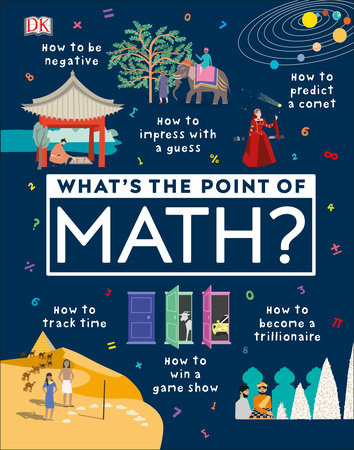
What’s the Point of Math? What's the Point of Math? by DK
by DK

What’s the Point of Math? not only highlights how math is all around us, but also,that math is fun. Through a slew of fun facts, magic tricks, and mathematical brainteasers, readers will be entertained while they learn. The book also touches on the history of math as well as bios of famous mathematicians.


Classroom activity: Pick a famous mathematician from the book to write about. Have students research their mathematician and write a short biography of that person. Ask them to find photos or images to go along with parts of their bios. Encourage students to write interesting hooks at the beginning of their bios and titles for their biographies.


Much Ado About Baseball

Much Ado about Baseball

by Rajani Larocca

Although this is fiction, Much Ado about Baseball is a stellar book. To be clear, it doesn’t specifically teach readers about mathematical concepts, but the narrative connects to math in many ways. For example, twelve-year-old protagonist Trish is able to solve tough math problems and loves baseball. When she moves and joins a new baseball team, they must solve a difficult puzzle or there will be tragic consequences.


Classroom activity: Part of writing fiction is developing characters. Ask students to develop a math-loving character. They should write descriptions of the character and how math is part of their lives. Pose these prompts: What kind of personality does this person have? What do they look like? What kind of math goals do they have? What are their strengths and weaknesses? Have students create posters with an image of their character, their character’s name, and a description of what they are like.


Karen Latchana Kenney loves to write books about animals, and looks for them wherever she goes—from leafcutter ants trailing through the Amazon rain forest in Guyana, where she was born, to puffins in cliff-side burrows on the Irish island of Skellig Michael. She especially enjoys creating books about nature, biodiversity, conservation, and groundbreaking scientific discoveries—but also writes about civil rights, astronomy, historical moments, and many other topics. Visit her at https://latchanakenney.wordpress.com

STEM Tuesday– Math – Book List


Math really is everywhere we look: from the geometry of nature to the physics of a jump shot. This month’s book list showcases the incredible world of mathematics.


It’s A Numbers Game! Basketball (part of “It’s a Numbers Game!” series)

by James Buckley Jr for National Geographic

Children may not realize it at first, but numbers play an important role in basketball. Math and numbers dominate this sport, from the dimensions of the court to the number of seconds NBA players have to score a basket. This is a fun book filled with math facts pertaining to basketball, colorful graphics, and sports trivia. It also includes a Foreword by the legendary Kobe Bryant.


A Quick History of Math

by Clive Gifford, illustrated by Michael Young

This book chronicles the history of math, beginning with the Lebombo bone (the very first mathematical object in the world) all the way to the present day. Readers will learn how to count like an Egyptian using hieroglyphs and how to do matha-magic with magic squares. It’s fun and engaging, and also packed with jokes, graphics, and activities.


What’s the Point of Math? What's the Point of Math? by DK

by DK

What’s the Point of Math? not only highlights how math is all around us, but also,that math is fun. Through a slew of fun facts, magic tricks, and mathematical brainteasers, readers will be entertained while they learn. The book also touches on the history of math as well as bios of famous mathematicians.


Much Ado About Baseball

Much Ado about Baseball

by Rajani Larocca


Although this is fiction, Much Ado about Baseball is a stellar book. To be clear, it doesn’t specifically teach readers about mathematical concepts, but the narrative connects to math in many ways. For example, twelve-year-old protagonist Trish is able to solve tough math problems and loves baseball. When she moves and joins a new baseball team, they must solve a difficult puzzle or there will be tragic consequences.


The Wacky and Wonderful World Through Numbers 

by Steve Martin, Clive Gifford, and Marianna Taylor


This book will likely entice readers with its wacky and fascinating facts that show how math is all around us. For example, honeybees must visit 2 million flowers to make about a pound of honey. It is a wealth of fun and interesting information presented in a well-organized, engaging way with over 60 different topics to choose from.


The School of Numbers

by Emily Hawkins & Daniel Frost

Young readers (and aspiring space cadets) will embark on an intergalactic mathematical journey as they make their way through this interactive book. Its 40 lessons are narrated by six “professors” from the fictional Astro Academy, covering topics like negative numbers, fractions, angles, statistics, and more. Along the way, the professors provide clear explanations of math concepts, handy tips and timesavers, and plenty of activities for practice.


Sir Cumference Math Adventures 

by Cindy Neuschwander and Wayne Geehan

This delightful, punny series features the brave knight Sir Cumference, his wife, Lady Di of Ameter, and their son, Radius. The noble family uses math to solve all sorts of problems that threaten King Arthur’s kingdom, from fire-breathing dragons to ogre kidnappers to enemy armies. Along the way, they unlock the mysteries of geometry, decimals, and data visualization.


The Kitchen Pantry Scientist Math for Kids [Book]

The Kitchen Pantry Scientist Math for Kids 

by Rebecca Rapaport and Allanna Chung, photos by Glenn Scott, illustrations by Kelly Anne Dalton

Equal parts history and “how-to,” this engaging book encourages kids to follow in the footsteps of incredible mathematical pioneers. It presents 20+ short biographies of influential mathematicians, from Federico Ardila to Florence Nightingale to Maryan Mizakhani. Each profile is accompanied by a hands-on activity related to the mathematician’s work. With magic tricks, games, and crafts galore, Rappaport and Chung bring abstract math topics to life.


Dollars & Sense: A Kids’ Guide to Using – Not Losing– Money

by Elaine Scott & David Clark

This primer explores history of money and banking, particularly within the US. After tracing the development of various currency and banking systems, it discusses the impacts of The Great Depression and The Great Recession and ends with some helpful hints about saving and budgeting. Overall, this is a great introduction and discussion starter for kids who are starting to think critically about their own values and habits about money.


The Big Fat Middle School Math Workbook

by Workman Publishing and the Editors of Brain Quest

This handy homework helper is packed full of lessons, definitions, study hacks, and hundreds of practice problems. Its layout is clear and straightforward, so students can jump to any topic and dive right in. The answer key at the back of the book not only provides the right answers but also explains how to solve each problem.


________________________________________________

This month’s STEM Tuesday book list was prepared by:

Author Lydia Lukidis

Lydia Lukidis is the author of 50+ trade and educational books for children. Her titles include DANCING THROUGH SPACE: Dr. Mae Jemison Soars to New Heights (Albert Whitman, 2024), DEEP, DEEP, DOWN: The Secret Underwater Poetry of the Mariana Trench (Capstone, 2023) and THE BROKEN BEES’ NEST (Kane Press, 2019) which was nominated for a Cybils Award. A science enthusiast from a young age, she now incorporates her studies in science and her everlasting curiosity into her books. Another passion of hers is fostering a love for children’s literacy through the writing workshops she regularly offers in elementary schools across Quebec with the Culture in the Schools program. For more information, please visit www.lydialukidis.com.


author Callie DeanCallie Dean is a researcher, writer, and musician living in Shreveport, LA. She writes stories that spark curiosity and encourage kids to explore their world. Follow her on Twitter at https://twitter.com/CallieBDean.


STEM Tuesday – Shining the Light on Technology, Engineering, and Math — Interview with Author Elizabeth Rusch

STEM TUESDAY from the mixed up files

Welcome to STEM Tuesday: Author Interview & Book Giveaway, a repeating feature for the fourth Tuesday of every month. Go Science-Tech-Engineering-Math!

Today we’re interviewing Elizabeth Rusch! She’s the author of this month’s featured technology/engineering book, The Next Wave: The Quest to Harness the Power of the OceanThis fascinating installment in Houghton Mifflin Harcourt’s Scientists in the Field series tackles the engineering challenge of turning ocean waves into useable electricity. As Horn Book‘s glowing review explains, “Rusch fully explores the engineering process, capturing the determined, entrepreneurial spirit of the profiled engineers as well as the need for creative problem-solving and ingenuity, a test-and-retest mentality, a high tolerance for failure, and perseverance through the quest for research funding.” The Next Wave received starred reviews from both Kirkus and School Library Journal.

Mary Kay Carson: Why did you decide to write The Next Wave?

Elizabeth Rusch: I keep a folder of clippings of newspaper and magazine articles that interest me. Once in a while, I read through them to see if there are any topic hiding in there that I might want to cover. About ten years ago I found that I had clipped a bunch of articles on scientists developing these cool devices to harness the movement of ocean waves and turn it into electricity. One Oregon scientist Annette von Jouanne was not only inventing clever devices but also finding ways to support other engineers and inventors in their work. I thought she would be a perfect place to start. I interviewed her and accompanied her as she tested a new device that bobbed up and down in the water and wrote an article about her work for Smithsonian magazine. As I was reporting and writing that piece, a little voice kept saying: Kids would find this fascinating – they love the beach, the ocean, invention, and environment. So I expanded my research to include the stories of other ocean energy inventors, such as “The Mikes” —Mike Morrow and Mike Delos-Reyes—childhood friends who were developing and refining a device that sits on the ocean floor that they first designed in college.

MKC: What was writing about engineering like?

Elizabeth: I loved covering a new, evolving renewable energy field. Engineers have already pretty much figured out great ways to harness solar and wind energy but ocean energy was and is still wide open. We don’t yet know the best way to take the up and down motion of waves and turn it into electricity. That means that all devices being invented and tested are wildly different. So I got to witness history in the making. Mike Morrow invited me to his lab, which was big cluttered shed in his backyard. It was like being in the garage with Steve Jobs as he invented his computer. I also observed tests in these huge wave flumes and basins and out the open ocean. Each test was really suspenseful because no one knew how the devices would perform. So I was crossing my fingers and cheering right along with the engineers.

Download an accompanying Common Core Guide and Discussion and Activity Guide for The Next Wave.

MKC: Are STEM topics especially interesting to you?

Elizabeth: I don’t actively set out to write STEM books. I am drawn to important, compelling stories that have been overlooked – and it just so happens that many of those stories are in STEM fields. I love stories of invention because they are at their core stories of the human spirit and our quest to understand the world and solve problems we face. To me, inventing something is essentially an adventure requiring creativity and heroic effort in the face of daunting obstacles. A fun example is my recent book The Music of Life: Bartolomeo Cristofori and the Invention of the Piano. While it is a picture book biography about music and history, I was delighted to see it was named a Best STEM Trade Book by NSTA-CBC.  So I guess what I’m saying is that to me STEM is just in integral part of the human story – and I love telling human stories.
Win a FREE copy of The Next Wave!

Enter the giveaway by leaving a comment below. The randomly-chosen winner will be contacted via email and asked to provide a mailing address (within the U.S. only) to receive the book.

Good luck!

Your host this week is Mary Kay Carson, fellow science nerd and author of Mission to Pluto and other nonfiction books for kids. @marykaycarson