It’s the month of Groundhog Day and Valentine’s Day and many new great books for middle grade readers!
Courage Has No Color, The True Story of the Triple Nickles by Tanya Lee Stone

They became America’s first black paratroopers. Why was their story never told? Sibert Medalist Tanya Lee Stone reveals the history of the Triple Nickles during World War II.
World War II is raging, and thousands of American soldiers are fighting overseas against the injustices brought on by Hitler. Back on the home front, the injustice of discrimination against African Americans plays out as much on Main Street as in the military. Enlisted black men are segregated from white soldiers and regularly relegated to service duties. At Fort Benning, Georgia, First Sergeant Walter Morris’s men serve as guards at The Parachute School, while the white soldiers prepare to be paratroopers. Morris knows that for his men to be treated like soldiers, they have to train and act like them, but would the military elite and politicians recognize the potential of these men as well as their passion for serving their country? Tanya Lee Stone examines the role of African Americans in the military through the history of the Triple Nickles, America’s first black paratroopers, who fought in a little-known attack on the American West by the Japanese. The 555th Parachute Infantry Battalion, in the words of Morris, “proved that the color of a man had nothing to do with his ability.”
Beholding Bee by Kimberly Newton Fusco

Bee is an orphan who lives with a carnival and sleeps in the back of a tractor trailer. Every day she endures taunts for the birthmark on her face—though her beloved Pauline, the only person who has ever cared for her, tells her it is a precious diamond. When Pauline is sent to work for another carnival, Bee is lost.
Then a scruffy dog shows up, as unwanted as she, and Bee realizes that she must find a home for them both. She runs off to a house with gingerbread trim that reminds her of frosting. There two mysterious women, Mrs. Swift and Mrs. Potter, take her in. They clothe her, though their clothes are strangely out of date. They feed her, though there is nothing in their house to eat. They help her go to school, though they won’t enter the building themselves. And, strangely, only Bee seems able to see them.
Whoever these women are, they matter. They matter to Bee. And they are helping Bee realize that she, too, matters to the world–if only she will let herself be a part of it.
This tender novel beautifully captures the pain of isolation, the healing power of community, and the strength of the human spirit.
The Whole Story of Half a Girl by Veera Hiranandani

What greater praise than to be compared to Judy Blume!–“Each [Blume and Hiranandani] excels in charting the fluctuating discomfort zones of adolescent identity with affectionate humor.”–Kirkus Reviews, Starred
After her father loses his job, Sonia Nadhamuni, half Indian and half Jewish American, finds herself yanked out of private school and thrown into the unfamiliar world of public education. For the first time, Sonia’s mixed heritage makes her classmates ask questions—questions Sonia doesn’t always know how to answer—as she navigates between a group of popular girls who want her to try out for the cheerleading squad and other students who aren’t part of the “in” crowd.
At the same time that Sonia is trying to make new friends, she’s dealing with what it means to have an out-of-work parent—it’s hard for her family to adjust to their changed circumstances. And then, one day, Sonia’s father goes missing. Now Sonia wonders if she ever really knew him. As she begins to look for answers, she must decide what really matters and who her true friends are—and whether her two halves, no matter how different, can make her a whole.
Hattie Ever After by Kirby Larson and Kirsten Potter
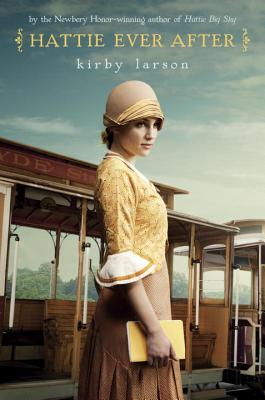
After leaving Uncle Chester’s homestead claim, orphan Hattie Brooks throws a lasso around a new dream, even bigger than the Montana sky. She wants to be a reporter, knowing full well that a few pieces published in the Arlington News will not suffice. Real reporters must go to Grand Places, and do Grand Things, like Hattie’s hero Nellie Bly. Another girl might be stymied by this, but Hattie has faced down a hungry wolf and stood up to a mob of angry men. Nothing can squash her desire to write for a big city newspaper. A letter and love token from Uncle Chester’s old flame in San Francisco fuels that desire and Hattie jumps at the opportunity to get there by working as a seamstress for a traveling acting troupe. This could be her chance to solve the mystery of her “scoundrel” uncle and, in the process, help her learn more about herself. But Hattie must first tell Charlie that she will not join him in Seattle. Even though her heart approves of Charlie’s plan for their marriage, her mind fears that saying yes to him would be saying no to herself. Hattie holds her own in the big city, literally pitching her way to a byline, and a career that could be even bigger than Nellie Bly’s. But can making headlines compensate for the pain of betrayal and lost love? Hattie must dig deep to find her own true place in the world. Kirby Larson once again creates a lovingly written novel about the remarkable and resilient young orphan, Hattie Inez Brooks.
The Apothecary by Maile Meloy

It’s 1952 and the Scott family has just moved from Los Angeles to London. Here, fourteen-year-old Janie meets a mysterious apothecary and his son, Benjamin Burrows – a fascinating boy who’s not afraid to stand up to authority and dreams of becoming a spy. When Benjamin’s father is kidnapped, Janie and Benjamin must uncover the secrets of the apothecary’s sacred book, the Pharmacopoeia, in order to find him, all while keeping it out of the hands of their enemies – Russian spies in possession of nuclear weapons. Discovering and testing potions they never believed could exist, Janie and Benjamin embark on a dangerous race to save the apothecary and prevent impending disaster.
Together with Ian Schoenherr’s breathtaking illustrations, this is a truly stunning package from cover to cover.
The Fourth Stall Part III by Chris Rylander

Their business is finished, and Mac’s and Vince’s lives have become something they have never been before: simple. None of the fortune or the glory, none of the risk or the threat of juvenile prison. There’s even a new business that has stepped in to take their place (and take the heat off Mac and Vince for once). Things couldn’t be better.
But that was before things at their middle school started to go haywire. Before they found out that there’s a new crime boss at a school another town over trying to consolidate power. And before their old nemesis, Staples, came back to town begging for help after his stint in the clink. Just when Mac and Vince thought they were out, the business pulls them back in. But this time, will they be able to escape with their lives and their permanent records intact?
Traitor in the Shipyard: A Caroline Mystery (American Girl Mysteries) by Kathleen Ernst and Sergio Geovine
The Quilt Walk by Sandra Dallas

Based on a real-life incident in Colorado history, this spellbinding story is by the “New York Times”-bestselling author of the adult titles “The Bride’s House” and “Prayers for Sale.”



