Author Interviews

How to write (or be) funny

When I think funny, and in particular, funny middle grade novels, the first character I think of is

Charlie Joe Jackson.

Charlie Joe belongs to Tommy Greenwald, who is also pretty funny. When his first book, Charlie Joe Jackson’s Guide to Not Reading was released, I interviewed him HERE. (For a while, after I posted that interview, people thought I was funny, too!)

Well…..now Charlie Joe is BACK with Charlie Joe Jackson’s Guide to Extra Credit. And I am still laughing. But now I want to know more.

Because, like a lot of writers, I would really like to know how to write funny, So, instead of an interview, I thought I would ask Tommy to share some of his secrets.

Because he is very funny.

And generous.

Or maybe he wants a favor from me.

Because he did it!

Are you ready to learn? Because here he is:


Write my blog post, Tommy!!!!!

(no problem, Sarah!)

People always ask me how am I able to write such funny books.


Then they realize I’m not who they thought I was, and they give me a slightly embarrassed look and walk away.


I think that may be what happened with Sarah, the nice woman who asked me to write this blog. (note from Sarah: flattery may not be funny, but it gets you everywhere!!) But the difference is, she asked me over email, so she can’t tell that I’m not the person she thought I was. And if she’s walking away embarrassed, I can’t see her.


So I’m writing the blog anyway. Just try to stop me.

How do you write funny? Wow, that’s a really good question. It’s kind of like asking, How do you BE funny? There’s no real answer. There are just a few tidbits, hints, suggestions, guidelines, bits of nonsense and wild guesses that I can share. It might help you. But it probably won’t.


  1. Don’t overdo it. I learned this the hard way, when I was starting out with my writing, and trying to make every situation hilarious and ridiculous and side-splitting. That just ended up making my writing completely overwrought. Keep the humor subtle, sly and surprising. Let it sneak up on you while you’re writing, and it will sneak up on the reader too. (In a good way, not in an “intruder in your house” kind of way.)
  2. Don’t underdo it. Don’t be so subtle, sly and surprising that no one gets what you’re trying to do. There’s nothing wrong with a good, solid gastro-intestinal joke every forty-seven pages.
  3. Let the characters be funny. I’m not sure this one makes sense, but I’ll say it anyway. Your job isn’t to be funny. It’s to make sure the characters are funny. The sense of humor has to be theirs, not yours. Don’t show the world how funny you can be. Show the world how funny your characters can be.
  4. Let the comedy breathe. Meaning, when something funny just happened in your writing, let the reader enjoy it for a little while. Don’t be in a rush to be funny again immediately. Take your time, get into a nice rhythm, relish in the chuckle you’re getting, then go in for the kill again a page or two later.
  5. POV. Make sure your characters have a distinct personality and point-of-view right away, complete with quirks. If the reader knows that the main character is a sarcastic, somewhat obnoxious book-hater right off the bat, then the reader knows some hopefully-entertaining commentary and situations will result.
  6. First Person rocks. I’m a huge fan of writing in a character’s voice. I’m not saying it’s for everyone, but I’ve found it’s a lot easier to make a character funny when he’s able to offer snarky asides and then get completely humiliated directly to, and in front of, the reader.
  7. Do what comes naturally. Every writer has their wheelhouse. For me, it’s writing humor. The idea that I could write a complicated dystopian romance is comical in its own right. Not a snowball’s chance in Phoenix. But I can write funny, so I go with it. Write to your strength. It’s impossible to force the funny.
  8. Eat a ton of chocolate and play with your dogs a lot. That’s what I do, anyway. (note from Sarah: FINALLY! something I can do!!!)


So, there you have it. My non-rules for writing humor. Follow them at your own risk. Except for the gastro-intestinal joke thing. That’s a must.


Thank you, Tommy!

You’re welcome, Sarah!

READERS: if you want a good laugh,

and we KNOW you do…..

check out Charlie Joe Jackson’s Guide to Extra Credit. If you would like people to look at you funny, read Charlie Joe Jackson’s Guide to Extra Credit IN PUBLIC! It’s a fun book.

(Just don’t drink anything while you’re reading. If you know what I mean!)

And don’t forget….if you have a question for Tommy….or you want to try making him (or me) laugh, post a comment!!! 

Sarah Aronson is the author of books with mostly subtle humor. (Another way of saying: not really all that funny. But still good. Just not all that funny.)


The Marble Queen – Interview with Stephanie J. Blake

For the past seven years, I’ve been celebrating the highs and lows of writing with my friend, Stephanie J. Blake. I’ll never forget the day she took us all by surprise and announced her book deal, not too long after she had announced that she was taking a break from writing to try out some other ventures. Most of us travel a bumpy road to publication and we learn to accept that the bumps are just part of the process. But Stephanie’s writing travels have been filled with twists and turns, and even an occasional cliffhanger.

At last, I am excited that we are now here to talk about Steph’s arrival at her first destination, a debut novel titled The Marble Queen, published by Amazon Children’s Publishing. The following description comes from Amazon.

Freedom Jane McKenzie isn’t good at following the rules. She doesn’t like any of the things that girls are supposed to like. She’s good at fishing, getting into trouble—and playing marbles. All she wants is to enter the marble competition at the Autumn Jubilee and show the boys in the neighborhood that she’s the best player. If she can’t be the Marble King, then she’ll be the Marble Queen. First, Freedom has to convince her mother to let her enter. But there’s a new baby on the way, Freedom’s daddy is drinking too much, her little brother is a handful, and her mother is even more difficult than usual. Freedom learns that when it comes to love, friendship, and family, sometimes there are no rules. Set in 1959, The Marble Queen is a timeless story about growing up.

Welcome to The Mixed-Up Files, Steph! Before we talk about your journey to publication, I’d like to know a little more about The Marble Queen which takes place in 1959. What kind of research did you do to learn about what life would be like for a young girl during that time?

Since 1922, hundreds of kids have competed (and still do) in the National Marbles Tournament, now held in Wildwood, New Jersey. Mibsters can win prizes and college scholarships. How cool is that?  I was inspired to write The Marble Queen after reading an article about a group of old men who were crowned Marble Kings as children. These men felt that playing marbles had changed their lives for the better. In 1948, sponsors started crowning a boy and a girl. A book idea was born. One problem, I knew virtually nothing about marble shooting. I took some liberties with the time frame in the book because I wanted to explore the gender roles of girls and women during the late fifties. I had a lot of fun teaching myself how to shoot and play Ringer, the marble game featured in the book. I’ve been collecting marbles from antique stores. I also learned a lot about the fifties. I ate SPAM. I watched tons of old commercials and television shows. I listened to Elvis.

Was the character of Freedom based on anyone you know?

The main character, Freedom, is the daughter I’ll never have, and she is a bit like me when I was a kid—independent, stubborn, strong-willed. The incident in church with the thimble is familiar. My mother used to thump us when we acted up. Also, I actually fed my little brother a worm once. We were going to name our last child Freedom Jane, but he happened to be a boy.

How did you know you were meant to be a writer?

In 6th grade, I decided I was going to become a writer. I kept a journal and read everything I could get my hands on. In high school, I had reported news and sports for my hometown newspaper. My first college major was journalism. I fancied myself the next Dianne Sawyer. I got a B.A. in English. My first creative publication credit was a poem in the college literary magazine. My father couldn’t understand why I didn’t get a teaching certificate. I told him I was going to be a writer! And I was/am. I wrote employee handbooks and policies & procedures for several years in the telecom field. I also worked on short stories and poetry. A few years into staying home with my boys, I started a cheesy romance novel, but quickly abandoned it for picture books. In 2006, I got serious about publication. Wrote a novel for middle grade boys. Came close, had an agent, but no offers.

Was there ever a moment when you thought you’d made a mistake about choosing to write?

I had just finished a new manuscript (ironically it was The Marble Queen), when I was abruptly dumped by my first agent. I worked with two other agents on another manuscript over two years, but nothing happened.

Agent after agent rejected The Marble Queen—17 in all. “Too quiet.” 13 publishers rejected it. I figured it was never going to happen for me. I gave up, went back to school, and earned a phlebotomy certificate. I was working at a hospital, drawing blood, when I got an offer on The Marble Queen.  The manuscript had been in a slush pile for a year! I quit that job two weeks later and haven’t looked back.

What has been one of the highest moments in your writing career?

The absolute best day was “The Call!” Of course, there have been some fairly awesome days since…depositing the advance check, squealing over cover art, seeing the printed ARC, seeing the pre-order go up on Amazon, and I’m starting to plan the launch party.

What has been one of the lowest moments?

Oh, the agony of trying to get published; don’t we all know it well? Honestly, some of my biggest challenges to date happened during revisions. I cried, I ranted, I worried, but it’s made the book stronger.

You strike me as a really strong-willed and tough person, a lot like your character Freedom. During the moments when the business side of writing becomes a drag, how do you stay motivated?

Well, thank you. I am unagented right now, so I’m going at this next part of the journey alone. I have not been assigned a publicist or given a big marketing plan, but I was given 25 ARC’s, and I am trying to place each one where it will get the most bang for its buck. I have created a school visit packet, a book club packet, bookmarks, bookplates, a website, etc. I have reached out to my local bookstores, libraries, and local media outlets.

I don’t write every day, but I do try to “work” an hour or so a day, whether it’s catching up on Facebook or Twitter, reading, research, etc. I need to get better at turning off the noise of the internet. I work better on deadline right now.

Your book was originally sold in June 2010 to Robin Benjamin at Marshall Cavendish. Then, in December, Marshall Cavendish was bought out by Amazon Publishing. Can you tell us what that process was like and what it means to you and The Marble Queen?

I found out along with the rest of the world that my original publisher had sold its children’s titles to Amazon. My heart fell out of my butt, if you want the truth. I was afraid that my little book would be swallowed whole by a big corporation. Turns out, the only thing that has really changed is the name of the publishing company. I don’t know what any of it means, except that the book will also be available for the Kindle, as well as hardcover and audio. I hope the book will be reviewed and makes its way into bookstores, but I don’t know, yet.

Do you have plans for your next book?

My editor is reading my option book, a contemporary middle grade with touches of magical realism. I’m keeping that one a secret for now. The main character’s name is Liberty. I am also working on a companion novel to The Marble Queen, which will be little sister Barbara’s story, set in 1971.

When can we get our hands on The Marble Queen?

Amazon is releasing all three versions on December 18, 2012: Hardcover, audio, and Kindle. They are available for pre-order. www.themarblequeen.com

To celebrate my birthday, Sept 24th, I would like to give away one Marble Queen ARC to a random commenter below.

That’s awesome! It’s your birthday and you’re offering our readers a chance at a free gift. Thanks, Steph. And thanks for dropping by for an interview. I hope you have a fantastic birthday!

So, readers, like Stephanie said, leave a comment below and I will draw a random name for an ARC (Advanced Reading Copy) of The Marble Queen. The winner will be announced on Sunday, September 30.

Trudi Trueit—Interview and Giveaway

Joining us on The Mixed-up Files today is author Trudi Trueit who has been on the road all week visiting blogs in support of her new tween novel Stealing Popular. Trudi is the author of more than 80 books of fiction and nonfiction for children, including the Julep O’Toole books and the Secrets of a Lab Rat series. To be in the running to win a signed advanced reader’s copy of Stealing Popular, leave a comment below. The winner will be announced tomorrow. Before we begin, though, a bit about the book from Indiebound:

At Briar Green Middle School, you are either a Somebody, a Sorta-body, or a Nobody. Twelve-year-old Coco Sherwood falls directly in the Nobody category—the kids who are considered the misfits and outcasts of the school. It’s not fair. It’s not right. And it’s time to even the score.

With clever planning and sneaky tactics, Coco becomes the Robin Hood of Briar Green. Girls who never thought they had a chance to be noticed are now making cheer squad and turning into beauty queens. But when Coco takes on the ultimate challenge—taking down Popular Girl#1 Dijon Randle—her dream of equality on the middle-school social ladder may turn into a nightmare. Can Coco and the rest of the Nobodies triumph in a world where popularity is power? Or will the Somebodies win—again?

Welcome to the Mixed-up Files, Trudi, and congratulations on the release of your new book.

Thanks, Laurie! It’s a treat to be here. I’m a big fan of the blog.

Thanks! I wish I’d had a friend like Coco Sherwood when I was in middle school. Actually—correction—I wish I’d been more like Coco when I was in middle school. Can you tell us what inspired her story?

Me, too! I was inspired to write this story by my own experience in middle school. When I was young, I was bit on the shy side. I often conformed to the social rules set by others, even when I disagreed with them. It’s something I’ve regretted – giving other people so much control over my path, and that’s what it was. It was me giving my power away. I wanted to write a character with the courage to say many of the things I wished I had said back then. I tend to do that in my writing; deal with issues I didn’t handle well in my own life or try to right the wrongs of the world.

5th Grade Trudi!

One of my favorite lines comes from Chapter 2. Coco reflects, “We were three Nobodies treading water in the vast, stormy ocean of middle school. The best we could do was hold onto one another, kick like mad, and pray for a miracle.”  What was your experience of middle school like? Do you think the social hierarchy has changed much?

That line reflects how I felt in middle school – swept along with the tide. I was the A-student (with glasses and uncooperative hair) that always had her head in a book. Although I wasn’t quite as much of a misfit as Renata is in Stealing Popular, I certainly felt the sting of the occasional insult. Kids have a tendency to take digs at each other and not think anything of it, but I can tell you that when someone makes a cutting remark to you, it hurts. You remember it for a long time. If the insults continue, they can start to chip away at your confidence and self-esteem. It was my friends who helped me navigate some of those stormy seas, just as Coco’s first real friends help her discover how friendships can be the life saver you hold onto when the waves come.

From what I observe, it doesn’t seem like the social hierarchy has changed much. I think that there will always be Somebodies, Sorta-bodies, and Nobodies. But I do see more kids willing to cross boundaries and reach out to kids outside their circle, and that’s a positive step. I also think young people are becoming more aware that there are different degrees of bullying. Bullying doesn’t have to be extreme. What might seem to be “just teasing” can cause more pain than you realize.

Trudi today

Coco’s not a whiner. Once she recognizes the unfairness of the social order she’s determined to change it. In fact, she’s so focused on helping her friends she doesn’t even notice that she’s fixing her own problems as well. What a cool role model for girls! Were you thinking along those lines as you wrote the story – or was all of that Coco’s doing?

It was always in the big picture to have Coco work through some of her own issues even as she help other kids, but of course, once you start writing a strong character, she wants to hop in the driver’s seat and take off! Just like all of us, Coco wants to be accepted and loved for who she is and I had planned for her to come that realization as she develops the first real friendships of her life. What I was less sure about was how she would handle her mom’s abandonment. Once Coco came through the fog of denial, I gave her the freedom to respond in her own way. And she stunned me with her candor. I thought she would defend her mother to the bitter end, but she didn’t. That’s always my favorite part of writing – those little unexpected surprises that come straight from the heart of a character.

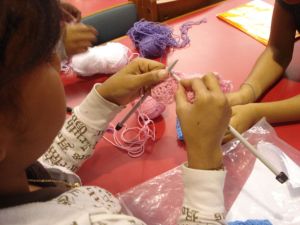
As funny as the story is — a detention monitor who forces kids to knit booties for her bulldogs! — Stealing Popular takes on some serious issues, including a scene where we see how adults help perpetuate the social order. My 8th grade daughter hadn’t given much thought to popularity or most-favored status until she tried out for her first sports team this year, and it’s been eye opening. What do you think teachers and coaches can do to help both the Coco’s (the Nobodies) and the Dijon’s (the Somebodies) of the world?

When I was in middle school, I had a soccer coach that had certain favorite players. There was a clear division on the team. Even though we were talented and won nearly all of our games, nobody was very happy, even the favored kids. I got so frustrated I nearly quit a sport I loved. A year later, another parent took over the team. Her style was completely the opposite of the old coach. She made each of us feel as if we were an integral part of the team. No one player was more or less valuable than another. We began to look at each other differently. With the wall torn down, we started, for the first time ever, to play cohesively. We had fun. Most important, we became friends.

I think it’s key for adults to recognize that a student’s personal growth is more important than winning a soccer game or looking like a model in a cheerleading uniform. Every child deserves encouragement, respect, and kindness, regardless of their ability, appearance, or social standing. Teachers and coaches who are inclusive, those who draw out the shy kid in the back of the room or let an uncoordinated girl play basketball, can change lives.

Coco’s heart is in the right place, but her means can be questionable…or downright stinky as a half-composted sweat sock. (Sorry guys, you’ll just have to read the story to get the joke.) Stealing Popular would make a great conversation starter about whether the ends justify the means. Have you been able to have that discussion with any of your readers yet?

I’ve had a few readers already share their thoughts, especially because Coco does get a bit carried away with her mission. And that’s an important element to discuss. Coco thinks that as long as her mission is a noble one, it’s okay to cross certain lines. It isn’t, of course, and she discovers the dangers of getting so focused on a goal you don’t realize the high price you are paying to achieve it.

I think a lot of girls are going to fall in love with Coco. Have we heard the last from her or will there be more stories from Briar Green Middle School – a.k.a. Big Mess?

I would LOVE to write more stories about Coco and her friends. It would be fun to write from the point of view of Fawn (the fashion designer), Adair (the dancer), Liezel (the rock musician) or maybe even the popular girls, Dijon or Venice! If readers want more and ask for more, I would definitely be up for it.

Sounds great, Trudi. Thanks again for stopping by.

Thanks, Laurie! It was my pleasure.

*  *  *

For more about Trudi Trueit, visit her at www.truditrueit.com. Trudi is available for Skype visits through OnlineAuthorVisits.com and is a regular contributor to Smack Dab in the Middle, another group-authored middle-grade blog that Mixed-up Files fans should check out.

Laurie Schneider is a reader, writer, library go-fer, and scone connoisseur in North Idaho.