
Posts Tagged parents

STEM Tuesday– Math– In the Classroom


What’s the story of math? It’s more than logical equations, patterns, and exact answers. These STEM Tuesday books tell of math’s history, its use, and how it integrates into the lives of fictional characters. Bring the story of math into the classroom with these fun activities.


A Quick History of Math

by Clive Gifford, illustrated by Michael Young

This book chronicles the history of math, beginning with the Lebombo bone (the very first mathematical object in the world) all the way to the present day. Readers will learn how to count like an Egyptian using hieroglyphs and how to do matha-magic with magic squares. It’s fun and engaging, and also packed with jokes, graphics, and activities.


Classroom activity: Reenact the history of math with micro-performances in the classroom. Have students research a moment of math history from the book. Then ask them to create a little skit to act out that moment. Some examples could be:

  • An Ancient Egyptian store where the cashier adds up purchases using heiroglyphs
  • Be a Babylonian math teacher and teach the class to add
  • Host a Chinese magic squares game show
  • Stage a short counting story play using Mayan math

Encourage students to create visuals, add math jokes, and interact with their audience. See how creative they can be!


What’s the Point of Math? What's the Point of Math? by DK
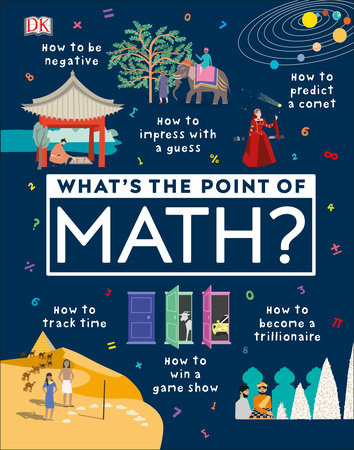
by DK

What’s the Point of Math? not only highlights how math is all around us, but also,that math is fun. Through a slew of fun facts, magic tricks, and mathematical brainteasers, readers will be entertained while they learn. The book also touches on the history of math as well as bios of famous mathematicians.


Classroom activity: Pick a famous mathematician from the book to write about. Have students research their mathematician and write a short biography of that person. Ask them to find photos or images to go along with parts of their bios. Encourage students to write interesting hooks at the beginning of their bios and titles for their biographies.


Much Ado About Baseball

Much Ado about Baseball

by Rajani Larocca

Although this is fiction, Much Ado about Baseball is a stellar book. To be clear, it doesn’t specifically teach readers about mathematical concepts, but the narrative connects to math in many ways. For example, twelve-year-old protagonist Trish is able to solve tough math problems and loves baseball. When she moves and joins a new baseball team, they must solve a difficult puzzle or there will be tragic consequences.


Classroom activity: Part of writing fiction is developing characters. Ask students to develop a math-loving character. They should write descriptions of the character and how math is part of their lives. Pose these prompts: What kind of personality does this person have? What do they look like? What kind of math goals do they have? What are their strengths and weaknesses? Have students create posters with an image of their character, their character’s name, and a description of what they are like.


Karen Latchana Kenney loves to write books about animals, and looks for them wherever she goes—from leafcutter ants trailing through the Amazon rain forest in Guyana, where she was born, to puffins in cliff-side burrows on the Irish island of Skellig Michael. She especially enjoys creating books about nature, biodiversity, conservation, and groundbreaking scientific discoveries—but also writes about civil rights, astronomy, historical moments, and many other topics. Visit her at https://latchanakenney.wordpress.com

STEM Tuesday– Math – Book List


Math really is everywhere we look: from the geometry of nature to the physics of a jump shot. This month’s book list showcases the incredible world of mathematics.


It’s A Numbers Game! Basketball (part of “It’s a Numbers Game!” series)

by James Buckley Jr for National Geographic

Children may not realize it at first, but numbers play an important role in basketball. Math and numbers dominate this sport, from the dimensions of the court to the number of seconds NBA players have to score a basket. This is a fun book filled with math facts pertaining to basketball, colorful graphics, and sports trivia. It also includes a Foreword by the legendary Kobe Bryant.


A Quick History of Math

by Clive Gifford, illustrated by Michael Young

This book chronicles the history of math, beginning with the Lebombo bone (the very first mathematical object in the world) all the way to the present day. Readers will learn how to count like an Egyptian using hieroglyphs and how to do matha-magic with magic squares. It’s fun and engaging, and also packed with jokes, graphics, and activities.


What’s the Point of Math? What's the Point of Math? by DK

by DK

What’s the Point of Math? not only highlights how math is all around us, but also,that math is fun. Through a slew of fun facts, magic tricks, and mathematical brainteasers, readers will be entertained while they learn. The book also touches on the history of math as well as bios of famous mathematicians.


Much Ado About Baseball

Much Ado about Baseball

by Rajani Larocca


Although this is fiction, Much Ado about Baseball is a stellar book. To be clear, it doesn’t specifically teach readers about mathematical concepts, but the narrative connects to math in many ways. For example, twelve-year-old protagonist Trish is able to solve tough math problems and loves baseball. When she moves and joins a new baseball team, they must solve a difficult puzzle or there will be tragic consequences.


The Wacky and Wonderful World Through Numbers 

by Steve Martin, Clive Gifford, and Marianna Taylor


This book will likely entice readers with its wacky and fascinating facts that show how math is all around us. For example, honeybees must visit 2 million flowers to make about a pound of honey. It is a wealth of fun and interesting information presented in a well-organized, engaging way with over 60 different topics to choose from.


The School of Numbers

by Emily Hawkins & Daniel Frost

Young readers (and aspiring space cadets) will embark on an intergalactic mathematical journey as they make their way through this interactive book. Its 40 lessons are narrated by six “professors” from the fictional Astro Academy, covering topics like negative numbers, fractions, angles, statistics, and more. Along the way, the professors provide clear explanations of math concepts, handy tips and timesavers, and plenty of activities for practice.


Sir Cumference Math Adventures 

by Cindy Neuschwander and Wayne Geehan

This delightful, punny series features the brave knight Sir Cumference, his wife, Lady Di of Ameter, and their son, Radius. The noble family uses math to solve all sorts of problems that threaten King Arthur’s kingdom, from fire-breathing dragons to ogre kidnappers to enemy armies. Along the way, they unlock the mysteries of geometry, decimals, and data visualization.


The Kitchen Pantry Scientist Math for Kids [Book]

The Kitchen Pantry Scientist Math for Kids 

by Rebecca Rapaport and Allanna Chung, photos by Glenn Scott, illustrations by Kelly Anne Dalton

Equal parts history and “how-to,” this engaging book encourages kids to follow in the footsteps of incredible mathematical pioneers. It presents 20+ short biographies of influential mathematicians, from Federico Ardila to Florence Nightingale to Maryan Mizakhani. Each profile is accompanied by a hands-on activity related to the mathematician’s work. With magic tricks, games, and crafts galore, Rappaport and Chung bring abstract math topics to life.


Dollars & Sense: A Kids’ Guide to Using – Not Losing– Money

by Elaine Scott & David Clark

This primer explores history of money and banking, particularly within the US. After tracing the development of various currency and banking systems, it discusses the impacts of The Great Depression and The Great Recession and ends with some helpful hints about saving and budgeting. Overall, this is a great introduction and discussion starter for kids who are starting to think critically about their own values and habits about money.


The Big Fat Middle School Math Workbook

by Workman Publishing and the Editors of Brain Quest

This handy homework helper is packed full of lessons, definitions, study hacks, and hundreds of practice problems. Its layout is clear and straightforward, so students can jump to any topic and dive right in. The answer key at the back of the book not only provides the right answers but also explains how to solve each problem.


________________________________________________

This month’s STEM Tuesday book list was prepared by:

Author Lydia Lukidis

Lydia Lukidis is the author of 50+ trade and educational books for children. Her titles include DANCING THROUGH SPACE: Dr. Mae Jemison Soars to New Heights (Albert Whitman, 2024), DEEP, DEEP, DOWN: The Secret Underwater Poetry of the Mariana Trench (Capstone, 2023) and THE BROKEN BEES’ NEST (Kane Press, 2019) which was nominated for a Cybils Award. A science enthusiast from a young age, she now incorporates her studies in science and her everlasting curiosity into her books. Another passion of hers is fostering a love for children’s literacy through the writing workshops she regularly offers in elementary schools across Quebec with the Culture in the Schools program. For more information, please visit www.lydialukidis.com.


author Callie DeanCallie Dean is a researcher, writer, and musician living in Shreveport, LA. She writes stories that spark curiosity and encourage kids to explore their world. Follow her on Twitter at https://twitter.com/CallieBDean.


STEM Tuesday– Genetics– In the Classroom

This month’s theme ties in with a few of my interests/hobbies. An amateur genealogist, I was recently reading about the use of genetics in genealogy. As a nature lover and Environmental Science merit badge counselor, I’m constantly hearing about the effects of biodiversity (or lack thereof) on the environment. These interests impacted the books I chose to read this month.

Book Cover for Saving The Tasmanian Devil

Saving the Tasmanian Devil: How Science Is Helping the World’s Largest Marsupial Carnivore Survive by Dorothy Hinshaw Patent
Tasmanian devils are threatened by a disease that defies genetics. This book follows the author as she learns about the disease and how scientists are working to save the species.


CRISPR: A Powerful Way to Change DNA by Yolanda Ridge, illustrated by Alex Boersma
The book delves into CRISPR technology and how it can be used to modify DNA. It’s packed with interesting scenarios and questions about ethics.


BIODiversityBiodiversity: Explore the Diversity of Life on Earth with Environmental Science Activities for Kids by Laura Perdew, illustrated by Tom Casteel
Biodiversity is the variety of living things in an environment. This book explores biodiversity with a host of hands-on activities.


Bonus – This topic also ties in with a book I read for October’s STEM Tuesday theme.
Champion, The Comeback Tale of the American Chestnut Tree by Sally M Walker
To read about this book, check out this post: https://fromthemixedupfiles.com/stem-tuesday-extinction-in-the-classroom

Some of this month’s books have activities built into them. There’s a lot to explore there. Here are a few more ideas to extend or add to those.

Research and Speculate or Debate

There are lots of questions asked in CRISPR. For instance, in Chapter 4, while discussing the options available for modifying mosquito genes to get rid of malaria, there are the following questions:

“[S]hould humans really get to decide whether an entire species will live or die? Who decides which pests are pesty enough to get rid of, and who makes sure the technology is limited to bugs?”

Mosquitoes are carriers for some serious diseases, but what if editing their genes wiped them out? What would that do to the food web? Do a little research to see if you can find out what role mosquitoes play in the ecosystem.

How are other animals impacted by the diseases mosquitoes carry? What would happen if we wiped out those diseases? How would biodiversity be impacted?

Once you’ve done a little research, speculate or debate. Speculate on what you think might happen in the different scenarios where genetically modified mosquitoes are unleashed on the world. Debate whether or not you think we have the right to do so.

If you don’t want to explore this topic, pick one of the other topics raised in one of this month’s books. (Each chapter in CRISPR has at least one topic worthy of a deep-dive.)

Go Sci-Fi

“What If?” is a common question to ask when plotting fiction stories. Many “What if?” questions come to mind when reading up on the topic of genetics. Chapter 10 of CRISPR includes a few futuristic scenes that could be used as a Sci-Fi writing prompt. Pick a genetics-based What If? and write a science fiction story based on it.

Here’s a blog post that gives some good advice: https://writingcooperative.com/how-to-write-a-science-fiction-story-3f04782d243c

Explore Family Genetics

One fun way to explore genetics is to look into inherited traits. There are many published activities out there. Here are a few to start with.
This page – https://learn.genetics.utah.edu/content/basics/activities – has several genetics activities. Perhaps start with “An Inventory of My Traits.”

If you want, explore traits among family members. “A Tree of Genetic Traits” from the previous website does this. Another similar activity is: https://www.sciencebuddies.org/stem-activities/seeing-pedigree-science-making-a-family-tree-of-traits.

Even if a child is adopted, they may share inherited traits with their adoptive parents. If not, maybe they can predict which traits they are likely to pass on to any children they might have.


Janet smiling while holding a butterflyJanet Slingerland is the author of over 20 books for young readers. Her latest project involves increasing the biodiversity in her yard by planting a wide variety of native plants. To find out more about Janet and her books, check out http://janetsbooks.com.