Posts Tagged middle-grade nonfiction

STEM Tuesday– Tiny Worlds (Microscopic/Nanotech)- In the Classroom

This month’s STEM Tuesday theme revolves around the small, the tiny, and the microscopic—from nanotechnology to microorganisms. Microbes and fungus may be small, but their effects in the world are far from that. They are vital to Earth’s complex, constantly cycling systems, which range from microscopic to monumental. What could microbes do? Try this activity in the classroom to help students understand how microorganisms can have big effects.


Yeast + Sugar Balloon Experiment

Student Prep

Read through Tiny Creatures: The World of Microbes by Nicola Davies and It’s a Fungus Among Us: The Good, the Bad & the Downright Scary by Carla Billups and Dawn Cusick as a class. Then tell students that microbes are in everything from the soil to our bodies to even our food. Explain that they will be doing a microbial experiment using yeast (a microorganism that is a member of the fungi kingdom). Then distribute materials to groups of students.

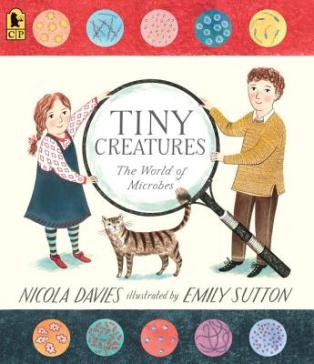
Tiny Creatures: The World of Microbes by Nicola Davies

This book is perfect for the curious kid who wants to know how microbes work. All around the world—in the sea, in the soil, in the air, and in your body—there are living things so tiny that millions could fit on an ant’s antenna. They’re busy doing all sorts of things, from giving you a cold and making yogurt to eroding mountains and helping to make the air we breathe.

It’s a Fungus Among Us: The Good, the Bad & the Downright Scary by Carla Billups and Dawn Cusick

All about Fungus! Who wouldn’t want to read this book? In It’s a Fungus Among Us, you’ll meet the wild group of organisms that can turn ants into zombies and eat trillions of pounds of feces every day. They’re not all gross though, these are the same types of organisms that make cheese stretchy, add sour tastes to candy, and make bread rise!


Materials

  • empty clear water bottle
  • yeast packet
  • balloon (stretched out by inflating a few times)
  • warm water
  • 1 tsp. sugar

Steps

  1. Have students empty the yeast packet into the water bottle. Then tell them to pour some of the warm water inside. Students should move the bottle a bit to mix the yeast and water.
  2. Ask students to stretch the balloon over the water bottle opening and observe what happens in the next 5 minutes. They should record their observations.
  3. Next have students carefully remove the balloon. Tell them to add 1 tsp. sugar to the bottle and mix. Students can now put the balloon back over the bottle opening.
  4. Have students observe the mixture and the balloon over the next 20 minutes. They can record their observations ever 5 minutes.

Conclusion

As the yeast consumes the sugar in the warm water mixture, the microbes produce gas that inflates the balloon at the top of the bottle. Tell students that this process is called fermentation, which is a process used to make all kinds of foods that we eat. Bread becomes light and airy due to fermentation. Milk turns into yogurt or kefir because of fermentation. The fermentation process also helps humans and animals digest food. This is just one of the many examples of how microbes affect us on Earth.


Need more ideas for teaching middle-school students about microbes? Check out these resources:

  • BioEd Online, Science Teacher Resources from Baylor College of Medicine, Microbes
    This site has 12 lessons to help students investigate microbes related to health (bacteria, fungi, protists, and viruses). Students will learn that microbes have important roles in humans, and that some help while others cause diseases. http://www.bioedonline.org/lessons-and-more/lessons-by-topic/microorganisms/microbes/
  • Microbiology Society, Microbe Passports
    Students can check out a virtual microscope on this site to study different microbes—from Bifidobacterium (which lives in human intestines) to Geobacter metallireducens (a metal-eating microbe that lives in muddy riverbeds).
    https://microbiologyonline.org/students/microbe-passports-1
  • Science News for Students, The dirt on soil
    Read all about the microbes in soil on this online science news publication site run by the Society for Science and the Public. It includes a glossary of “Power Words,” links for further reading, and a downloadable wordfind worksheet.
    https://www.sciencenewsforstudents.org/article/dirt-soil


***************
Karen Latchana Kenney loves to write books about animals, and looks for them wherever she goes—from leafcutter ants trailing through the Amazon rain forest in Guyana, where she was born, to puffins in cliff-side burrows on the Irish island of Skellig Michael. She especially enjoys creating books about nature, biodiversity, conservation, and groundbreaking scientific discoveries—but also writes about civil rights, astronomy, historical moments, and many other topics. Her award-winning and star-reviewed books have been named a YALSA Quick Pick for Reluctant Readers, a 2015 Book of Note from the TriState Review Committee, a 2011 Editor’s Choice for School Library Connection, and Junior Library Guild selections. She lives in Minneapolis with her husband and son, and bikes, hikes, and gazes at the night sky in northern Minnesota any moment she can.

STEM Tuesday– WELCOME to our new STEMTuesday Team Members


STEM TUESDAY is adding some STEM-tastic new team members!


We are thrilled to announce the addition of the following new members to our team. All of these awesome women are highly experienced authors, bloggers… and the one thing they have in common? They are all excited about STEM/STEAM children’s books. Check out their bios and click on their websites to find out what they do in the STEM kidlit world.

Consider  following  them on Twitter, Instagram, or Facebook, too.  We are delighted to have them on board and we know our blog will be even better because of their presence.


Week 1 new members:

Sue Heavenrich

www.archimedesnotebook.blogspot.com


Sue Heavenrich writes about science for children and their families,
from space to backyard ecology. Bees, flies, squirrel behavior—things
she observes in her neighborhood and around her home—inspire her
writing. A long line of ants marching across the kitchen counter
generated one of her first articles for kids. When not writing, you can
find her committing acts of science from counting native pollinators to
monitoring water quality of the local watershed. Her most recent book
is  Diet for a Changing Climate (2018).


Maria Marshall

The Picture Book Buzz

Twitter: MariaMarshall_


Maria is a children’s author, blogger, and poet passionate about making nature and reading fun for children. She was a round 2 judge for the 2018 & 2017 Cybils Awards. And a judge for the #50PreciousWords competition since its inception. Two of her poems are published in The Best Of Today’s Little Ditty 2016 and 2014-2015 anthologies. She is the parent of two amazing adults and lives in the Pacific Northwest with two Pixie Bob cats. When not writing, critiquing, or reading, she bird watches, travels the world, bakes, and hikes.


Week 2 new members:

Carla Mooney

www.carlamooney.com

Twitter: @Carlawrites

Facebook: @carlamooneyauthor


Carla Mooney loves to explore the world around us and discover the details about how it works. An award-winning author of numerous nonfiction science books for kids and teens, she hopes to spark a healthy curiosity and love of science in today’s young people. She lives in Pennsylvania with her husband, three kids, and dog. When not writing, she can often be spotted at a hockey rink for one of her kids’ games.


Janet Slingerland

website: www.janetsbooks.com
Facebook: @JanetBooks

Twitter: @Slingsong

Instagram: https://www.instagram.com/janetslingerland


Janet Slingerland grew up studying animals and conducting science experiments before pursuing a degree in electrical engineering. She spent 15 years writing code for things like submarines, phones, and airplanes before deciding to share her passion for knowledge and STEM with others. Janet now has more than 20 published books for readers in grades K through 12, including Explore Atoms and Molecules! With 25 Great ProjectsEngineering the Eiffel Tower, and The 12 Biggest Breakthroughs in Sports Technology. Her books have been recommended by PSLA (Pennsylvania School Librarians Association), NSTA (National Science Teachers Association), School Library Connection, and others.


Week 3 new member:

Kirsten W. Larson

 kirsten-w-larson.com 

Twitter and Instagram @KirstenWLarson


Kirsten W. Larson used to work with rocket scientists at NASA. Now she writes about both science and history for kids. She is the author of 25 nonfiction books, including the Robotics in Our World series (Amicus). Calkins Creek will publish her debut picture book, WOOD, WIRE, WINGS: Emma Lilian Todd Invents an Airplane (illus. by Tracy Subisak) in 2020. Originally from Virginia, Kirsten lives near Los Angeles. 


****  A FEW REMINDERS about STEM TUESDAY ****


The STEM Tuesday blog is searchable! Have a topic that you want to find more books on, click on our STEM Tuesday home page and searchfor it.

If we don’t cover a topic you want, let us know. Send an email to stemmuf@gmail.com. We will definitely consider adding it.

DON’T FORGET! The last Tuesday of every month we giveaway a FREE autographed copy of one of the books of the month. All you have to do is to leave a comment in the post and you will be considered. (Hint: we usually only get less than 10 entries, so the odds of winning are HIGH)

Look for STEM Tuesday in other places on the web:

Reading with your Kids STEM Tuesday podcast


MG Book Village Blog for STEM Tuesday Spin-Off 


STEM Tuesday is now on Instagram!  Follow us at STEM_Tuesday 

STEM Tuesday is on Pinterest, too

Finally, Watch for our Second Annual Co-STEM Contest to celebrate our second anniversary. Details will be released in late July or early August!

GO STEM!


***********

Jennifer Swanson is the creator and administrator of the STEMTuesday blog. She is also the award-winning author of over 35 nonfiction books for kids. A self-professed science geek, Jennifer started a science club in her garage when she was 7 years old. While no longer working from the garage, Jennifer’s passion for science and writing is evident in her many books and also her presentations at the World Science Festival and the National Book Festival (2019). You can find Jennifer through her website, www.JenniferSwansonBooks.com

STEM Tuesday — Chemistry ROCKS! — Interview with Author Kathy Ceceri

Welcome to STEM Tuesday: Author Interview & Book Giveaway, a repeating feature for the fourth Tuesday of every month. Go Science-Tech-Engineering-Math!
Today we’re interviewing Kathy Ceceri about her chemistry-infused book, EDIBLE INVENTIONS: Cooking Hacks and Yummy Recipes You Can Build, Mix, Bake, and Grow. PickaGoodBook.com says,”this book is such a great source to explore and learn through science and more.”

Mary Kay Carson: How did Edible Inventions come to be?

Kathy Ceceri: I have to credit my friend Miguel Valenzuela, inventor of the PancakeBot, a kind of 3D printer for making cool designs with pancake batter. I had written two books for Maker Media — Making Simple Robots and Paper Inventions — and gotten good feedback from educators and families looking for low-tech projects to help kids learn about STEAM (Science, Technology, Engineering, Art, and Math) concepts. I ran into Miguel at World Maker Faire New York — one of the worldwide celebrations of creativity in tech produced by Maker Media — where I was a speaker, but also casting about for inspiration for my next title. Miguel suggested I focus on food projects, and I roped him into a creating one of them — a hand-powered Lego version of the PancakeBot that lets kids “draw” with icing on cookies. The other projects touch on a wide variety of science and technology, with a heavy emphasis on chemistry, of course!

MKC: What was it like developing all these projects?

Kathy: Like most science experimentation, this one involved a lot of mishap! I spent several days trying to build an edible Rube Goldberg machine that included cucumber slice “dominoes” and a marble run using celery stalks and cherry tomatoes, but in the end it proved too difficult to coordinate all the moving parts. (You can see a test run video here.) More successful was the cardboard box solar oven. After going through several iterations, I finally developed a design that got hot enough to bake a chocolate cake! One of the things I loved about this book (and all my books, really) was learning a bunch of new stuff. For instance, thanks to a tip from another friend, flour expert Amy Halloran, I discovered that housewives used to make their own baking powder from chemicals they got at the local pharmacy. But probably the best part of creating Edible Inventions was getting to eat the results!

MKC: Why do you choose to write STEM books?

Kathy: My background is as a journalist. Over the years, I’ve written for local newspapers, magazines such as Sesame Street Parent, and websites such as Wired.com (where I helped create the GeekMom blog) and About.com (now Thoughtco, where I was the Homeschooling Expert). I’ve covered education, child development, history, art, and science — but I’m not an expert in any of those areas. You could say my expertise is in digging up background information research, finding the right people to talk to, and asking the right questions. My real talent is knowing how to distill what I learn into a form that’s easy for anyone to understand.

Kathy Ceceri is the author of over a dozen books of nonfiction for middle grade readers that teach STEAM along with history, geography, literature, and culture. Her hands-on projects have been used in classrooms and enrichment programs across the country and around the globe. Visit Kathy at Crafts for Learning, and follow her on Twitter @kathyceceri for sneak peeks of works in progress and links to her free online tutorials (including how to make Juicy Edible Gel Dots from Edible Inventions)!

I began focusing on STEAM (the “Art” is an important aspect to me!) after educational publisher Nomad Press asked me to do a book on robotics. Because my then-teenage oldest son was exploring robotics at the time as part of his homeschooling studies, I had spent a couple of years jumping on any opportunity to interview robotics engineers and designers. So I already had a good grasp of the basics, and a contact list of experts who were kind enough to let me pick their brains for topics and project ideas. I discovered I really enjoyed the process and I’m good at it, so I’ve continued writing about STEAM topics even after my kids grew up and moved onto other interests!

Today I teach crafts-based electronics and enrichment programs for kids and teens, and present hands-on professional development workshops for teachers and librarians. I’ve also worked with the Girl Scouts of the USA on their recent line of Robotics badges and their first-ever Cyber Challenge, coming this fall. All of these experiences help me keep in touch with what students and educators want to know about STEAM topics and ensure my writing is fresh and relevant.

MKC: To whom did you imagine yourself writing to while drafting the book?

Kathy: All my books are written for readers with little to no knowledge about the topic. That’s where I am at the start, too. So I can recognize the places where beginners are going to need some hand-holding and encouragement. I always try to relate concepts and techniques to things the reader is already familiar with. With robots, I use familiar materials like cardboard and duct tape. With Edible Inventions, I included a chapter featuring recipes that used standard ingredients and techniques to create unexpected textures and flavors (sort of like Molecular Cuisine, but using things you could find in any supermarket or natural food store). What makes my book different from an ordinary cookbook is that I emphasize the science. How does whipping an egg white turn a gooey liquid into a stiff meringue? Why do juice-flavored gelatin dots change color when you plop them into lemon-lime soda? And what’s the chemical reaction that causes watermelon lemonade to foam up and bubble over when you add a touch of baking soda? Readers get to learn about chemistry while making tasty snacks — what could be better?

MKC: What’s your current project and how are you tackling it?

Kathy: My next book, Bots! from Nomad Press, is an update on my original 2012 book Robotics. It contains several new projects and topics, as well as old favorites. As with every book I write, I try to approach the topic from as many different angles as possible. I firmly believe that showing how science relates to other kinds of creative activities helps bring in people who might not otherwise give it a try. So along with engineering, electronics and programming, there’s a “kitchen chemistry” robotics project that shows you how to make edible, stretchable robot skin! And like most of my projects, it ties into actual research — in this case, researchers who are trying to make inflatable robots that can crawl or slither into hard-to-reach areas. They hope their edible robots could help rescue lost explorers trapped in a cave, for example, and provide nourishment after sending back data about their location. You can see video of my homemade edible inflatable robot here. Bots! comes out in October 2019.

Win a FREE copy of EDIBLE INVENTIONS!

Enter the giveaway by leaving a comment below. The randomly-chosen winner will be contacted via email and asked to provide a mailing address (within the U.S. only) to receive the book.

Good luck!

Your host is Mary Kay Carson, author of The Tornado Scientist, Alexander Graham Bell for Kids, Mission to Pluto, Weird Animals, and other nonfiction books for kids. @marykaycarson