Posts Tagged interview

MALCOLM AT MIDNIGHT: Interview and Giveaway with W.H. Beck

W.H. Beck

W.H. Beck is an elementary school librarian by day and a middle-grade writer by night (well, actually, very early mornings). She lives and reads in Wisconsin, sharing her home and books with a husband, two sons, and a sneaky dog. MALCOLM AT MIDNIGHT (Houghton Mifflin, 2012) is her first novel.

Previous books include the FOLLOW THAT FOOD CHAIN (Lerner, 2009) series, a choose-your-own-adventure interactive look at different habitats, and DR. KATE: ANGEL ON SNOWSHOES, a regional biography about one of first doctors in the northwoods of Wisconsin.


Watch the Book Trailer!

What’s your favorite thing about middle-grade fiction?

My favorite thing about middle- grade fiction is the same thing I love about middle- grade kids: they’re funny, they’re serious, they’re unexpected, they’re full of truth about what’s really important in the world. I love working with middle-grade kids because they’re sophisticated enough to think deeply about what they believe in, yet at the same time, a clever joke about toilets is always appreciated.

 Why do you write middle-grade?

I write middle-grade because that’s how my writing comes out. I don’t mean that to sound flippant, but I do feel like that’s my voice and an age I connect with. Middle -grade books have always been my favorites, even long after I had “outgrown” them. They’re why I became a teacher—and an elementary school librarian.

You’ve written a lot of nonfiction. What led you to write a novel?

Novel writing—middle -grade novel writing, in particular—has always been my first love and aspiration. It just took a while for me to learn how to write a novel that was worth reading!

That’s not to say I don’t enjoy writing nonfiction. I love learning new things and sharing that information with others. In fact, MALCOLM came about because of the nonfiction research I was doing for my FOLLOW THAT FOOD CHAIN series. It struck me that animals can do so many amazing things—they kind of have super powers, really. What if I wrote a mystery about an animal who used his “superpowers” to prove his innocence?

I did make a conscious decision to set aside my nonfiction writing, though. It was a gamble—I turned down some nonfiction offers to finish MALCOLM. I know that sounds crazy, but one of the things I learned was that I only have time for one writing project at a time. And if I really wanted to be a middle- grade novelist, then I needed to give it a chance.

As you were writing, did you imagine there would be illustrations? How involved were you in the decision and in the process?

Part of my own writing process is drawing doodles of my characters and settings, so I did dream that it might be illustrated someday (although I would definitely have “settled” for just publication!).

Malcolm sketch

My first sketch of Malcolm

When I sold MALCOLM, I was lucky enough to have more than one publisher interested in it. As I spoke to the different editors, Kate O’Sullivan told me not only did Houghton Mifflin want to have it illustrated, but Brian Lies had already read it and wanted to work on it.  Well, I almost fell over—I actually teach Brian’s bat books with the first graders in my library! So I knew his work, and I knew that he’d be perfect for my critters.

As far as input into the process, Brian and I didn’t talk directly until the whole book was pretty much finished. When he had questions, he’d ask our editor and she’d relay them to me. I’d see snippets of his work, but mostly, I tried to stay out of his way and let him do his magic. The only thing I did request (through my agent and editor) was that, even though it’s not stated explicitly in the text, Amelia was Amelia Vang—and she was Hmong. This was important to me because I really wanted to honor some of my students who don’t often get to see themselves in the books they read.

Midnight academy

Malcolm at Midnight artwork by Brian Lies (http://www.brianlies.com), courtesy of Houghton Mifflin Books for Children

Brian and I finally met for the first time last fall at some book events. It’s been great fun swapping stories about how we went about working on the book. It turns out we have a lot in common, and I now count him as a friend.

Why an iguana?

I don’t know where Aggy came from! There is an iguana that my kids visit at our local pet store, so maybe that’s it. Other animals are easier to trace. My dad raised oscar fish while I was growing up; my brother’s fifth grade teacher had a hedgehog; my own sixth grade classroom had a tarantula; and Beert came from a talk on owls at a nearby nature center.

How did you come up with the unique point of view?

I went through many, many, MANY different starts to this book, but I wasn’t happy with any of them. I knew the main events of the mystery, but the telling of it felt flat. One of the things I sometimes do to help me learn about my characters is write letters from each of them, explaining the outcome of the story—why they did what they did. When I wrote Amelia’s, it just felt right, and the whole story finally started to flow.

If there was one single thing that you wanted readers to get from MALCOLM AT MIDNIGHT, what would it be?

That reading is fun. I certainly hope readers take away more—like not letting people label you and that you can choose to be the kind of person you want to be—but I’ve done some recent thinking about why I write funny talking animal stories, and what it comes down to is that I want kids to READ. I believe to be an adult with choices, you need to be a reader, and the only way to become a reader is to read. A lot. And it’s so much easier to practice something if you find enjoyment in it.

What books do you recommend to readers who enjoyed MALCOLM AT MIDNIGHT?

Mysteries: HALF MOON INVESTIGATIONS, THE FOURTH STALL, THREE TIMES LUCKY, ICEFALL

Animal fantasy: BUNNICULA, THE RESCUERS, CHARLOTTE’S WEB, THE FAMILIARS, THE CHESHIRE CHEESE CAT, THE UNDERNEATH

Rats as heroes, NOT villains: NIGHTSHADE CITY, MRS. FRISBY AND THE RATS OF NIMH

School stories: anything by Andrew Clements, BECAUSE OF MR. TERUPT, FLYING SOLO, the ORIGAMI YODA books, THE BOY PROJECT


GIVEAWAY!

Leave a comment to be entered in a giveaway for a signed copy of MALCOLM AT MIDNIGHT and a cute little stuffed rat. Enter by midnight (how appropriate) on Wednesday, January 16. The winner will be announced on Thursday, January 17.


Jacqueline Houtman is the author of THE REINVENTION OF EDISON THOMAS. In her former life as a scientist, she poked at the insides of many rodents. These days, she can be found trembling on a kitchen chair whenever a mouse finds its way into her house.

Here Where the Sunbeams are Green with Helen Phillips

Today we welcome Helen Phillips to the Mixed-Up Files! Her novel, HERE WHERE THE SUNBEAMS ARE GREEN, just released on November 13th. Her official bio: Helen Phillips grew up in the foothills west of Denver with her three siblings. When she was eleven, she lost her hair due to the autoimmune condition alopecia, which was pretty hard at the time, but now she thinks there are some major advantages to not having hair (no shampoo in the eyes, for one). Soon after she lost her hair, she (like Mad) made a New Year’s resolution to write a poem a day, a practice she continued for more than eight years. Helen attended Yale University and went on to earn a master of fine arts in fiction from Brooklyn College. She lives in Brooklyn with her husband, artist Adam Douglas Thompson, and their child.

About HERE WHERE THE SUNBEAMS ARE GREEN: Mad’s dad is the Bird Guy. He’ll go anywhere to study birds. So when he’s offered a bird-tracking job in Central America, his bags are packed and he’s jungle bound. But going bird tracking in the jungle and disappearing completely are very different things, and when the Very Strange and Incredibly Creepy Letter arrives, Mad can’t shake the terrible feeling that her father is in trouble. Roo, Mad’s younger sister, is convinced that the letter is a coded message. And their mom is worried, because the letter doesn’t sound like Dad at all. But Mad is sure it’s a sign of something sinister. The only way to get to the bottom of it is to go to Lava Bird Volcano and find their dad themselves. Though they never could have imagined what they’re about to discover. (from IndieBound)

I loved that Madeline and Ruby are a sister team. Ruby, the younger sister, often comes across as the fearless leader. How does Madeline gain the courage to ultimately save her family from the evil corporation La Lava Resort and Spa?

Mad’s journey from scaredy cat to heroine is in a sense the central journey of the book. When push comes to shove, Mad has plenty of inner resources—it’s just that push has never come to shove until now. A lot of the struggle has to do with how she perceives herself; she has to overcome considerable self-doubt. All along she gives herself less credit than she deserves. She’s intelligent and creative and big-hearted. But in comparison to Roo, she feels weak and wimpy and un-magical. At the same time, Roo’s courageousness is what inspires Mad in the climactic scene.

Speaking of La Lava Resort and Spa, it purports to be an eco-friendly resort while it’s actually hunting the Lava-Throated Volcano trogon [a type of bird] to extinction for use in a stay-young cosmetic. What inspired this type of villain?

I thought it would be interesting for a place that seems like paradise to have a very dark underbelly. It was a fun writing challenge to depict the sinister qualities of such a gorgeous, “perfect” location. Moreover, as someone who attempts to tread lightly on the earth and buy green products, I’m fascinated/horrified by the trend of “green-washing,” in which companies falsely claim to be environmentally friendly and market their products as being greener than they actually are, taking advantage of well-intentioned consumers like myself.

Madeline and Ruby’s father, the Bird Guy, is thrilled to discover the Lava-Throated Volcano trogon is a Lazarus species. This was the first time I’d heard of a Lazarus species, where a species thought to be extinct is rediscovered. Is this based on a true story? How frequently are Lazarus species discovered?

I write about this in my Author’s Note: in the early 2000s, my dad showed me a newspaper article about a recent sighting of the Ivory-Billed Woodpecker, otherwise known as the “Lord God Bird” for its spectacular appearance. Declared extinct by the International Union for Conservation of Nature in the 1990s, it had supposedly been sighted in its former territory, causing a flurry of excitement in the ornithological community and inspiring a great search effort. Unfortunately, none of the searches for the Lord God Bird has proven that it still exists. Even so, this tale stuck with me, a tiny bright spot amid the disturbing news about the ever-decreasing biodiversity of our planet. It seemed as magical to me as the sighting of a unicorn or dragon. For years I knew I wanted to write a book about the thrilling possibility that a species believed extinct might have managed to survive. There are some wonderful examples of these so-called “Lazarus species” (Lazarus, in the Bible, was raised from the dead). The Bermuda Petrel, a bird believed extinct for 330 years, was found alive on small, remote islands. The Lord Howe Island stick insect, believed extinct since 1930, was rediscovered beneath a shrub on the world’s most isolated sea stack. The Monito del Monte, a marsupial believed extinct for eleven million years, was revealed in a thicket of Chilean bamboo. These are just a few from the intriguing list of thirteen Lazarus species on the Mother Nature Network site. Wikipedia also maintains a list of Lazarus species.

One thing that stands out in your story right away is how strong the rainforest is as a setting. How much research did you do to make it come alive?

Though I (sadly!) didn’t get the chance to travel to Central America for research purposes while I was writing the book, I lived in Costa Rica for two summers in high school and college, studying Spanish and doing volunteer work. As someone raised in the arid foothills of Colorado, those first encounters with the rain forest made a huge impression on me, and I drew on that stockpile of rich, quasi-magical images in writing Here Where the Sunbeams Are Green. My creation of the jungle setting got a boost when my brother and sister-in-law spent their honeymoon in Costa Rica while I was revising the book; they sent me about 200 pictures of birds, flowers, foliage, bugs, monkeys, etc. Aside from that, the Internet was helpful in terms of jogging my memory and enhancing the details.

In the rainforest, you describe an umbrella flower that blooms just in time to be a shelter for the rain. Does that exist? And can flowers really grow out of your toes, like they do for Ruby?

I wish! As far as I know, there are no umbrella flowers or toe flowers. But they’re both just believable enough …

What’s next for you?

I’m working on a collection of short stories for adults, and I have the idea for my next book for young readers, which will be set in a post-apocalyptic world.

What’s your favorite middle-grade book?

I have to confess that I adored From the Mixed-Up Files of Mrs. Basil E. Frankweiler; now that I live in New York City and actually get to visit the Met, I think of that book every time I step through those doors. Other favorites include Madeleine L’Engle’s A Wrinkle in Time and Laura Ingalls Wilder’s Little House on the Prairie books. And everything by Cynthia Voigt. And Lloyd Alexander. And C.S. Lewis. And J.R.R. Tolkein. And … well, you get the idea …

To learn more about Helen and her books, check out her website and her book trailer. Leave a comment to win a copy of HERE WHERE THE SUNBEAMS ARE GREEN (US only).

Karen B. Schwartz writes humorous middle-grade novels (and tween and YA) and raises humorous middle-grade kids (one is a tween that thinks he’s YA).


Indie Spotlight: Monkey See, Monkey Do

Anyone who thinks children’s bookstores are becoming a thing of the past probably needs to get out in the country more!  True, some wonderful old favorites are no longer with us, but others are doing just fine and wonderful new ones keep springing up, even in these recent hard times.  Today we’re talking to owner Kim Krug of Monkey See, Monkey Do in Clarence,  New York, whose small-town shop is just over three years old  and  has already become an asset  to the community and  earned the 2012 Pannel Prize for Children’s Specialty Bookstore from The Women’s National Book Association.
Sue Cowing for Mixed-Up Files: It’s always a pleasure to discover a new—and thriving—children’s bookstore. What led you to start one up in Clarence, New York?
Kim: Our three children inspired me to open a children’s business.  I had the wonderful opportunity to stay at home with them for the first five years and then wanted to share with them a passion I had to give back to our community, teach them the importance of following a dream and work to inspire other families with a love of reading and lifetime learning.
MUF:Describe the atmosphere in Monkey See, Monkey Do.
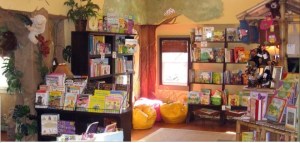
Kim: It’s a very warm, charming and creative space.  Both children and adults alike love to look at the books and enjoy the building.  Our bookstore is housed in a historic 1840’s building with timber beams in the young adult/adult book room.  There are six cozy rooms in which books are shelved, tables are set up and classes are held.  People are very curious about the history of the building, it is said to have ties to the Underground Railroad.
MUF: How do you select the books to carry at Monkey See, Monkey Do? What are some favorite titles, fiction or nonfiction, that you recommend to middle-graders?
Kim: I spend a lot of time reviewing advanced titles provided by independent authors and publishers.  I follow our regional book groups and the American Booksellers Association for reviews.  I love finding unique, indie titles that I can bring into the store and tie a program around.  One of my favorite titles is Wonder by RJ Palacio, I absolutely love this book and highly recommend children in grades 5 and up along with parents/adults to read it!  It’s an inspiring story about a 5th grade boy who has a facial deformity  and is homeschooled up until the 5th grade.  The story switches narrative throughout the book as we journey along with Auggie, the main character through his first year of transition in public school.  Some newly released picture books that I am a huge fan of are:  Big by Coleen Paratore, Because Amelia Smiled by David Ezra Stein, What Does it Mean to be Present by Rana DiOrio  and Say Helloby Jack & Michael Foreman. Our Gorilla Girls Book Club (Gr. 5 and up) has been reading Out of My Mind by Sharon Draper, and the Bright Monkeys Literacy Club (Grades 3-6) is reading The Lion, the Witch, and the Wardrobe.  

Gorilla Girls Book Club

MUF: The Pannel Prize folks cited your “innovative approaches to getting kids engaged with reading.” That seems like an understatement. Monkey See, Monkey Do has a strong commitment to promoting literacy and acts on it by holding a number of literacy classes and activities, even individual tutoring sessions. Tell us about some of those efforts and the community response.
Kim:We truly believe we “bring our books to life” through the variety of creative, literacy-based classes we offer each month.  This past summer we held over 40+ to inspire children to creatively engage in literature.  This Fall we began a new venture in partnering with schools in our After-School Literacy Clubs in which we offer a 6-week literacy club led by a

Reading to each other on National Star Wars Reads Day

NYS certified teacher where children practice reading aloud, work on cadence, pace, vocabulary-building and comprehension.  Children discuss the reading each week, practice journal writing and reflective questions.  In this current session we are running in the schools, the last class will end with a very special author Skype in which children can engage directly with the author to learn about what inspired them to write their book and question the author directly.

MUF:Your book camps sound fun and popular, and you hold them not only in the summer but also during school breaks throughout the year. What have been a couple of your most memorable ones?
Kim: That is a tough question, I have so many fantastic memories from many of our camps but here’s a few that really stick out:
  • Art Safari – children spend a full week reading about a new artist each day and then working on an art project inspired by that particular artisan’s work.

    Art Safari

  • Cupcake Diaries – a full week camp in which children formed reading circles each day to complete reading, creating cupcake journals and writing entries that tied in with their reading and discussions and ended each day with a cupcake decorations lesson by a pastry artist.  The children learned a new cupcake recipe each day, worked on frosting/decorating skills and then enjoyed their work!
  • Let’s Go To Spain – a full day camp reading about Spanish culture, learning new vocabulary, enjoying Spanish treat and engaging in a role-playing skit.
MUF: All this community involvement and teaching and operating a bookstore, too! You must have some good help and/or very little sleep!
Kim: Yes, that is true!  We have an absolutely amazing staff of devoted teachers, employees, artisans and interns from local colleges that offer their time, talent and energy!  And yes….little sleep these days in juggling our family and the business.
MUF: Many towns have no bookstore at all, much less a children’s bookstore. If an out-of-town family decided to make an excursion to Monkey See, Monkey Do, would there be any places for them to have a snack or a bite to eat after browsing?
Kim: Yes, right in the back of our bookstore is a charming restaurant called The Carriage House.  It’s steps away from our bookstore and offers a wonderful lunch menu.
MUF: Are any special events planned at Monkey See, Monkey Do (or in Clarence) for Halloween or November?
Kim: Yes!  Next week we are hosting our 4th Annual Storybook Halloween Party in which we encourage families and children to dress up as their favorite storybook character and come to our free event that features free crafts, sweet treats and two local authors that will be reading their book and signing copies!
In November,  we will be hosting our 4th annual Black Friday camps (Friday, November 23rd) for children to enjoy and parents to have a place to drop off their children for creative programing while they shop.  On Saturday, November 24th we will have our SHOP LOCAL Holiday Event where we invite several authors, artisans and small business owners to come into our bookstore and sell their wares and promote a local shopping spirit.
MUF: Thanks, Kim, for talking with us and for creating not just a children’s book store but a center for learning to love to read  Here’s wishing you success and many anniversaries and honors in the future!
Readers, if you would like to know more about this place, go to http://www.monkeysread.com.  If reading about Monkey See, Monkey Do makes you want to visit the shop, and/or if you think Kim’s approach to running a bookstore is intriguing, please leave her a comment here.
Sue Cowing is the author of the middle-grade puppet-and-boy novel, You Will Call Me Drog, (Carolrhoda, 2011; Usborne UK, 2012)