Posts Tagged graphic novels

Author Spotlight: Stan Yan

In today’s Author Spotlight, Sydney Dunlap chats with author Stan Yan about his middle-grade graphic novel, THE MANY MISFORTUNES OF EUGENIA WANG.

Stan is an award-winning, first generation American-born-Chinese, Denver-based writer, illustrator, caricature artist and instructor. He helped to co-found the Squid Works comic creator cooperative and was a board member of the Colorado Alliance of Illustrators. Stan is a recent co-Regional Advisor for the Rocky Mountain Chapter of the Society of Children’s Book Writers and Illustrators (RMC-SCBWI) and a co-founding professor of the online kidlit art school, the CuddlefishAcademy.com. You can find him online at stanyan.me.


All About the Book

In this hilarious and heartfelt debut graphic novel, a girl born on a day considered unlucky in Chinese superstition starts to wonder if she really is cursed when she’s troubled by visions of doom set to occur on her thirteenth birthday.

Twelve-year-old Eugenia Wang has never celebrated her birthday on her actual birthday, April 4th, because of her mom’s belief in the Chinese superstition that four is an unlucky number. And that’s not the only thing Mom’s strict about; she won’t let Eugenia go to a summer comic art camp because she thinks art is a waste of time. This year, Eugenia is determined to defy her mom by applying for the camp, having her party on her actual birthday, and inviting her super cute crush while she’s at it, too!

But when Eugenia gets hit in the head with a sneaker during PE, she starts getting unnerving visions of impending doom about her upcoming birthday. It might be the aftereffects of her head injury, or maybe she’s just anxious about turning thirteen. As the visions get worse, even affecting her artwork, Eugenia suspects an unseen force may be sending her messages. If she’s haunted after all, Eugenia will have to figure out why before it’s too late. Even more horrifying, she may have to do the unthinkable: admit her mom was right.


Interview with Stan

Sydney: Congratulations on your new book release! THE MANY MISFORTUNES OF EUGENIA WANG is such a cool mix of spookiness, humor, and oh-so-relatable tween angst. You do such a great job of balancing these elements. Was it difficult to craft this? What were your biggest challenges?

Stan: I’d be lying if I were to say it was easy. I think my biggest challenge was making it paranormal, because I discovered you’ve gotta create a paranormal ruleset and be consistent, which made plotting this story extra difficult, then after getting editorial notes, even harder. Any change I’d make would create a cascade of dominoes through the rest of the story.

Praise for This Book

Sydney: Your graphic novel has been praised by Kirkus with this glowing review: “The panels, which vary in perspective, adding visual interest, support the tone of this dramatic, funny, and touching graphic novel. . . Readers will relate to Eugenia’s struggles over meeting family expectations, following her passions, navigating relationships, and negotiating daily life as a tween. Slightly spooky and filled with humor and heart.” What inspired this story?

Stan: This story was inspired initially by a “bucket list” challenge to myself to write and illustrate a comic that actually scared me. I’m a huge fan of horror, but horror comics didn’t really seem to spook me at all, but I thought there had to be a way. In film and novels, I found that most of the things that tended to scare me related to a child character, so I thought I’d make my protagonist a child. So, by accident my story became a children’s book.

I tried to think of what I was scared of as a child, and I remember (ironically) having existential fears of death, so I inserted that into the story. As I wrote an early draft, it quickly became evident that my story didn’t scare me, but I liked it. Later, after getting a manuscript critique from an editor, who convinced me to simplify my story and make it contemporary, I completely rewrote it, reconceiving the main characters, and reimagining how the protagonist would fall into visions of her death on her 13th birthday, and in the process, I felt like it became scary again!


Characters

Sydney: Eugenia is a great main character. Your other characters are compelling and interesting as well. Do you have a favorite secondary character? Who and why?

Stan: While I find most readers’ favorite secondary character is Peanut, I feel like he’s mostly an emotional proxy for Eugenia, which I admit is adorable. But I think her best friend, Keisha, is my favorite character. I think Keisha is the hilarious free spirit that Eugenia wishes she could be, and I love her humorous interactions with her dads. Keisha is a loyal friend that really believes in Eugenia, and I think that’s what we all want in a bff.

Inspiration

Sydney: How amazing that you are such a talented artist as well as a wonderful story creator. Have you always loved art? When did you decide to tell stories?

Stan: Well, thank you so much! I do feel like what I do is less a result of talent and more a result of passion. My earliest memories of holding a pencil in my hand were of me drawing the same stick figure doing different things in boxes I later found out were called “panel borders.” I was doing comics before I realized it! Drawing has always been simply my muse for telling my stories, and that’s what I loved about my art practice. I never had a shortage of stories to tell, so I got a lot of practice training my hand to do what my brain wanted it to do. As I often say, “you don’t run a marathon before you’ve run a mile.”

(Interspersed below are a few images of the same scene from rough idea to finished product.)


Takeaways

Sydney: What do you hope readers take away from this book?

Stan: There’s a lot of things I’d love readers to take from this book. First and foremost, I just want my readers to be entertained: I want them to laugh, be spooked, maybe get a bit misty in places. I also hope it leaves them thinking about my story after they’re done. And I’d love for my story to spark conversations and debates about what people think happened in it. Hopefully, it’ll be a book club favorite! Lastly, I hope aspiring authors and illustrators will feel they have permission to create stories with characters who look like themselves. I didn’t want to perpetuate the lack of representation in my available school library reading that led me to not consider this for decades by default.


Process

Sydney: Where/when do you prefer to write?

Stan: I don’t have a normal place I like to write. I find that I often am drawing all the time but not writing, or writing all the time and not drawing. That’s how being on a book deadline is for me. So, while I find myself most often just writing at home at the dining room table out of necessity (and proximity to the kitchen and refrigerator), sometimes it’s on the couch, or maybe at Panera Bread…anything I feel like I need, but I don’t have any sort of magic preference.


Influences

Sydney: What are some current books that have influenced you as a kidlit graphic novelist?

Stan: THIS WAS OUR PACT by Ryan Andrews was an amazing book that I felt like meshed all of the aspects of graphic novels together seamlessly. I also have really been influenced by STARGAZING by Jen Wang. I don’t know if these are as current as you were looking for. But GHOST BOOK by Remi Lai was a more recent masterpiece I hoped my books could become like, even if her work hadn’t perceptibly influenced my work yet.


Advice

Sydney: What is your advice for aspiring writers?

Stan: My best advice for writers is to read a lot. My second best advice for writers is to craft an emotional story arc for your protagonist and probably a few of your other main characters.


Upcoming Projects

Sydney: Can you give us some insights into what you’ll be working on next?

Stan: Well, depending on when this is published, my next project might not be announced yet, but you can get a little sneak peek into its universe by looking at my weekly Sunday webcomic, Peter Cadaver (salemcharteracademy.com).


And for the lightning round:

Sunrise or sunset? Sunrise (not by choice, but that’s when my body gets me up now)

Favorite place to travel: Hawaii (as long as your wife doesn’t break her shoulder)

Favorite dessert: Mochi filled with red bean paste

Favorite music: Depends on what I’m doing, but if I’m not needing to write or do panel layouts, I tend to always love listening to 90’s grunge, particularly Hole, The Screaming Trees, and the like.

Favorite book from childhood: If the library card was any indication, WHERE THE WILD THINGS ARE by Maurice Sendak was. I checked that out over and over.

Find Stan on Instagram at @zombicatures. 

Magic Tree House Author Spotlight: Mary Pope Osborne plus bonus interview with graphic illustrator Jomike Tejido

photo Mary-Pope-Osborne

credit: Elena Seibert (2012)

If you’ve ever had trouble coming up with book ideas, you may be encouraged to know Magic Tree House author, Mary Pope Osborne, struggled to find a method for Annie and Jack to travel back in time. She tried seven different ways, including a cellar, an artist’s studio, and a museum, before she and her husband spotted a tree house during a Pennsylvania vacation.

And the rest was history…

The first Magic Tree House book came out in 1992. Since then, she has written 67 books in the series, and more than 191 million copies have been translated into 39 languages and shipped to over 100 countries. And now, the Magic Tree House books are coming out as graphic novels.

If you’re wondering how Mary Pope Osborne can write so many books, she once said she can work up to 12 hours a day and 7 days a week. But she also had to set aside time for other activities, such as traveling to schools, creating programs for teachers, and supporting writing organizations.

We’re delighted to have this beloved author here with us on our blog today. Welcome, Mary! Thank you for joining us and answering some questions for our readers (and yours). We’re really excited to see your books come out as graphic novels.

Did you have any childhood dreams for when you became an adult? If so, did they come true?

I had big dreams as a child. I wanted to be a movie star, a singer, a dancer, a TV announcer, a star athlete, a famous politician. As a child, I never actually dreamed of becoming a children’s book author. But now after forty years of writing books, I can say I’ve had the best career I ever could have imagined.

You moved many times when you were young. How did you adjust to new situations?

I have two brothers and a sister, and we were all best friends. (We still are). So moving was easy when we all discovered our new surroundings together. We treated each move as a new adventure.

How did the unusual places you lived—across from an ancient castle in Austria or in a fort with a moat in Virginia—influence your imagination and spur your storytelling abilities?

I think these historic environments gave a sense of timelessness to childhood. It felt natural for me to later write stories about a brother and sister who travel to long ago times and faraway places.

In your books, Annie is the fearless one, and Jack is the worrier. Which character is most like you? And why?

In many ways, I was more like Annie when I was young. I threw myself into everything, often taking a leap before I really understood a situation. Today I am more like Jack. I worry about many things, but I’ve learned how to seek advice or gather information to handle my feelings.

What were some of your fears when you were young?

Fire ants, wild dogs, tsunamis, jellyfish, spiders, ghosts, centipedes…That’s just a few items on a very long list. But happily, all those fears seem baseless now, as I was never harmed by any of these things.

What advice would you give to your younger self?

Don’t be afraid. Don’t worry. Just personally try to do the next right thing, and everything will work out.

You’ve written so many books. Do you have any tips for coming up with fresh and uniquecover: Midnight-on-the-Moon-Graphic-Novel. ideas?

Don’t allow yourself to think you’ve run out of ideas. There are an infinite number of possibilities for a story. Study your personal world – your family, friends, pets, and natural surroundings. Read lots of books and gather inspiration from the past. Study history, animals, insects, other cultures, mythology, fairy tales, and the Bible. A zillion ideas are out there, waiting for writers to discover them.

Can you tell us about your family’s involvement with the books?

Soon after I started writing the fictional Magic Tree House books, my husband Will started the nonfiction line called the Magic Tree House Fact Trackers. His books are factual companions to my adventure stories. Then, Will turned his attention to creating a Magic Tree House planetarium show, and my sister Natalie took over the nonfiction Fact Trackers and has written more than 40 of them, along with many MTH activity books. About fifteen years ago, Will began work on a series of Magic Tree House musicals with our best friends, composer Randy Courts and playwright Jenny Laird; and their team now has nine shows that are performed around  the country. Currently, Jenny Laird is adapting the Magic Tree House books into graphic novels. And Will, Randy, and Jenny are working on a Magic Tree House animation.

Book Cover: SpaceThat’s so exciting that the books have appeared in so many different forms, including shows and graphic novels. And the nonfiction companion books are so helpful in providing additional information about the topics.

Do you have any message or advice for the teachers and parents who will be sharing your book with their students and families?

I urge teachers and parents to have a good time while reading Magic Tree House stories with children. Share your readers’ excitement as they imagine themselves overcoming the adversities that Jack and Annie face, and review with them new knowledge they’ve gained about the world.

Teachers can go to the wonderful Classroom Adventures site for resources, teaching tools, and free Title 1 books.

What do you hope readers will take away from your books?

I hope they take away a love for reading, and a love for learning more about world history, heroes, animals and nature – and themselves. Jack and Annie overcome many challenges by simply being good people.

Can you share what you are working on now?

I’m working on the first of a new quartet of books called Magic Tree House History Heroes. The first hero Jack and Annie visit is twelve-year-old Mary Anning who lived on a rocky shore of England in the early 1800’s. Though Mary had no money and no schooling, and suffered from a tragic home life, she made a discovery that helped change the way we think about the history of the world. The story of Mary Anning is unbelievable, but true.

We appreciate you taking the time to answer these questions, and we look forward to the launch of your graphic novels as well as the Magic Tree House History Heroes.

A SNEAK PEEK INSIDE A MAGIC TREEHOUSE GRAPHIC NOVEL

 If you’ve ever wondered how graphic novels are made, you’ll enjoy this special bonus to Mary Pope Osborne’s interview. Jomike Tejido, one of the illustrators for the Magic Tree House graphic novels, has agreed to share some of his secrets and show us a few of his early drawings. I asked Jomike because he illustrated my middle-grade novels in the Second Chance Ranch series.

photo Jomike TejidoHi, Jomike, so nice to have you here today. I’m really excited to see inside your graphic novels. And we have some questions for you as well. Thanks for agreeing to an interview.
Please share a little about where you grew up and any books you liked.

I grew up in Manila, Philippineswhere I still live now with my family. Growing up, I liked reading Spot, Babar, Berenstein Bears and Georgie the Ghost. My favorite was Where’s Waldo, though since I liked the visual storytelling it had in its tiny drawings. In later grades, I liked the detective series Hardy Boys.

Can you share a childhood story about how you first became interested in art?

I first got into art with my dad, as he was an architect and practiced in a small family-run home-office. He would teach me in the sidelines of his actual work as there were a lot of scratch papers around. The setup was just my parents and a few draftsmen/women who came in and out of an extra room in our house. It was the time when no computers were used for drafting. The only use of the computer at the time was making charts and lists. I had a lot of physical art materials from the office at my disposal. My favorites were large papers and watercolors, and they were always within reach. I only got into trouble if I did not return them in their proper places. To remedy this, I setup a little table within their office so I could have my own space and little chair. I told people not to bother me, as I was also “busy.”

When did you know you wanted to be an illustrator?
 In high school, a local newspaper opened a kiddie magazine called Junior Inquirer where kids could contribute art, write and illustrate—and actually get paid for it. I repeatedly sent submissions to them just so I could buy my own video games. The editors saw my enthusiasm and told me there was an organization dedicated to the craft I was beginning to like, called Ang Ilustrador ng Kabataan (Ang InK), which means Illustrators for Children. I joined the org as the youngest member at 18, and learned the ropes around publishing and met the people of the local industry. My love for the craft led me to have my first publication at that age, and then become an author-illustrator at age 20. I learned from the illustrator’s group how the industry works in a global scale, particularly how artists from the US work with agents. I kept the idea at the back of my mind as a long-term plan as I went on publishing around 70 titles throughout my college years (where I took up Architecture). The opportunity came in 2007 where I was able to sign with MB Artists, NYC, and I have been working with them ever since for my books outside of the Philippines.

Did you ever read the Magic Tree House books when you were young?

I never saw a Magic Treehouse book when I was little. But when my first daughter was at a starter age for reading in 2015-2016, we found them in a local used bookstore where I often bought books in bulk for research and self-study. We turned Magic Treehouse into bedtime stories for several years until she started reading on her own and moved up to novels. I recall looking at the illustrations and wished I could have a long serialized project like that someday. I even felt sad that Magic Treehouse was already done and something that fun would not be repeated again.

What do you like most about being an illustrator?

I like being able to draw a lot, every day. As an artist, I juggle two paths- as an abstract painter and as a digital illustrator. Both work in different ways as they serve two interests I have. As an illustrator, I like making pictures that are light, funny, adventurous and whimsical. I don’t feel like I am working when I do it. It is just like drawing on that little desk I setup for myself back when I was little (and yes-, when the process starts, I still dislike being bothered). 😀

What is the most challenging part of illustrating a graphic novel?

The most challenging part is the layout. Unlike illustrating picture books where the text occupies (usually) a single block in a page, graphic novels have panels. The panels are like little pages where the order of the speech balloons have to go a certain flow, and those have to come in first to make sure the dialogues fit. Second—as it is a nonfiction graphic novel, I also find it challenging to find the references that would fit the tiny panels and convey the right amount of detail needed. Lastly, as an inker/line artist for the series, I find myself often feeling sleepy when I do not see colors for a long time! In contrast to my other job as a painter, linework is easy with the iPad as my main tool, but maybe I just have to remind myself to get up and stretch or take a walk after a few pages!

graphic novel pagesgraphic novel page


Can you tell us how the characters were developed for the illustrations?

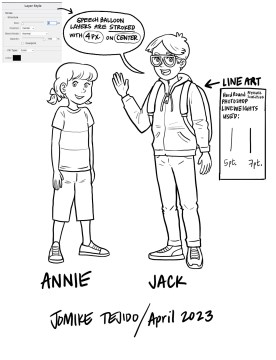
The characters were based off several reference specifications, from written descriptions, the new Jack and Annie in the main graphic novels and also the original grayscale versions. I had to find a middle ground that would make my Jack and Annie still resemble those but also look like my own work. It took several backs and fourths. It was soooooo stressful because I really wanted to get it and surprise my daughter that I would be working on the series we used to read for bedtime! I was so happy I got picked.

jack and Annie character sketches

Do your characters differ from those in the books? If so, how?

I would say my characters look similar to those in the main graphic novel but are probably simpler due to the fact that they don’t necessarily have to be in adventurous/action scenes for the Fact Trackers. This balances off my time to focus on the detailing of the factual/technical illustrations.

Can you tell us about your art technique?

My art technique is purely digital and done on an iPad. It involves one of the clean ink brushes that produces thin lines and tapers when I do fast gestural strokes with my stylus. It relies heavily on photos of the objects, people, animals and places that are needed for illustrating the facts, so those usually are on a separate screen where I copy them and reduce details to make it look like they are part of the comic world that my Jack and Annie live in.

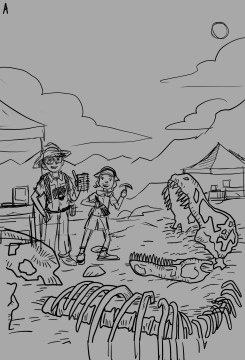
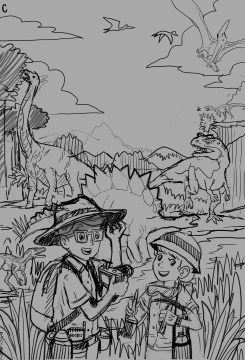
rough sketchesrough sketch


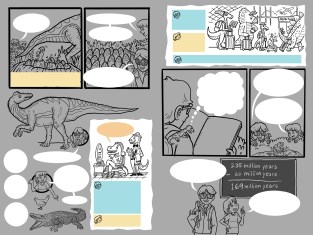
The process starts with rough sketches which look messy. I use a gray backgound so the contrast of my lines won’t be too stark. The main purpose of this stage is to allot speech balloons that can fit the amount of dialogue allotted in each panel. We can call it the problem-solving stage. My thoughts in this stage are usually like “How do I cram all these data in such a small space?!” or “Do I have to draw the stuff that’s BEHIND the speech bubble?” (Of couse I still do!)

Since this involves a lot of eyeballing and guesswork, it takes a lot of trial and error until I get the right size and shape of ellipses to encase the words. I make sure I have ghosted out rulers around my pages as a template, so I do not go over the side edges or the central gutter.

graphic novel pagepages with speech bubbles


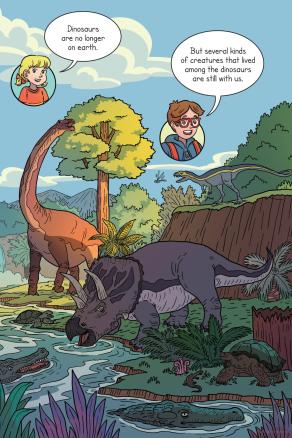
The rough sketches are sent to my editors and then returned to me with comments for improvement. Luckily, I get to ink them already after this stage. I only have to re-sketch things when big movements are needed. I don’t make a tight sketch round anymore as the time it takes to do this is almost the same time as I would take to already go into the final inking. That would be the fun stage. There is something about the final ink rendering stage that triggers something in my mind that tells me, “Now let’s make these pages look nice.”

inked dinosaur

Inked cover of Fact Tracker: Dinosaurs

cover: Dinosaurs


interior page

interior page


It’s been a lot of fun to see how you work on pages in the graphic novels and to see them go from rough sketches to finished pages.

In addition to working on the Magic Tree House graphic novels, please tell us about some of your favorite books that are already out.

Book cover: There Was an Old WomanMy favorite is There Was an Old Woman Who Lived in A Book (Jimmy Patterson/ 2019) as it was my debut as an author-illustrator in a US publication. I got a chance to have an author visit for this title in some schools around Manhattan and Brooklyn.

A recent book I worked on that was fun and imaginative was Addy’s Chair to Everywhere by Debi Novotny, and I loved how the book kept jumping from real world to imagined world throughout the story.Book Cover: Addy's Chair

I also loved Second Chance Ranch (Jolly Fish Press). Aside from the fact that it spanned a good number of titles (series work is always AWESOME for me), I got to do an aerial view map of the setting, which I always wanted to do for MG titles.

Another title coming this August is Live Big with Catch-M, written by Kat Kronenberg. It has a lot of animals and galaxy scenes which I’ve always loved Book cover: Live Bigto paint digitally.

What are you working on now?

I am now working on the fourth installment of the Magic Treehouse Graphic Novel Fact Trackers and the theme is Mummies and Pyramids. It is especially fun to do as it taps into my architectural roots and the scenes I am currently drawing involve a lot of rooms and isometric views of rooms, which is also reminiscent of video games I used to play.

Locally, I am working on a series of papercraft books called Foldabots. They are D-I-Y cut-out robots kids can build, and they actually transform into cars, animals and other cool stuff. Foldabots Toy Book 1 (Anvil Publishing house) has QR codes linked to my YouTube channel where I guide my builders though the assembly process of each character.

Thanks so much for sharing your process with us, Jomike. We look forward to seeing your latest books. And we’re eagerly awaiting the Magic Tree House graphic novels, which come out this week.


Author-Illustrator Spotlight: Jessixa Bagley

In today’s Author Spotlight, Landra Jennings chats with author-illustrator Jessixa Bagley about her new middle-grade graphic novel, Jazzy the Witch in Broom Doom (Simon & Schuster Books for Young Readers, July 15). She’ll share her inspiration behind writing it, her creative process and a few hints about the next Jazzy book!

Book Summary:

“Whimsy abounds in this playful” (Publishers Weekly, starred review) middle grade graphic novel about a young witch who struggles to fit in—perfect for fans of The Okay Witch and Hooky!

In her town full of witches, Jazzy’s always been a little bit different. She’s not excited about magic. She forgets the steps to spells. And even though her parents run the town’s broom shop, she doesn’t want to fly.

Then, one day, she discovers what she was born to do: cycling! Now she just has to find a way to get a bicycle…and learn how to ride it. But will her new passion come between her and her best friend—and possibly get her in big trouble?

Interview with Jessixa Bagley

LJ: Welcome to the Mixed-Up Files, Jessixa! Thanks for joining us today.

JB: Thank you so much for having me.

LJ:  First off, I want to tell you how much I enjoyed this novel. Your characters’ expressions—those nuances—really take us into the heads of the characters and into the story. There are so many laughs and so much heart. Can you tell us about your inspiration for writing this book?

JB: It’s a funny thing how the idea came about. I had a dream, and when I woke up in the morning, I drew a picture of a little witch that looked kind-of like me as a kid. It made me think of a lemonade stand or Lucy’s advice booth in Peanuts, but the kid in my dream was selling bicycle seats for broomsticks to witches. I posted it on Instagram and the feedback was: This needs to be a book!

Around that time, my son was learning how to ride a bike and I was reflecting on how I had a really hard time learning how to ride a bike myself. As I began developing my little witch character, I found myself putting more of “me” into her. I also added some snark and sass because I love characters with some texture. So, my inspiration was a mix of the unconscious, my childhood, and some bits from real life.

Developing Ideas

LJ: I’m always curious about how author-illustrators work. How do you develop your ideas?

JB: My process has changed over the years. Before I was published, I was looking everywhere for a story, trying really hard. I didn’t feel the ideas were coming to me very easily; the stories didn’t feel interesting or personal and I didn’t have much of a connection.

These days, as I’ve tuned more into my own experiences and my childhood, I might be inspired by something in a dream, I might get ideas while I’m meditating, or something in the world might catch my eye. I try to capture these moments. During school visits, I show the students the place in my sketchbook where I do just that—I jot down words or phrases or an animal that I like, because there’s something inside of those that was inspiring.

Writing and Illustrating

LJ: What’s your creative process like? Does the writing come first, or the pictures?

JB: These things are usually happening simultaneously. I jot down some ideas and then I’ll sketch a little and go back and forth.

For illustrations for Jazzy, I had my stylistic approach from that initial sketch. I was also inspired by Adrienne Adams’ The Woggle of Witches, which has a beautiful and moody quality to the artwork, and Norman Bridwell’s The Witch Next Door series, with those minimal illustrations and simple colors. I wasn’t intentionally creating something retro or vintage, but I was picking up on the things that I liked.

As far as the writing, my process is that after I get the initial concept, I outline the novel, considering total word count and what I plan to happen. Then I’ll reverse-engineer, writing the whole manuscript before I start sketching. My years of creating picture books (those page-turn moments!) and making comics really informs my work. For this project, I was focused on dialogue, because graphic novels are all dialogue.

Overall, making graphic novels is fun because there’s that sense of the unexpected that comes through during the process. I just try to go with the flow and stay loose and let things happen.

Creative Tools

LJ: What’s your medium? Do illustrators still use pen and paper or is everything software-driven now?

JB: I used to be much more of a traditionalist. Thumbnail, then pencil, ink, color. That’s how I did my comics. For most of my picture books there was very minimal involvement of digital tools. I created everything by hand and with watercolor. I loved doing that.

But making picture books the traditional way creates so much pressure because if you don’t get it right, you’re starting over. And an entire graphic novel done in traditional fashion can also take a real physical toll.

The newer tools allow for moving things around, changing things. They make the process easier and more fun. I’m trying to be freer with how I make art. For me, that’s allowing for the opportunity to work smarter. I enjoyed using Photoshop for iPad for this project, my first attempt to do an entire book digitally.

Character Expressions

JB: You mentioned the facial expressions that you loved. I created this postcard, as part of my pre-order goodies, reflecting Jazzy’s different moods.

LJ: Thank you so much for sharing the postcard! It really nails Jazzy’s feelings. For those interested in obtaining a copy, Books of Wonder may still have some of the pre-order goodies available with purchase.

Deep relationships

LJ: I love how you handled relationships, with Jazzy and her family, with her best friend Aggie, with her mentor Madame Melcha (even the bickering familiars got a relationship arc!). How did you balance all those threads?

JB: Collaborating on graphic novels for upper elementary with my husband Aaron had me thinking on character arcs for that slightly older reader. So, I was used to keeping an eye on what was happening with the different characters, building that muscle memory, like, “When’s the last time we saw Aggie or Madame Melcha?” And making sure that the characters all evolved a little bit differently.

One of the relationships I loved the most was that minimal arc that Aggie’s familiar, Cassie has with Jazzy’s familiar, Fiona. Cassie hates Fiona. Fiona likes to needle her. I enjoyed having a moment where they come together. So even though this novel is for a middle grade audience that’s a bit younger than the books I did with Aaron and the relationship arcs are simpler and more straightforward, I still wanted to make sure that they were there.

Favorite Scene(s)

LJ: There were so many scenes that were hilarious with a lot of fun details. There were also others like the “I found it” scene (where Jazzy stares into the television) that were simpler, but impactful. What was your favorite scene to create?

JB: There’s three that come to mind. I really love the conversation that Granny Titch has with Jazzy where she’s telling the family history over the course of a few pages. It was an opportunity for me to go outside the panels and do more of a flowy composition. I also liked being able to tuck in bits about the history of witches.

A similar moment occurs with Madame Melcha where she’s telling Jazzy about her past. Witches have a complicated history and I really liked the opportunity to acknowledge some of the things we know about witches and witchcraft, like, for instance, that relationship to nature and to the harvest, while also keeping the story sweet and joyful and age-appropriate

My other favorite scene is when Jazzy and Aggie go to the junkyard and they make the bike. We see Aggie coming prepared. She has her spell and Spellopedia and she’s very confident. But Jazzy has to bring her own magic to it too. And she’s a little unsure, but she makes it work because she really wants this and she really loves this. I loved that element—that when we really want something, we can bring a lot more of ourselves to it and we can actually make it happen.

On Learning How to Ride a Bike

LJ: There are actually quite a few panels about riding a bike after that scene. What was your thinking there?

JB: I mentioned that I was a very late learner to riding a bike and I fell a lot. I was very much like: Why can’t I just do this thing? Well, it takes practice. You have to form this energy force effectively between yourself and this object. You have to find your balance.

So, after Jazzy created a bike for herself, I found a really fun opportunity to have all that in there. What are the things you need to think about when riding a bike? Because maybe some of the kids who are going to read this novel don’t know how to ride a bike yet. I wanted that little tutorial and also the message: You’re going to fall and that’s part of it. It’s okay.

To the heart of Jazzy

LJ: The theme of being your own person is meaningful for so many. Can you share with us what drew you to that theme?

JB: If I were to have had a theme in mind from the beginning, I don’t think the book would’ve worked. I didn’t want to make a self-help book for kids or beat anyone over the head with theme. I wanted to create this as much from a “kid feeling” as I possibly could. So, I really just set out to create this little book about this witch and her world.

It was only when it was done that I realized this book actually speaks to larger themes that could apply to kids in so many different ways: You don’t have to be what others expect you to be. Jazzy perceives that she’s supposed to be a certain kind of witch. And her family just assumes she’ll be into witchcraft because it’s their whole world. These sorts of expectations come in so many forms in real life for kids, be it academic, athletic, religious, cultural, or community. And that can be very hard when you don’t feel those things are your identity.

What I absolutely love about making books, about making art in general, is that people will look at it and reflect and bring their own feelings to it. I don’t get to decide what this book means to somebody, the same way I don’t get to decide what a painting means.

On Creating

LJ: Anything else you want to share?

JB: I hope I’ve set a tone for Jazzy’s world. That it can feel real in people’s minds and these characters feel big and rich. Making graphic novels is not for the faint of heart, for sure. But I have loved every second of this, even the hard parts, because it was just so much fun. I would encourage anybody that has an interest in it to give it a try. I know that it can be daunting. But kids love graphic novels so much. I feel like I’m trying to make up for all the books that I didn’t get to have when I was a kid.

More Jazzy

LJ: What will the next Jazzy book be like?

JB: I have so many more of those big, full-page moments that really add emotional heft to the book. This next book is even more expressive, even more yelling, more faces.

LJ: I already know we’ll love it!

Lightning Round

No MUF interview is complete without a lightning round, so. . . .

Coffee or tea?

I drink tea, but I like the idea of coffee way better. Like, I love the ritual and the idea. My body just doesn’t love coffee as much.

Sunrise or sunset?

Oh, that’s really hard. I’ll say sunsets. But what I have learned in living in a place where I get to see the sunrise, is that it does give you a sense of hope.

Favorite city besides the one you live in?

I have two. I’m a bit of a Francophile. I love Paris. And I do really love New York. My dad was from there.

Favorite childhood television show?

Pee Wee’s Playhouse. I’m staring at things from the show right now!

Favorite ice cream.

I like inclusions. So, I’ll say Mint chocolate chip.

If you could choose a superpower, what would it be?

Teleportation, hands down.

Favorite book from childhood?

Beatrix Potter books. I was really steeped in those when I was a kid. And that definitely led me as an adult to making books that featured animals. They were “delicate,” those books, with whimsy before I knew what whimsy was.

LJ: How can readers obtain a copy of the book?

JB: The book can be ordered at your local independent bookstores, Books of Wonder, Bookshop.org, Barnes and Noble, or Amazon, or any place books are sold.

About the Author 

Jessixa Bagley is a children’s book author-illustrator with a background in fine art and comics. She has had work featured in publications such as New American PaintingsHighlights Magazine, The Stranger, and Illustoria Magazine. She’s also the author of the middle grade graphic novels Duel and Dear Jackie (illustrated by Aaron Bagley) and the author-illustrator of the middle grade graphic novel series Jazzy the Witch. Jessixa is a two-time Washington State Book Award recipient; first in 2016 for her debut picture book, Boats for Papa, and again in 2024 for her graphic novel, Duel. Jessixa also received a 2018 Ezra Jack Keats Honor Award for picture book Laundry Day. Many of her books are Junior Library Guild Selections. In her work, she’s drawn to animals and emotional themes often inspired by her own experiences. Jessixa also teaches and speaks about writing and illustration. She often illustrates for other writers and artistically collaborates with her husband, Aaron Bagley. Jessixa lives in Seattle with her husband and son.