
Posts Tagged books

STEM Tuesday — Animal Superpowers — Book List


Who needs superhuman heroes when there are animals with their own superpowers? This list gives readers an opportunity to explore all of the ways animals use their skills for surviving in the wild and even help us humans out as well!  

Animal Zombies! And Other Bloodsucking Beasts, Creepy Creatures, and Real-Life Monsters by Chana Stiefel  

Some may call these creatures creepy, but others will marvel at their special skills.  

Insect Superpowers: 18 Real Bugs that Smash, Zap, Hypnotize, Sting, and Devour! by Kate Messner, illustrated by Jillian Nickell

 Messner explores the super talents of bugs in this fun title.  

Stronger Than Steel: Spider Silk DNA and the Quest for Better Bulletproof Vests, Sutures, and Parachute Rope by Bridget Heos, photographs by Andy Comins

Can you believe that delicate little spiders can create something with such amazing strength that might someday be used to repair or replace human ligaments? Read all-about it in Heos’ Scientists in the Field title.  

Superpower Field Guide: Moles and Superpower Field Guide: Eels by Rachel Poliquin, illustrated by Nicholas John Firth

Discover the extraordinary skills of moles and eels in these two guides. Then explore the rest of the series. Poliquin and Firth have two other titles about beavers and ostriches.

Superpower Dogs: Disaster Response Dogs by Cosmic  

Dogs have some of the best noses in the business. Learn how they help in disasters.

Super Sniffers: Dog Detectives on the Job by Dorothy Hinshaw Patent  

Explore how dogs use their super sniffing detection skills to help humans.
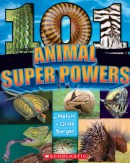
101 Animal Super Powers by Melvin Berger and Gilda Berger

Discover lots of extraordinary animals with this collection of animal superpower stories.  


Photo of DESERTS author Nancy Castaldo

Nancy Castaldo has written books about our planet for over 20 years including, SNIFFER DOGS: How Dogs (and Their Noses) Save The World, so she knows first hand about animal superpowers. Her books have earned the Green Earth Book Award, Junior Library Guild Selection, and other honors. Nancy’s research has taken her all over the world from the Galapagos to Russia.  She strives to inform, inspire, and empower her readers. Nancy also served as Regional Advisor Emeritus of the Eastern NY SCBWI region. Her 2020 international title about farm and food is THE FARM THAT FEEDS US: A Year In The Life Of An Organic Farm. Visit her at her website, on Twitter, on Facebook, and on Instagram

Sibert Honor author Patricia Newman shows young readers how their actions can ripple around the world. Using social and environmental injustice as inspiration, she empowers young readers to seek connections to the real world and to use their imaginations to act on behalf of their communities. One Texas librarian wrote, “Patricia is one of THE BEST nonfiction authors writing for our students in today’s market, and one of our MUST HAVE AUTHORS for every collection.” Titles include: Planet Ocean (new); Sibert Honor book Sea Otter Heroes; Green Earth Book Award winner Plastic, Ahoy!; The NSTA Outstanding Science Trade Book Eavesdropping on Elephants; California Reading Association’s Eureka! Gold winner Zoo Scientists to the Rescue. Visit Patricia online at her website, on Twitter, on Facebook, and on Pinterest.  

STEM Tuesday — Reptiles — In the Classroom

I learned quite a bit about reptiles this month by reading the following books from the book list.

World’s Biggest Reptiles by Tom Jackson, illustrated by Vladimir Jevtic Support Independent Bookstores - Visit IndieBound.org
Many different reptiles are represented in this book, representing the biggest of the species. It includes lots of information and fun facts, represented in fun, accessible ways. Each reptile featured has a graphic novel style page and a page with a large photograph and general information. Each also includes an infographic showing the animal’s size relative to an adult human. (One nitpick on the infographic is it’s not clear what size the human is.)

Sneed B Collard III’s Most Fun Book Ever About Lizards by Sneed B. Collard III Support Independent Bookstores - Visit IndieBound.org
This book focuses on (surprise!) lizards. It highlights a few specific species, but is written to give more general information about lizards. It has chapters with titles like “Eating Like a Lizard” and “Lizard Troubles.” The tone is very conversational and fun to read, although some of the references may be a little dated.

Sea Turtles are Awesome by Mirella S. Miller Support Independent Bookstores - Visit IndieBound.org
Since turtles are my favorite reptile, I had to read this book! Like all 12-Story Library books, this one has 12 chapters that can be read in any order. There are lots of great photos and fun facts about sea turtles throughout the book.


So what can you do with these books? Here are a few ideas I had…

Check Out the Locals

Research what reptiles you might see in your backyard or local park. Most states have websites with information about the reptiles (and other animals) that can be found there.

This can be a great exercise for entering search parameters into an internet search and evaluating the sources it recommends.

When I enter “New Jersey reptiles” into my search engine, the first four recommended sites are provided by the state of New Jersey, which includes the Division of Fish & Wildlife. Of these, one of my favorite sites is the “Online Field Guide for Reptiles and Amphibians.” Each NJ herp (reptile or amphibian) has a printable fact sheet.

To take this a step further, visit a local park where you might be able to view some of the local reptiles.

Bigger Than…

Each of the books I read talked about the size and speed of different reptiles. This could become a fun and informative activity.

Pick a reptile to do some comparisons on. How long is it? How heavy? How fast does it move? This could come from the books on this month’s list or from research done on local (or other) reptiles.

Once you have the information on your reptile, you need to find things for comparison. Here are some to try:

Bigger than a _____________________.

Smaller than a ____________________.

Faster than a _____________________.

Slower than a _____________________.

These will be based on a number that came from somewhere. That means it should include a source citation. Explore what makes a source credible and see if you can find multiple sources for each fact. You can also practice how to create a bibliography and/or source notes. 

Lots of zoos and aquariums have great resources for researching the animals they have there. Another great resource for animal information is the Animal Diversity Web, produced by the University of Michigan Museum of Zoology.

To explore representing information, create infographics that show the relative size and speed of the all the things used in the comparisons.

Participate in the Tour de Turtles

Since 2008, the Sea Turtle Conservancy has been running the Tour de Turtles. Through it, they hope to educate people about sea turtles, how they migrate, and what dangers they face. There is a page dedicated to Teacher Resources, and another for Activities. I love exploring the different turtles and where their travels have been taking them.

In addition to exploring the resources on this web site, you could hold your own Tour de Turtles or Tour de Reptiles. Organize a charity walk/run to raise money for a sea turtle organization like the Sea Turtle Conservancy or other organization that supports turtles and/or reptiles. (This could include organizations that protect lots of different wildlife, like the Conserve Wildlife Foundation of NJ.) To add more education into this exercise, have each participant pick a type of turtle or reptile to research and represent.

Explore Turtle Symbolism

Years ago, we met Native American artist Eli Thomas and bought a print about Turtle Island. It still hangs on our wall, and I still think about the symbolism embedded in it. (You can see the print and read about the symbolism here: https://www.etsy.com/listing/483429848/turtle-art-native-american-art-wolf-art

Explore how indigenous people view turtles. Here are a few interesting resources.

The Native American Box Turtle Connection – https://www.stlzoo.org/about/blog/2016/10/13/native-american-box-turtle-connection

From Voices of Indian Country: https://blog.nativehope.org/native-american-animals-turtle-keya

Read and explore Thirteen Moons on Turtle’s Back by Joseph Buchac and Jonathan London, illustrated by Thomas Locker Support Independent Bookstores - Visit IndieBound.org

Then check out these additional resources:
https://teachingsofourelders.org/thirteen-moons-on-turtles-back
https://www.earthhaven.ca/blog/13-moons-on-turtles-back/208


I hope these ideas have inspired you to incorporate these books (and the subject of reptiles) into your plans.


Author Janet Slingerland on the London Eye.Janet Slingerland has written more than 20 nonfiction books for children. She even got to write about sea turtles in 12 Epic Animal Adventures. When she’s not writing, Janet can often be found exploring the world in her own backyard (which sometimes includes turtles!). For more information about Janet, check out her website at http://janetsbooks.com.

STEM Tuesday — Reptiles — Book List

Have you ever found a snake in your garden? Watched a turtle cross the road? Met a dragon face-to-face? These books are all about the cold-blooded, scaly denizens of our planet, and how we can make our world a better place for them.

Ultimate Reptileopedia: The Most Complete Reptile Reference Ever by Christina Wilsdon

The first section introduces what reptiles are, adaptations, habitats, and conservation concerns. This is followed by sections with detailed information on a diversity of species: lizards and snakes; turtles and tortoises; and crocodilians. Each spread includes a photo, quick facts, and an encyclopedic entry about the featured reptile. Plus there’s a chat with a herpetologist at the end.


World’s Biggest Reptiles by Tom Jackson with illustrations by Vladimir Jevtic

How can animals grow so big – and why would they? This book takes a look at huge reptiles in the ocean and on land. There’s a fun mix of photos, textboxes, and graphic-style pages with speech bubbles as well as size comparisons to a human.


Unusual Life Cycles of Reptiles by Jaclyn Jaycox

Which reptiles are only female, which climb trees, and which ones take 18 months to hatch? These fascinating facts, as well as the lifecycles, lifespans, migrations, and reproduction of a range of reptiles are explored using a combination of full page photographs, side-bar fact nuggets, and helpful back matter.


One Iguana, Two Iguanas: A Story of Accident, Natural Selection, and Evolution by Sneed B. Collard III

A great introduction to the marine iguana and land iguana that live in the Galapagos Islands. This book covers the formation of the islands and how iguanas arrived (by accident!). It shows how the Galapagos shaped the evolution of other species as well.


Sneed B. Collard III’s Most Fun Book Ever About Lizards  by Sneed B. Collard III

Lizards are the least understood but most common reptile on our planet. This book introduces a diversity of lizards, how they eat and keep from being eaten, and other adaptations. There’s a section on threats to lizards and conservation efforts.


Komodo Dragons: Deadly Hunting Reptiles by Rebecca Hirsch

Fun exploration of the traits, habits, and habitats of a Komodo Dragon, through the use of a compare and contrast evaluation of other unusual, amazing reptiles. Although the Rhinoceros Iguana, Mexican Mole Lizard, Yellow-Bellied Sea Snakes, and Burmese Pythons share some individual aspects, the Komodo Dragon is a unique, big, venomous reptile. The book includes conservation efforts, a trait chart, and expanded learning resources.


DK Everything You Need to Know About Snakes and Other Scaly Reptiles by John Woodward

After a quick definition and a family tree, this book jumps right into snakes. We see the insides of snakes and a detailed skeleton, learn all about how fangs work, what venom is, and how it works. An interactive component is added by turning the book.


Awesome Snake Science! 40 Activities for Learning about Snakes by Cindy Blobaum

A good introduction to finding snakes, as well as their anatomy, how they eat, how they move, and adaptations. Lots of fun “snake science” sidebars sprinkled throughout. Activities include experiments and art projects that are simple, engaging, and safe for kids.


Sea Turtles are Awesome by Mirella S. Miller

A concise overview of sea turtles, their adaptations to underwater life, where they live, what they eat, threats facing them, and what you can do to help save sea turtles. Throughout the book are sidebars highlighting a number. It might be how many hours it takes to dig a nest, with a bullet-list of details about how to dig one, or the number of eyelids a sea turtle has.


Turtles & Tortoises: An In-depth Look at Chelonians, the Shelled Reptiles That Have Existed Since the Time of Dinosaurs by Taylor, Barbara

Full of stunning photographs and detailed diagrams, this book delves into the features and movement, life cycles and survival, habitats and history of familiar and strange chelonians. In addition to six detailed “Focus On” sections (one on the Galapagos Tortoise), it offers fascinating nuggets from the literature, mythology, and art surrounding turtles, tortoises, and terrapins.


Alligators and Crocodiles!: Strange and Wonderful by Laurence Pringle and illustrated by Meryl Henderson.

This book opens with an up-close-and-personal encounter with an alligator and its hatchlings. From there we are introduced to the diversity of crocodilians, and how they are alike and different. There’s info on conservation issues, too.


Bringing Back the American Alligator by Cynthia O’Brien

The American alligator was endangered at one time, but conservation efforts helped the population recover. This book shows how legislation and action by federal and state agencies helped protect the alligator. The increasing number of gators is helping restore the ecosystem as well. Includes information about what people can do to keep wetland habitats healthy for all species.


____________________________________________________________________

This month’s book list prepared by:


Sue Heavenrich is a blogger, author and, as a kid, adopted a horned lizard (aka: horny toad) and curated a collection of snake skulls on a hidden shelf in the back of the garage. When not writing, you’ll find her counting pollinators in the garden or tromping through the woods. Visit her at www.sueheavenrich.com.


Maria Marshall is a children’s author, blogger, and poet passionate about making nature and reading fun for children. She’s been a judge for the Cybils Awards from 2017 to present. Her poems are published in The Best Of Today’s Little Ditty 2017-2018, 2016, and 2014-2015 anthologies. When not writing, critiquing, or reading, she bird watches, travels the world, bakes, and hikes. Visit her at www.mariacmarshall.com.