Posts Tagged books

STEM Tuesday– Math – Book List


Math really is everywhere we look: from the geometry of nature to the physics of a jump shot. This month’s book list showcases the incredible world of mathematics.


It’s A Numbers Game! Basketball (part of “It’s a Numbers Game!” series)

by James Buckley Jr for National Geographic

Children may not realize it at first, but numbers play an important role in basketball. Math and numbers dominate this sport, from the dimensions of the court to the number of seconds NBA players have to score a basket. This is a fun book filled with math facts pertaining to basketball, colorful graphics, and sports trivia. It also includes a Foreword by the legendary Kobe Bryant.


A Quick History of Math

by Clive Gifford, illustrated by Michael Young

This book chronicles the history of math, beginning with the Lebombo bone (the very first mathematical object in the world) all the way to the present day. Readers will learn how to count like an Egyptian using hieroglyphs and how to do matha-magic with magic squares. It’s fun and engaging, and also packed with jokes, graphics, and activities.


What’s the Point of Math? What's the Point of Math? by DK
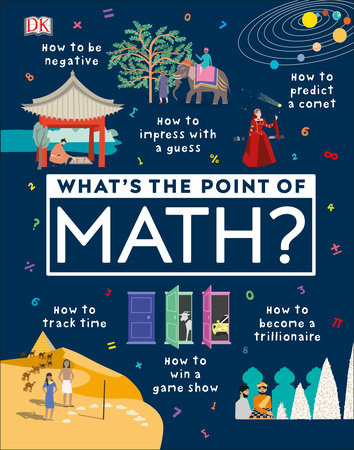
by DK

What’s the Point of Math? not only highlights how math is all around us, but also,that math is fun. Through a slew of fun facts, magic tricks, and mathematical brainteasers, readers will be entertained while they learn. The book also touches on the history of math as well as bios of famous mathematicians.


Much Ado About Baseball

Much Ado about Baseball

by Rajani Larocca


Although this is fiction, Much Ado about Baseball is a stellar book. To be clear, it doesn’t specifically teach readers about mathematical concepts, but the narrative connects to math in many ways. For example, twelve-year-old protagonist Trish is able to solve tough math problems and loves baseball. When she moves and joins a new baseball team, they must solve a difficult puzzle or there will be tragic consequences.


The Wacky and Wonderful World Through Numbers 

by Steve Martin, Clive Gifford, and Marianna Taylor


This book will likely entice readers with its wacky and fascinating facts that show how math is all around us. For example, honeybees must visit 2 million flowers to make about a pound of honey. It is a wealth of fun and interesting information presented in a well-organized, engaging way with over 60 different topics to choose from.


The School of Numbers

by Emily Hawkins & Daniel Frost

Young readers (and aspiring space cadets) will embark on an intergalactic mathematical journey as they make their way through this interactive book. Its 40 lessons are narrated by six “professors” from the fictional Astro Academy, covering topics like negative numbers, fractions, angles, statistics, and more. Along the way, the professors provide clear explanations of math concepts, handy tips and timesavers, and plenty of activities for practice.


Sir Cumference Math Adventures 

by Cindy Neuschwander and Wayne Geehan

This delightful, punny series features the brave knight Sir Cumference, his wife, Lady Di of Ameter, and their son, Radius. The noble family uses math to solve all sorts of problems that threaten King Arthur’s kingdom, from fire-breathing dragons to ogre kidnappers to enemy armies. Along the way, they unlock the mysteries of geometry, decimals, and data visualization.


The Kitchen Pantry Scientist Math for Kids [Book]

The Kitchen Pantry Scientist Math for Kids 

by Rebecca Rapaport and Allanna Chung, photos by Glenn Scott, illustrations by Kelly Anne Dalton

Equal parts history and “how-to,” this engaging book encourages kids to follow in the footsteps of incredible mathematical pioneers. It presents 20+ short biographies of influential mathematicians, from Federico Ardila to Florence Nightingale to Maryan Mizakhani. Each profile is accompanied by a hands-on activity related to the mathematician’s work. With magic tricks, games, and crafts galore, Rappaport and Chung bring abstract math topics to life.


Dollars & Sense: A Kids’ Guide to Using – Not Losing– Money

by Elaine Scott & David Clark

This primer explores history of money and banking, particularly within the US. After tracing the development of various currency and banking systems, it discusses the impacts of The Great Depression and The Great Recession and ends with some helpful hints about saving and budgeting. Overall, this is a great introduction and discussion starter for kids who are starting to think critically about their own values and habits about money.


The Big Fat Middle School Math Workbook

by Workman Publishing and the Editors of Brain Quest

This handy homework helper is packed full of lessons, definitions, study hacks, and hundreds of practice problems. Its layout is clear and straightforward, so students can jump to any topic and dive right in. The answer key at the back of the book not only provides the right answers but also explains how to solve each problem.


________________________________________________

This month’s STEM Tuesday book list was prepared by:

Author Lydia Lukidis

Lydia Lukidis is the author of 50+ trade and educational books for children. Her titles include DANCING THROUGH SPACE: Dr. Mae Jemison Soars to New Heights (Albert Whitman, 2024), DEEP, DEEP, DOWN: The Secret Underwater Poetry of the Mariana Trench (Capstone, 2023) and THE BROKEN BEES’ NEST (Kane Press, 2019) which was nominated for a Cybils Award. A science enthusiast from a young age, she now incorporates her studies in science and her everlasting curiosity into her books. Another passion of hers is fostering a love for children’s literacy through the writing workshops she regularly offers in elementary schools across Quebec with the Culture in the Schools program. For more information, please visit www.lydialukidis.com.


author Callie DeanCallie Dean is a researcher, writer, and musician living in Shreveport, LA. She writes stories that spark curiosity and encourage kids to explore their world. Follow her on Twitter at https://twitter.com/CallieBDean.


STEM Tuesday– Genetics– Book List


Genes play an important role in determining what makes us us. Dive right into these books, which are great resources on genes, DNA, and cutting-edge technology that holds a lot of promise for the future.

Genetics (A True Book: Greatest Discoveries and Discoverers) 

by Christine Taylor-Butler

Scientists now know that genes are the blueprint for life, but many years ago they didn’t. They discovered it when they attempted to change the traits of living things by altering their genes. Learn about the a-ha moments these scientists had; and more, with this engaging text


The DNA Book

by Alison Woollard

A colorful, interesting book with an in-depth look at DNA and its role in our lives: what DNA does, why we look like our parents, how DNA evidence helps catch criminals, genetic engineering, and more.


The Human Genome

The Human Genome: Mapping the Blueprint of Human Life

by Carla Mooney, illustrated by Tom Casteel

All about the human genome, and how understanding it has added to our knowledge in fields like medicine and human history. With hands-on STEM activities, and discussions on the social and ethical issues of genomic science, this book is a fascinating peek into the world of genetics.


The Code Breaker -- Young Readers Edition


The Code Breaker: Jennifer Doudna and the Race to Understand our Genetic Code

by Walter Isaacson, Adapted for young readers by Sarah Durand

An account of how Nobel Prize Winner Jennifer Doudna and her colleagues launched CRISPR, a tool that can edit DNA, and a discussion of its potential, and the associated moral implications.


CRISPR: A Powerful Way to Change DNA

by Yolanda Ridge, illustrated by Alex Boersma

An engaging book, with detailed illutsrations that explains CRISPR, and the potential it has in the fields of medicine, food and conservation.


Blood, Bullets and Bone: The Story of Forensic Science from Sherlock Holmes to DNA

by Bridget Heos

A history of modern forensic science right from the 1700s to modern times, with its advanced technology, including DNA testing, which has changed the world of forensic science.


Biodiversity: Explore the Diversity of Life on Earth with Environmental Science Activities for Kids (Build It Yourself)

by Laura Perdew (Author), Tom Casteel (Illustrator)

Calling all middle schoolers who are curious about life on earth and its biodiversity. This hands-on STEM-based book is filled with activities to engage critical thinking, as well as lead readers to explorations of the biodiversity around them. 


I Can Be a Science Detective: Fun STEM Activities for Kids 

by Claudia Martin

Simple hands-on experiments on how to catch a thief, extract DNA from strawberries, and much more!


Extract DNA with Rosalind Franklin: Women in Science Interactive Book With Illustrations

Rosalind Franklin is a known chemist and x-ray crystallographer who is passionate about DNA. She loves sharing her knowledge about this fantastic discovery:  she was the first person to discover the shape of DNA! With her expert guidance, readers will be able to experiment at home and make discoveries for themselves. 


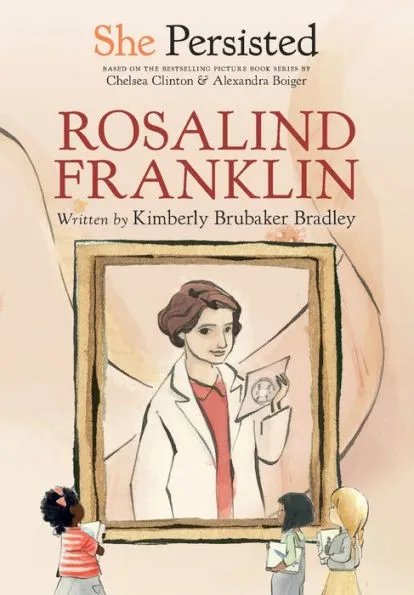
She Persisted: Rosalind Franklin


She Persisted: Rosalind Franklin

by Kimberly Brubaker Bradley, Chelsea Clinton, Alexandra Boiger (Illustrator), Gillian Flint (Illustrator)

A biography of the amazing woman who persisted in following her dreams to become a scientist and played an important role in the discovery of the shape of the DNA.


Saving the Tasmanian Devil: How Science is Helping the World’s Largest Marsupial Carnivore Survive

by Dorothy Hinshaw Patent

This book describes how scientists are working to prevent and eradicate genetic diseases, and helping to save Tasmanian Devils, which are dying in large numbers due a deadly disease.


De-Extinction: The Science of Bringing Lost Species Back to Life

by Rebecca E. Hirsch

This book explains how scientists are trying to reverse extinction and bring back species to life, using techniques like cloning. It also discusses the pros and cons of de-extinction.


Susan Summers is a wildlife enthusiast and an author. Contact her at: https://susan-inez-summers.weebly.com/


Shruthi Rao is an author. Her home on the web is https://shruthi-rao.com


STEM Tuesday– Nuclear/Atomic Science– Book List

From X-rays to bombs, coverups to meltdowns, the history of radioactive elements has never been boring.

Who Split The Atom? by Anna Claybourne

Using a DK-like format, it explores the early history and research into the structure of atoms, the periodic table, radioactivity, and atomic science. Loaded with photographs, graphics, “That’s A Fact!,” “Breakthrough,” and scientific sidebars, as well as vignettes of scientists, it is an accessible and engaging introduction to radioactivity.

Atomic Universe: The Quest To Discover Radioactivity by Kate Boehm Jerome

This National Geographic book uses a running timeline across the top of the pages (from 1800 to 1971), photographs, mini biographies, and “science booster” sidebars to interest high-low readers in an introductory overview to radioactivity, atomic science, and nuclear reactors.

The Woman Who Split the Atom: The Life of Lise Meitner by Marissa Moss

Lise Meitner made groundbreaking discoveries in the study of radiation. She was the first to split the atom. But as a woman she faced many barriers, with men often taking credit for her scientific research. When Hitler came to power she had to face anti-Semitic threats as well. In addition to the science of radioactive elements, this book shows how easily women’s contributions can be erased from the history of science.

Radioactive!: How Irène Curie and Lise Meitner Revolutionized Science and Changed the World by Winifred Conkling

This gripping dual biography provides an in depth look at both the discoveries, life-long personal sacrifices, and professional struggles which Irène Curie and her husband Frédéric Joliot-Curie made in discovering artificial radiation and Lise Meitner made in discovering nuclear fission. It also touches on Marie and Pierre Curie’s discovery of natural radiation, society’s grappling with radiation, World War II, and the atomic bomb. Includes a time line, Who’s Who section, black and white photos, and fascinating sidebars further explaining the science.

Marie Curie for Kids: Her Life and Scientific Discoveries, with 21 Activities and Experiments by Amy M. O’Quinn

This book begins with Marie Curie’s childhood in Poland and takes readers through her scientific work and discoveries. Her work in radioactive elements was pivotal in creating the field of atomic physics and she added new elements to the periodic table. Curie was the first woman to win a Nobel Prize in not one, but two fields: chemistry and physics. Hands-on activities include building atomic models, a periodic table scavenger hunt, and splitting water into atoms.

The Science and Technology of Marie Curie, by Julie Knutson

Another book for Curie fans, that explores her groundbreaking research in physics and chemistry. Just as these discoveries forced scientists to rethink the structure of the world, Curie’s work forced them to rethink the role of women in science. Information boxes and sidebars are scattered throughout chapters, as are some biographies of other women in science, and there are a handful of activities to explore.

The Radium Girls: The Scary But True Story Of The Poison That Made People Glow In The Dark by Kate Moore

Equal parts medical mystery, corporate cover-up, and justice for women workers. This riveting true story about young women who used “glow-in-the-dark radium paint” on watch dials details the incredible lengths that the corporations took to evade responsibility for the women’s radium poisoning and deaths and the horrendous suffering of the girls. As well as the amazing efforts of a few doctors and lawyers determined to help these women fight back for their families and to save others and forever change workplace laws.

Bomb: The Race to Build—and Steal—the World’s Most Dangerous Weapon by Steve Sheinkin

Take one part spy thriller, one part scientific research, and a dash of political intrigue and you get an explosive mix! In this book Sheinkin traces the race from splitting the uranium atom to harnessing the power of the first atomic bomb. Section headings include titles such as “how to build a bomb” with an epilogue that discusses the fallout of the atomic arms race. The heart of the book is based on first-hand accounts by participants in the events.

In Fallout: Spies, Superbombs, and the Ultimate Cold War Showdown, Steve Sheinkin takes readers on a fast-paced and terrifying journey into the Cold War and nuclear arms race. Like Bomb, Fallout is a page-turning nonfiction – perfect for kids who love science and history.

Chien-Shiung Wu: Pioneering Nuclear Physicist by Richard Hammond

This upper-middle grade book looks at the contributions this brilliant Chinese-American nuclear physicist made to the Manhattan Project – production of radioactive uranium for the atomic bomb and improvements of radioactive detectors. As well as Wu’s later experiments which changed scientists’ understanding of physics and resulted in her election as the first female president of the American Physical Society. Includes photographs, timelines, diagrams, and extensive further resources.

The Disappearing Spoon, And Other True Tales of Rivalry, Adventure, and the History of the World from the Periodic Table of the Elements (Young Readers Edition) by Sam Kean

While this book isn’t exclusively about radioactive elements, there are plenty of stories about them – and their discoveries – to make it worth checking out. In a conversational tone, Kean talks about the periodic table, element families, and how elements are discovered. Sprinkled throughout are stories about the discovery of fission, the Manhattan Project, the “radioactive boy scout,” as well as Marie Curie and Lise Meitner.

Meltdown: Earthquake, Tsunami, and Nuclear Disaster in Fukushima by Deirdre Langeland

On March 11, 2011, the largest earthquake ever measured in Japan occurred off the northeast coast. It triggered a tsunami with a wall of water 128 feet high that ripped apart homes, schools, and damaged the nuclear power plant in Fukushima, causing a nuclear meltdown. Chapters describe the events as well as the science of nuclear reactors. Each section begins with a readout of reactor status, from “offline” to “meltdown” with the last chapter exploring lessons learned.


This month’s STEM Tuesday book list was prepared by:

Sue Heavenrich, author

Sue Heavenrich, who writes about science for children and their families on topics ranging from space to backyard ecology. Bees, flies, squirrel behavior—things she observes in her neighborhood and around her home—inspire her writing. Her most recent book is Funky Fungi (with Alisha Gabriel). Visit her at  www.sueheavenrich.com

Maria Marshall, a children’s author, blogger, and poet who is passionate about making nature and reading fun for children. When not writing, critiquing, or reading, she watches birds, travels the world, bakes, and hikes. Visit her at www.mariacmarshall.com