Chemistry

STEM Tuesday– Chemistry– Book List


Chemistry is everywhere! It helps us understand how the world works. Explore many aspects of chemistry with biographies, a cookbook, a graphic novel, a study guide, amazing true tales, and several fascinating informational texts!

Cover of the book Who Was George Washington Carver?

Who Was George Washington Carver? by Jim Gigliotti

This book introduces Carver, a famous American agricultural scientist, educator, and scientist. Born into slavery in 1864, Carver became the first Black student at Iowa State Agricultural College and then its first Black professor. His research with plants which focused largely on peanuts, revolutionized Southern agriculture.

Cover of the book Maria Orosa Freedom Fighter, Scientist and Inventor from the Philippines

Maria Orosa Freedom Fighter: Scientist and Inventor from the Philippines by Norma Olizon-Chikiamco

This book shares the inspiring biography of a remarkable woman who studied chemistry and pharmaceutical science and created super-nutritious foods to save the lives of many people in the Philippines during a time of crisis.

Cover of the book The Illustrated Encyclopedia of the Elements The Powers, Uses, and Histories of Every Atom in the Universe

The Illustrated Encyclopedia of the Elements: The Powers, Uses, and Histories of Every Atom in the Universe by Lisa Congdon

Learn about all 118 elements in this book for children age 10 and up. The book includes images that take the reader on a periodic table journey. Along the way it also includes infographics and information about scientists.

Cover of the book Science Comics The Periodic Table of Elements Understanding the Building Blocks of Everything

Science Comics: The Periodic Table of Elements: Understanding the Building Blocks of Everything by Jon Chad

Mel, an anxious chemistry student, dreams of the land of the elements in this graphic novel. Readers learn about the elements and periodic table as Mel and Hydrogen battle against their evil nemesis Elemancer. The book’s imaginative and interesting story are likely to appeal to older elementary and middle school students and provide a fresh approach to understanding the periodic table.   

Cover of the book Chemistry for Curious Kids

Chemistry for Curious Kids: An Illustrated Introduction to Atoms, Elements, Chemical Reactions, and More! by Lynn Huggins-Cooper

This book provides clear, easy to follow explanations that support understanding of the states of matter, chemical building blocks, the periodic table, and scientific tools. Illustrations, questions, and thoughtful arrangement of key ideas make complex chemistry content accessible.  Other titles in this STEM series focus on biology and science and math.


Cover of the book The Complete Cookbook for Young Scientists

The Complete Cookbook for Young Scientists: Good Science Makes Great Food: 70+ Recipes, Experiments, & Activities (Young Chefs Series) America’s Test Kitchen

This book explains everyday cooking phenomena and helps children understand the “why” in food preparation. It’s full of hands-on experiments that explain how chemical interactions transform food. It will encourage young chefs to ask questions, observe, measure with precision, collect data, analyze, and answer the food science questions they find intriguing.

Cover of the book The Radium Girls

The Radium Girls: Young Readers’ Edition: The Scary but True Story of the Poison that Made People Glow in the Dark by Kate Moore

This book is the true and shocking story of hundreds of girls who worked in factories, painting watch dials with radium. With each new dial, they licked the paintbrush to create the finest possible tip. At first the fact that they glowed was a marvel but the novelty turned controversial and horrifying as radium poisoning overtook them. Their heroic courage and resolve led to advances in laboratory regulations and research.

Cover of the book Our World in Pictures The Elements Book

The Elements Book: A Visual Encyclopedia of the Periodic Table (DK Our World in Pictures)

With remarkable pictures and text, this book offers a fascinating tour of the elements, substances that cannot be broken up into smaller ingredients. It looks at the unique and sometimes surprising properties of the elements and explains where they come from, what they can do, and how they can be used.

Everything You Need to Ace Chemistry in One Big Fat Notebook by Jennifer Swanson

This book uses diagrams, graphics, mnemonic devices, and compelling characters to delve into atoms. elements, compounds, mixtures, the Periodic Table, chemical reactions, chemical calculations, and so much more. It’s a great companion for students studying for a chemistry exam.

Cover of How Do Molecules Stay Together?

How Do Molecules Stay Together?: A Book About Chemistry by Madeline J. Hayes

This book uses a question-and-answer format to explain a variety of chemistry concepts: atoms, elements, compounds, states of matter, and chemical reactions. It includes a simple and effective explanation of condensation, evaporation, freezing, and melting. The book is part of the How Do Series.

Cover of the book the Disappearing Spoon

The Disappearing Spoon: And Other True Tales of Madness, Love, and the History of the World from the Periodic Table of the Elements by Sam Kean

This book is full of fun and fascinating chemistry stories. Anecdotes of adventure, conflict, drama, and obsessions reveal how elements influenced our world. First published in 2011, this book continues to bring the history of chemistry alive.

Cover of the book Marie Curie for Kids

Marie Curie for Kids: Her Life and Scientific Discoveries, with 21 Activities and Experiments by Amy M. O’Quinn

Learn about Marie Curie in this engaging book. Many are familiar with Curie’s brilliance in chemistry and physics as the first woman to win a Nobel Prize through boiling mercury off to reveal pure radium metal. Alongside Curie’s brilliance in atomic physic discoveries, the reader learns about Curie’s role as a mother, her scientific partnership with her husband, inclination to forget sleeping and eating, refusal to monetize her scientific discoveries, and her health concerns. Twenty-one hands-on activities and experiments further the text, along with a list of resources and interesting sidebars.


This month’s STEM Tuesday book list was prepared by:

New Realeases Nov 2025

Bev Schellenberg is an author (A Prince Among Dragons; A Princess Among Dragons), as well as a writer of creative nonfiction, poetry, and picture books. She’s an advocate of STEM who was a science fair national winner and high school robotics club sponsor, and passionate about young people discovering, following the passion inside them and flourishing. She’s taught grades kindergarten to grade 12 and is currently an academic advisor, careers teacher, and armchair futurist. Learn more about Bev at BevSchellenberg.com.


Carolyn Pfister is a STEM Content Developer, writer/illustrator, and coordinator of the California Early Math Project. She is interested in encouraging family and community STEM opportunities and maintaining 

children’s early love and success with math and science. Carolyn writes a monthly Substack on behalf of the California Early Math Project – https://carolynpfister.substack.com/. Learn more about Carolyn at Carolynpfister.com


STEM Tuesday — Chemistry ROCKS! — Interview with Author Kathy Ceceri

Welcome to STEM Tuesday: Author Interview & Book Giveaway, a repeating feature for the fourth Tuesday of every month. Go Science-Tech-Engineering-Math!
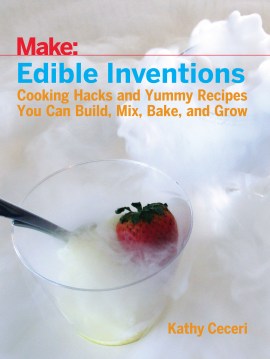
Today we’re interviewing Kathy Ceceri about her chemistry-infused book, EDIBLE INVENTIONS: Cooking Hacks and Yummy Recipes You Can Build, Mix, Bake, and Grow. PickaGoodBook.com says,”this book is such a great source to explore and learn through science and more.”

Mary Kay Carson: How did Edible Inventions come to be?

Kathy Ceceri: I have to credit my friend Miguel Valenzuela, inventor of the PancakeBot, a kind of 3D printer for making cool designs with pancake batter. I had written two books for Maker Media — Making Simple Robots and Paper Inventions — and gotten good feedback from educators and families looking for low-tech projects to help kids learn about STEAM (Science, Technology, Engineering, Art, and Math) concepts. I ran into Miguel at World Maker Faire New York — one of the worldwide celebrations of creativity in tech produced by Maker Media — where I was a speaker, but also casting about for inspiration for my next title. Miguel suggested I focus on food projects, and I roped him into a creating one of them — a hand-powered Lego version of the PancakeBot that lets kids “draw” with icing on cookies. The other projects touch on a wide variety of science and technology, with a heavy emphasis on chemistry, of course!

MKC: What was it like developing all these projects?

Kathy: Like most science experimentation, this one involved a lot of mishap! I spent several days trying to build an edible Rube Goldberg machine that included cucumber slice “dominoes” and a marble run using celery stalks and cherry tomatoes, but in the end it proved too difficult to coordinate all the moving parts. (You can see a test run video here.) More successful was the cardboard box solar oven. After going through several iterations, I finally developed a design that got hot enough to bake a chocolate cake! One of the things I loved about this book (and all my books, really) was learning a bunch of new stuff. For instance, thanks to a tip from another friend, flour expert Amy Halloran, I discovered that housewives used to make their own baking powder from chemicals they got at the local pharmacy. But probably the best part of creating Edible Inventions was getting to eat the results!

MKC: Why do you choose to write STEM books?

Kathy: My background is as a journalist. Over the years, I’ve written for local newspapers, magazines such as Sesame Street Parent, and websites such as Wired.com (where I helped create the GeekMom blog) and About.com (now Thoughtco, where I was the Homeschooling Expert). I’ve covered education, child development, history, art, and science — but I’m not an expert in any of those areas. You could say my expertise is in digging up background information research, finding the right people to talk to, and asking the right questions. My real talent is knowing how to distill what I learn into a form that’s easy for anyone to understand.

Kathy Ceceri is the author of over a dozen books of nonfiction for middle grade readers that teach STEAM along with history, geography, literature, and culture. Her hands-on projects have been used in classrooms and enrichment programs across the country and around the globe. Visit Kathy at Crafts for Learning, and follow her on Twitter @kathyceceri for sneak peeks of works in progress and links to her free online tutorials (including how to make Juicy Edible Gel Dots from Edible Inventions)!

I began focusing on STEAM (the “Art” is an important aspect to me!) after educational publisher Nomad Press asked me to do a book on robotics. Because my then-teenage oldest son was exploring robotics at the time as part of his homeschooling studies, I had spent a couple of years jumping on any opportunity to interview robotics engineers and designers. So I already had a good grasp of the basics, and a contact list of experts who were kind enough to let me pick their brains for topics and project ideas. I discovered I really enjoyed the process and I’m good at it, so I’ve continued writing about STEAM topics even after my kids grew up and moved onto other interests!

Today I teach crafts-based electronics and enrichment programs for kids and teens, and present hands-on professional development workshops for teachers and librarians. I’ve also worked with the Girl Scouts of the USA on their recent line of Robotics badges and their first-ever Cyber Challenge, coming this fall. All of these experiences help me keep in touch with what students and educators want to know about STEAM topics and ensure my writing is fresh and relevant.

MKC: To whom did you imagine yourself writing to while drafting the book?

Kathy: All my books are written for readers with little to no knowledge about the topic. That’s where I am at the start, too. So I can recognize the places where beginners are going to need some hand-holding and encouragement. I always try to relate concepts and techniques to things the reader is already familiar with. With robots, I use familiar materials like cardboard and duct tape. With Edible Inventions, I included a chapter featuring recipes that used standard ingredients and techniques to create unexpected textures and flavors (sort of like Molecular Cuisine, but using things you could find in any supermarket or natural food store). What makes my book different from an ordinary cookbook is that I emphasize the science. How does whipping an egg white turn a gooey liquid into a stiff meringue? Why do juice-flavored gelatin dots change color when you plop them into lemon-lime soda? And what’s the chemical reaction that causes watermelon lemonade to foam up and bubble over when you add a touch of baking soda? Readers get to learn about chemistry while making tasty snacks — what could be better?

MKC: What’s your current project and how are you tackling it?

Kathy: My next book, Bots! from Nomad Press, is an update on my original 2012 book Robotics. It contains several new projects and topics, as well as old favorites. As with every book I write, I try to approach the topic from as many different angles as possible. I firmly believe that showing how science relates to other kinds of creative activities helps bring in people who might not otherwise give it a try. So along with engineering, electronics and programming, there’s a “kitchen chemistry” robotics project that shows you how to make edible, stretchable robot skin! And like most of my projects, it ties into actual research — in this case, researchers who are trying to make inflatable robots that can crawl or slither into hard-to-reach areas. They hope their edible robots could help rescue lost explorers trapped in a cave, for example, and provide nourishment after sending back data about their location. You can see video of my homemade edible inflatable robot here. Bots! comes out in October 2019.

Win a FREE copy of EDIBLE INVENTIONS!

Enter the giveaway by leaving a comment below. The randomly-chosen winner will be contacted via email and asked to provide a mailing address (within the U.S. only) to receive the book.

Good luck!

Your host is Mary Kay Carson, author of The Tornado Scientist, Alexander Graham Bell for Kids, Mission to Pluto, Weird Animals, and other nonfiction books for kids. @marykaycarson

STEM Tuesday — Chemistry ROCKS! — Writing Tips & Resources

“CHEMISTRY! CHEMISTRY! CHEMISTRY!”

The crowd chants as the June sun sets on the western horizon. The emcee, DJ “Atom” Mick Orbitals, takes the stage to thunderous applause.

“Ladies and gentlemen…

ARE YOU READY TO ROCK?”

The crowd explodes with a roar like an alkali metal added to water. 


“Welcome to the Chemistry Rocks Summer World Tour 2019! Let’s rock!”

By https://pxhere.com/es/photo/41796 via Wikimedia Commons.

STEM Tuesday fans, sit back, relax with your favorite chemically enhanced or brewed beverage and enjoy the show.

Chemistry Rocks!

It really does. Qualitative, quantitative, organic, bio, physical, whatever or whichever, they all rock the scene. From the twitch of a muscle to the Fourth of July fireworks display to the explosion of the LH2 (liquid hydrogen) fuel that propels a rocket into space toward Mars, chemistry is there. Reaction after reaction after reaction occurring all around us every microsecond of every day. Sight, smell, taste, touch (If you think about it, we can also technically go with sound when we consider the neurochemistry involved in processing a sound wave) are all affected by chemistry.

Chemical Fun!

Don’t throw your shoe at me! I realize not everyone has had a positive experience with chemistry. I understand. I’ve been there. The struggle was real. I was only able to dig myself out of a “D” hole in high school chemistry because of the additions I was able to add to my science teacher’s herpetological and ichthyological collections for extra credit on the biology side of his classroom. I washed out of Chemistry 101 as an immature, baseball-playing freshman in college and it took three full semesters to dig out of that hole in my transcript.

Chemistry is hard. It’s one of those sciences that is like a completely foreign language. Like the Tower of Babel, one can be confused, frustrated, and want to throw a shoe at that one person who tries to tell you that chemistry is fun. As with language, once you learn the basics, begin to understand the meanings of the words, and learn to navigate those foreign roads, a whole new world opens up. With chemistry comes a new understanding of the world around us and how it operates. We are able to drive our existence toward a better life.

And where else can you perform experiments where colors change, states of matter are shifted, and there’s a potential for explosions?

Celebrate the Periodic Table! 

In 1869 Mendeleev proposed the first periodic table of elements. That makes the periodic table 150 years old! In my opinion, it looks just a fresh and vibrant at 150 as it did in it’s 20s. Maybe even better! I guess some things get better with age, right? I’ve always marveled at the beauty of the periodic table. Well, I marveled when I finally gave in, buckled down and learned the basics of the periodic table. The periodic table is a masterpiece. Just as The Beatles had Sgt. Pepper’s, DaVinci the Mona Lisa, Michaelangelo his sculpture of David, chemistry has the periodic table.

Happy Birthday, Periodic Table!

Better Life

Chemistry has made life better.

I’m sitting on my back patio as I write this section. It’s a beautiful early June Saturday morning. Chemistry surrounds me.

  • I see the cat eating his store-bought cat food, which has been optimized through a blend of macro and micronutrients. In other words, chemistry.
  • There’s the gardener table I built from my kids’ old wooden swingset that both got a recent coat of water sealant. Chemistry.
  • The house paint. Chemistry.
  • The cement of the patio. Chemistry.
  • The flowers and vegetables in pots and in the garden which were recently fertilized with BR-61. Chemistry.
  • I just ate a bowl of rice cereal made from a chemistry-based recipe. The peanut butter on my toast is loaded with chemistry. Heck, even the toasting of the bread by electrical heating elements in a closed chamber is chemistry.
  • I’m working at a steel patio table painted with a rust deterrent coating while typing on a laptop that relies on rare earth metals. Tell me that’s not some amazing chemistry!

I could go on and on but the point is this:

We are surrounded by chemical marvels every second of every day.

Chemistry makes our lives better.

Dark Side

There’s little argument as to the benefits chemistry brings to society. But to everything good, there’s always a dark side. The dark side of chemistry often is a result of our attempts to develop a fix to one particular problem without consideration of the entire ramification spectrum. Pesticides that are also potent carcinogens. Pharmaceutical chemicals with side effects that almost override the positive effects or cause addiction. Chemical weapons.

I could go on with examples of chemistry gone wrong but the point remains we need to be more vigilant with the power of chemistry. The current and future generations of chemists need to design chemical solutions with an eye to the long-term effects and cost-benefit of the solution. This particular solution may work to solve the issue BUT what else does it do?

Writing With Chemistry

I was going to title this section, Writing Chemically, but had second thoughts about the unintended connotations associated with that title. Most writers would classify chemistry as something on the opposite end of the creative spectrum than writing. I understand but hear me out before launching the other shoe at my head.

An ionic bond forms between two oppositely charged atoms when an atom with the weaker force donates an electron to the atom with a stronger force. Covalent bonds form between two atoms when they share electrons to fill their outer orbitals. Hydrogen bonds are weaker bonds that form when the partial positive charge of the hydrogen is attracted to a negatively charged atom. When thinking about the interactions between story elements or characters, chemistry provides three good ways to explore these interactions and reactions.

Or how about using the principals of exothermic (heat released) and endothermic (heat absorbed) reactions to move the plot forward in your story? You can also think about character development in the structural terms of chemistry, primary structure, secondary structure, tertiary structure, and quaternary structure. All four structures contain the same basic bits; it’s a matter of increasing the complexity of the model.  

See? The principles of chemistry can help out the writer as well as the chemist. Another win for science!

By Thomas Shafee – Own work. Via Wikimedia Commons

Explore Chemistry!

Bottom line: Give chemistry a chance because it really does rock.

The benefits far outweigh the detriments.

The rewards in understanding the fundamentals of chemistry are well worth the failures, false starts, and frustrations of the learning process.

We are all a whole lot better off with chemistry than without (and it doesn’t even matter if we don’t understand a lick of the science behind it).

Chemistry Rocks!

Now go enjoy the show.

By Ian T. McFarland from Los Angeles, USA via Wikimedia Commons.

Mike Hays has worked hard from a young age to be a well-rounded individual. A well-rounded, equal opportunity sports enthusiasts, that is. If they keep a score, he’ll either watch it, play it, or coach it. A molecular microbiologist by day, middle-grade author, sports coach, and general good citizen by night, he blogs about sports/training related topics at www.coachhays.com and writer stuff at www.mikehaysbooks.comTwo of his science essays, The Science of Jurassic Park and Zombie Microbiology 101,  are included in the Putting the Science in Fiction collection from Writer’s Digest Books. He can be found roaming around the Twitter-sphere under the guise of @coachhays64.


The O.O.L.F Files

The Out Of Left Field (O.O.L.F.) Files this month take a look at close look at chemistry from all angles, from industry to academics to studying for med school. Plus, what’s a look at how Chemistry ROCKS! without a look at the chemistry of rocks?