WNDMG

WNDMG Wednesday – Holiday Gifts for MG Readers

We Need Diverse MG


We Need Diverse MG Logo hands holding reading globe with stars and spirals floating around

Illustration by: Aixa Perez-Prado

Holiday Gifts for MG Readers

Welcome to WNDMG Wednesday – the holiday edition! Looking for holiday gifts for your MG readers?

How about a video game or virtual reality goggles?

Ha.

Not April Fools yet, sorry, I got confused.

But seriously folks, how about books … and not just books, but a subscription book box? I’ve got the perfect idea: the Atlas Book Club, founded by Bunmi Emenanjo. The Atlas Book Club was created specifically with diversity in mind: to provide a way for kids to read in a way that builds global awareness, cultural consciousness, empathy, and understanding.

Lucky for us at WNDMG, we got to talk to Bunmi a little bit about the Atlast Book Club, and we can’t wait to introduce her.

Interview with Bunmi Emenanjo

WNDMG: What made you decide to start Atlas?

BE: In 2016, my husband and I moved with our kids to our current home in a lovely neighborhood with very little diversity. To ensure the kids remain connected to their heritage, I started a children’s book club initially focused on African books. This book club included kids from different backgrounds made up of kids of friends and from our neighborhood. Also, whenever I was a Guest Lucky forReader at the kids’ elementary school, I selected books from our diverse collection. This usually led to interesting conversations with kids who normally would not have exposure to books set in countries such as Uganda or Burkina Faso. I saw how these books set all over the world resonated with my kids and other kids. My observation was that kids need to see themselves in the books that they read! When they do it helps build their confidence and have a sense of belonging. I also observed that kids are yearning to learn about cultures different from their own! What started off as a home book club where we read books set in different parts of Africa eventually grew into an exploration of countries all over the world. Since launching Atlas Book Club as a business in 2019, we have explored over 25 countries through our book selections!

Atlas Book Club Focuses on Global Diversity

WNDMG: In a time when there’s so much choice in subscription book boxes—and some of those choices do include a focus on diversity—how does Atlas set itself apart from the rest?

EB: Atlas Book Club is different because our focus is on global diversity. We believe that cultural competence is an important aspect of a child’s education and development. We also believe that we do our kids a disservice by not introducing them to global culture when they are young because they will enter, as adults, a workforce that will be more globally diverse than ever.

Our focus, with our boxes, is to bring global culture to a child through a fun, engaging, and interesting book. We are also very intentional about the books that make it into our boxes. Every decision we make is towards fulfilling our mission – (1) to help children of color see themselves in the books that they read; (2) to help all children travel the world and experience global culture through the books we select; and (3) to help shatter single story narratives and stereotypes by showcasing diversity within cultures. Every single item in our box is designed to fulfill that mission. For example, our Fun Facts card typically contains facts that are not well known and that celebrate different parts of the culture of the country we are exploring. We also include a local sourced souvenir from the featured country, which in turn supports a local family or community in that country. We are very particular about the book select and they have to fit certain criteria – we feature books with protagonists of color in genres that do not typically have kids of color as the main character such as magical realism or historical fiction; we ensure that we include books that show kids just being regular kids; and we do not shy away from complex societal issues. Lastly, we explore countries that most people are not even thinking about including Turkey, Iran, Haiti, Botswana, Korea, Peru, and Australia with a focus on Aboriginal history and culture, just to name a few.

Diversity Within Race and Culture Too

WNDMG: You’ve committed to selecting a variety of books that showcase diversity “not just in race and culture, but also diversity within race and culture.” Can you talk a little bit about why that’s such an important distinction?

EB: This is one of the main parts of our mission and we take it very seriously. Often countries have a single story or a narrative that most people associate with that country which can end up fostering dangerous stereotypes. We believe that children are intelligent enough to understand that there are different aspects to every culture and country, we just have to teach them. When a child learns that diversity within cultures exist, they grow up with an awareness and sensitivity that will only serve them well as adults. Even more importantly, it helps them develop a level of respect for these cultures, and an understanding that to really know a person, you must seek to know who they are and where they are from and not simply assume certain things about them based on narratives that exist out in the world.

Furthermore, cultures and countries around the world have such rich, interesting histories and traditions that to boil them down to a single narrative is to lose out on so much richness and stories that could really broaden our understanding of people and of the world. A good example of this is the book You Bring the Distant Near which was featured in one of our YA boxes. This book exposed our readers to Indian Bengali culture. This nuance is important because we were able to dive into the diversity that exists within Indian culture and other South Asian countries. We learned, during our conversation with author Mitali Perkins, the difference between Indian Bengalis and Bangladesh Bengalis, and the history of the Bengal region. This is an example of what we mean by showcasing diversity within cultures through our book selections.

((Looking for additional holiday book suggestions? Check out Rosanne Parry’s latest Diverse Book List HERE))

Working with Parents, Schools, and Libraries

WNDMG: Do you have any partnerships with libraries or schools to support diversity and a global perspective in their collections?

EB: We offer a number of consulting packages to schools, libraries and parenting groups to help them build a book collection and curriculum that is diverse and inclusive in an intentional manner. It is extremely important to create an environment where ALL children can see themselves represented and feel like they truly belong.

WNDMG: Even though your books are curated for young readers, we know adults love to read middle-grade and young adult as well. What kind of responses have you had from parents of your readers?

EB: Ha! I love the parents that snatch up the books before their kids can get to it! The YA books and some of the middle grade ones have been a hit with the parents. You will find that YA books set in other parts of the world have stories that are deep, complex and quite satisfying. Atlas YA books are not all fluff! We have the occasional romance novels but these YA books are simply fantastic. My favorite book of 2020 was one of our YA selections called The Things She’s Seen which we featured when we explored the Aboriginal people of Australia, and it is incredible. And my favorite book this year so far is a middle-grade book called Other Words for Home that just hit me square in the gut. It is featured in our Syria Box.

Kids Feel Seen

WNDMG: Do you have a favorite story of an interaction you’ve had with your book subscribers?

EB: My favorite is a story a mom told me about her Nigerian-American son who attended a mostly white school. He read the book Ikenga by Nnedi Okorafor—a fantasy book with a Nigerian boy as the main character—and he loved the book so much he took it to his school librarian and advocated for the book to be added to his school library. He felt like the book represented so much of him and his culture that his classmates should get to read the book too. This really hit home because he validated what we have always believed – when kids see themselves represented in the books that they read, it helps with their sense of identity and belonging. They feel seen. This kid felt seen by reading the book Ikenga and felt his friends should see him, too.

Next for Atlas

WNDMG: What’s next for Atlas?

EB: Gosh! So much we would love to do! We would love to deepen our relationship with the homeschooling community. Our boxes have been such a hit with homeschooling families because they are perfect for social studies, geography and language arts with a focus on global culture. We also would like to grow our consulting clients because we feel that parents and schools do want to ensure that their libraries are diverse and inclusive, and they do want to provide these options to their students, but they do not know where to start! Our goal is to help schools, libraries and parents get there.

About Bunmi Emenanjo:

(Bio excerpted from Work With Me page on Atlas Website)

With over 17 years as an attorney, I have worked in spaces that span the spectrum from the think-tank Woodrow Wilson International Center for Scholars, biotechnology companies, a number of federal agencies to the White House. The diversity of my work experience allows me to be able to communicate with individuals from different professional and personal backgrounds in a manner that resonates such that they feel seen and heard. As a student of vulnerability and authenticity, I bring all that I have learned to the table,

Stay in Touch with Atlas:

Instagram

Facebook

For more on subscriptions, homeschooling, and school visits, check out the Atlast website HERE.

WNDMG Wednesday — Call for Submissions

We Need Diverse MG Logo hands holding reading globe with stars and spirals floating around

Illustration by: Aixa Perez-Prado

WNDMG Wednesday Submissions

It’s a WNDMG Wednesday call for submissions! This month we’re excited to tell you that we’re looking to expand our team.  We’ve been a fixture on the Mixed-Up Files blog for two years now,  providing readers with once-a-month posts designed to center diverse writers, books, and readers.

Now it’s time to grow! We’re eager to add more voices to those to contribute content for this important series.

Who Should Apply?

Do you love middle-grade books as much as we do? Are you a middle-grade book writer, librarian, or media specialist from an underrepresented or marginalized community? We’re eager to add your voice to the ongoing conversation about diversifying our bookshelves!

WNDMG Contributor Responsibilities

Posting: WNDMG is part of the Mixed-Up Files blog team, which means our contributors work together with the whole blog to keep us running. As a WNDMG contributor, we would ask you to post 2-3 times a year for the series, plus possibly 1-2 times a year for the blog as well.

We value original, quality posts on discussion-invoking topics about diversifying our bookshelves and the publishing industry, unique book lists, or author interviews.

((What don’t we do? Book reviews or self-published books.))

Promotion: We need dedicated new members who will commit to regularly promoting our blog via their own social media pages as well as our own. We also urge you to share the good news when our members have a launch or great news to share!

Blog Upkeep: We ask EACH Mixed-Up Files/WNDMG contributor to take at least one blog maintenance job. A few examples of these jobs (there are more!) are:

  • Updating one of our social media pages
  • Keeping our Oh MG! sidebar news updated
  • Interview team (they rotate taking interview requests that come in…but Mixed-Up Files members are always welcome to coordinate interviews themselves!)


If you’re interested in joining us, click here to fill out an application.


Tip to help you prepare: Read some of our posts here: We Need Diverse Middle Grade. What would you like to see in this series? Use that to help you craft your submission sample.

Please spread the word to others who might be interested. If you applied a while back and would still like to join us, we’d be happy to receive a new application from you.

Applications will be open until December 1. We can’t wait to hear from you and will contact all applicants by mid December. If you have questions, we’re happy to answer them—leave a comment below.

WNDMG Wednesday Author Interview with Nicole Melleby

We Need Diverse MG Logo hands holding reading globe with stars and spirals floating around

Illustration by: Aixa Perez-Prado

Welcome to WNDMG Wednesday and happy September to you all. I’m excited to share my interview with author Nicole Melleby, on her latest book: THE SCIENCE OF BEING ANGRY (Algonquin Young Readers, May 2022).

Book cover with the title The Science of Being Angry featuring a figure in the center of a re-orange circle - with two people looking on at the main figure

About the Science of Being Angry

Eleven-year-old Joey is angry. All the time. And she doesn’t understand why. She has two loving moms, a supportive older half brother, and, as a triplet, she’s never without company. Her life is good. But sometimes she loses her temper and lashes out, like the time she threw a soccer ball—hard—at a boy in gym class and bruised his collarbone. Or when jealousy made her push her (former) best friend (and crush), Layla, a little bit too roughly.

After a meltdown at Joey’s apartment building leads to her family’s eviction, Joey is desperate to figure out why she’s so mad. A new unit in science class makes her wonder if the reason is genetics. Does she lose control because of something she inherited from the donor her mothers chose?

A warm WNDMG welcome to Nicole Melleby (and welcome back to MUF!)!

A Two-Mom Household

MUF: What’s the origin story for your book?

NM: During the early days of the pandemic, I binge-watched a lot of the TV show the Fosters. It’s one of the only shows I had seen that had lesbian moms as the head of the family. It was representation I didn’t realize I was craving. And I realized that I hadn’t yet written a book with a family dynamic that could resemble the one I would have someday. So I knew then that I wanted to write a book with two moms, and tell a story about what their family might look like. I also wanted to tackle childhood anger, and with all of these things in place, Joey came to be. With Joey’s anger, and her two-mom household, it naturally developed into a story about nature vs. nurture and what makes us worthy or not of love from there.

The Science of Being Angry

MUF: Your main character, Joey, is searching for answers about why she is the way she is – and since it’s in the title, (!!) I guess it’s no spoiler to say she’s wondering about why she’s always so angry. You’ve framed a thoroughly 21st century perspective to this age-old but also complicated question. How did you work through the challenge of exploring the science and the question itself for a middle-grade audience?

NM: I think that what it came down to for me was to show that Joey’s anger causes a lot of issues, but that Joey herself doesn’t mean to be this way. She hates that she’s this way and can’t control it. And while yes, her actions need to have consequences, I wanted to show that Joey isn’t unlovable because of it. She deserves love and she deserves to feel safe regardless of her anger issues. In her search for those answers, she ends up on an ancestry website to find out why she is the way she is, and I think having those sort of answers at her fingertips with the internet is a very 21st century middle grade thing. It’s messier when you pair the internet with any sort of soul searching, regardless of how old you are!

An Unconditional Love

MUF: I was particularly struck by a moment in the book where (no spoilers here) your main character, Joey, expresses concern that one of her mothers will want to give her up because of her anger. I think all of us have those moments where we worry that the love we get from others is conditional. Why was this scene important for the book?

NM: I wanted to show that DNA doesn’t make a family, love does, and that Joey’s anger doesn’t make her any less worthy of that love. That who she is, regardless of where her DNA came from and which parent she shares a biological connection with, doesn’t mean that any one of her family members could just walk away from her. It’s a struggle for everyone to learn how to understand one another, but at the end of the day, they are there for Joey no matter what.

These are Important Stories

MUF: At WNDMG, part of our canon is that representation matters, but in this current (loud) culture of book banning, that message sometimes gets shouted down. Have you faced challenges to your book?

NM: I have! And it’s hard, and it sucks, and it’s easy to get caught up in it in a “woe is me” kind of way. But, really, you need to use it to fuel you to keep pushing. I’m going to keep writing these stories because they’re important and these kids need them. And, well, the more books like this I publish, the less of a chance they can ban all of them, right?

MUF: Right!!!!! You never name Joey’s diagnosis – curious to know whether you were describing Oppositional Defiance Disorder?

NM: I purposely didn’t name Joey’s diagnosis because I wanted to show that it could take time to get one. Hopefully they find a good solution, but it was more about everyone understanding one another. When I was writing, I looked up a bunch of different reasons a kid like Joey could have these anger issues—Oppositional Defiance Disorder was one of them, so was ADHD, sensory issues, and a whole slew of others. I took the time to decide what Joey’s anger looked like, and realistically what it could look like, and shaped it from there. I have my own theories as to what she would be diagnosed with, but I never sat down and pin-pointed one specific thing.

((Enjoying this interview? Here’s another from the last time she visited with MUF during her 2019 debut of Hurricane Season))

Keeping Track of the Triplets

MUF: What parts of this book were hard to write?

NM: Honestly, the hardest thing was balancing triplets!!!! I originally write it as quadruplets, but it was way too many siblings and I kept losing track of one of them. So, they became triplets, and even that was a lot to keep track of! I kept forgetting who was in a scene and who wasn’t. Those poor brothers of Joey.

Valid and Worthy of Love

MUF: What resonates most for you?

NM: Getting to write about and see this particular type of family in a published book meant a lot to me.

MUF: Who did you write this book for?

NM: I wrote it for the kids of same-sex parents, for the angry kids, for the queer kids. I want them to know that I see them and that they’re valid and worthy of love.

What’s Next

MUF: What are you working on next?

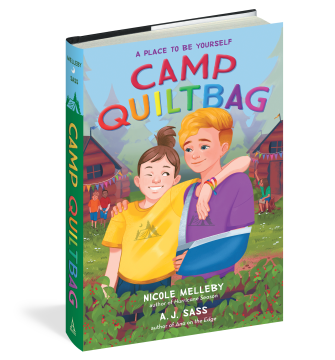
NM: I have a lot to look forward to in 2023! My very first picture book, Sunny & Oswaldo, comes out from Algonquin Young Readers in Februray, and my very first co-written middle grade project, Camp QUILTBAG, written with A. J. Sass, comes out in March!

Cover illustration featuring two young people, one with an arm slung around the other, both smiling.

We Love Easter Eggs

MUF: The Wild Card question: is there anything I didn’t ask but you wish I had? Feel free to use this space for closing remarks if you like!

NM: Are there any Easter Eggs in The Science of Being Angry? Why, yes! Like every single one of my books so far, Joey and her family live in my hometown of the New Jersey shore. And, because of this, in every one of my books the characters get pizza from Timoney’s pizza (the pizzeria Pluto and her mom own in my book How to Become a Planet!) Though, unfortunately for Joey, she doesn’t get to eat the pizza so much as she’s hit in the face with it…..


About Nicole Melleby

headshot of author Nicole Melleby, a brown-haired smiling woman in an outdoor setting

Photo Credit: Liz Welch

Nicole Melleby, a New Jersey native, is the author of highly praised middle-grade books, including the Lambda Literary finalist Hurricane Season and ALA Notable book How to Become a Planet. She lives with her wife and their cat, whose need for attention oddly aligns with Nicole’s writing schedule. Visit her online at nicolemelleby.com and @LadyMelleby on Twitter.

To buy Nicole’s Books:

Workman Publishers

Bookshop.org