Writing

Writer’s Tools: Wisdom from a Third Grade classroom

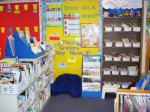
UnknownOne of the things I love about school visits it that I get to go to classrooms all over the country and meet wonderful students and teachers. There are some comforting universals to a grade school classroom: a certain amount of clutter, a map, the alphabet along the wall. And then there are delightful surprises: a pet iguana, a stunning view of the wilderness, a reading loft, a tank of salmon fry to be released in a local stream, a flag flown by a student’s father over his army camp in Afghanistan. It’s a window into the thoughts and values of the community I’m visiting.

I recently visited a third grade classroom where I saw two student made posters on the wall. The first was titled Writer’s Tools in the Hand. Underneath was an illustrated list: paper, pencil, eraser, dictionary, word list, and illustration tools.Unknown-1
It was a good reminder to take a moment before I begin my writing session of the day to have all the tools I need at hand. I especially liked the word list idea. I know many teachers help their students brainstorm a list of likely words before they start a writing assignment to help them get started. Though I don’t need that technique, I have used a variation of it. Every writer has word habits, words or phrases that pop up more often than they should. I have about a half dozen that I lean on more than I should, so I make a word list of them and post it over my workspace to remind me to make stronger word choices and not lean over much on the familiar.
It was the second poster that really struck me though. It was titled: Writers’ Tools in the Head and Heart. The list included: thinking, good ideas, awareness, fun attitude, information, concentration, quiet or silence.
There are so many things to love about that list, and perhaps most importantly that writing well engages both the head and the heart. I love it that thinking comes before good ideas, an excellent reminder. Sometimes I have to think about a scene for days, even months, before I have a good idea about how to fix it.
    Awareness is a tricky idea, I asked a group of the third graders who had made the poster what they thought awareness meant. They said that it meant you should pay attention to all your ideas about a story not just the easy ideas that were in the last story you read. Excellent advice!
  images Fun attitude might just be the best advice of all though. If my writing isn’t going well, it’s almost always because I’ve lost the joy of it. Loss of joy may not be the cause of bad writing, but it is at least the reliable companion of bad writing. And when I change to a more positive and playful outlook, the writing reliably improves.
   Information and concentration are pairs I’ve been learning to use as a pair. I love research so much, I could spend all my time chasing the next dazzling fact and completely lose track of my story in my zeal to fill it up with the amazing details I’ve learned. But sometimes what I need is not more information but concentration on the research I’ve already done.
   Finally I love it that quiet and silence are not the same thing. Sometimes I need absolute silence for a particular task. Reminding myself to turn off the music for the duration of the task helps. Other times I just need the quiet of my brain focusing on just one thing, not email, not social networks, not housework or snacks but simply the quiet of letting myself be a writer and nothing else for a few hours–a true gift!
So how about you? Do you have a favorite tool of the hand, head or heart?  I’d love to hear about them in the comments.

The Making of a Champion

IMG_0818Earlier this month I took my daughter to the North American Championships of Irish Dance. It was the culmination of a decade of hard work for her and for dancers she’s known since first grade. Three of her dance friends did so well at this competition that they qualified for World Championships. One of the things I found encouraging is that one of the girls who’s going to Worlds was not the most promising beginner dancer. She had oodles of talent but couldn’t remember an entire step to save her life. The young man who is also going on to Worlds was the shyest little boy I have ever met—and yet there he was standing up tall, dancing his heart out, in front of hundreds of people. I never would have guessed seven years ago that he’d be in the limelight and loving it.
images-1These winning dancers put in a brilliant set of dances on competition day but what was telling to me was watching them practice  the day before under the intensely critical gaze of their teachers. They were so strong on that practice stage but even so their teachers had a torrent of corrections to their body position, rhythm, strength, and speed. These young dancers were capable of world class performances and yet there was still a long list of things to improve.  It made me think of my own experience of having my writing critiqued (thankfully a far less sweaty experience) Here’s my take away from Nationals.
1) A champion listens to her mentor as whole heartedly as possible, not defensively or with an attitude that her work is somehow the exception to the usual rules that govern the art form. She doesn’t hedge or make excuses for work when a mentor points out a flaw. Except when a clarifying question is needed, a simple thank you is the most useful response to criticism.
images2) A champion not only puts in the performance, but also the drill work that builds the strength for performance.  Barre work, weight training, stretches, and drills, are not wasted time and effort but an integral part of the eventual performance.
3) A champion watches other dancers with intensity and focus in order to learn from the best.  A champion is uplifted and not threatened by excellence in other dancers.
4) A champion dances with joy. This was perhaps the most moving part of watching these young dancers take the stage as world class competitors. There is no college scholarship or professional dance career for Irish dancers. It’s done entirely for the love of the art form and to honor the culture that saved it’s traditional songs and dances in the face of oppression. Each dancer I watched was there because they love dance enough to do it—not just at dance class but at the bus stop and at lunch and late into the night. And each one of them radiated that joy in every step on stage.
I love story like these young competitors love to dance. I love what story can do in the life of a reader and I love the puzzle of pulling a story together from the disparate threads of my imagination. Going forward I’m going to try my best to take critiques with equanimity and put in the hours of practice and pages of rough draft that make good prose roll freely. I am going to redouble my effort to read the best writers in my genre with more concentration to learn all I can from them. And more than all that I want to let my joy show on every page. The Olympics is coming up in a few short weeks and I hope we can all take some inspiration from the dedicated athletes we watch there.

Nine, Ten: A September 11 Story–Nora Raleigh Baskin Interview and Giveaway

9781442485068-1

I’m thrilled to welcome author Nora Raleigh Baskin to From the Mixed-Up Files. Today is the release date of her newest novel, Nine, Ten: A September 11 Storywhich has already received starred reviews from Publishers Weekly and Kirkus Reviews.

I recently had the pleasure of chatting with Nora about her work as a writer. Read on for the interview, as well as more about her, the novel, and how you could win an autographed copy!


When did you first get the idea to write about September 11, and how long did it take you to determine what you wanted to say about the event?

Well, I don’t know that I had anything specific to “say,” and certainly not to “teach” about the event, other than I wanted to re-create the moment it happened, or more precisely, the hours just before it happened. My goal for this book was to raise questions, rather than present answers. Of course, I’m human and I have my own perceptions and biases, but I try very, very hard not to use my characters that way.

My interest in writing about 9/11 was to write about “change.” I wanted to show the world we knew before, and the world after. There are many events in our collective American history so profound, they altered everything we knew, or thought we knew, to be true. I could have chosen any number of them; Pearl Harbor, the Kennedy assassination, the sinking of the Lusitania — moments when our innocence (or naiveté) was lost. I chose the one I remembered, the one I had actually experienced.

Did you plan from the beginning to have four narrators or is that something that evolved once you started writing?

Interesting question because yes, in fact, I had the structure before I had anything else. I was watching a movie called Bobby, about the day before Bobby Kennedy was shot and killed in the ballroom of the Ambassador Hotel. When that happened, in 1968, I was seven years old, too young to understand what ended that day, but I grew up in a culture that was forever altered.

The movie follows several unconnected characters (except that they all find themselves in that same Los Angeles hotel) and each story reveals something about the specific time period in which they all live; feminism, racism, the drug culture, and of course, the political landscape.

In Nine, Ten I worked very hard to do the same thing with each of my four characters, but in a way that requires work on the part of my readers. For example, Naheed clearly foreshadows the bigotry Muslim Americans faced after 9/11. Aimee is in the story to represent all the It-would-have-been-me-but (fill in the blank) stories that came out of that day. Sergio’s story touches on the first responders, because no one can talk about 9/11 without thinking about those dedicated men and women. But the very hardest to connect was Will’s section, against the context of Flight 93 and the passengers that rose up against the hijackers. I wanted to speak to the concept of bravery and heroism, which is not a cut and dry, black and white, either or, issue.

I want my readers to think, and come to their own conclusions. I expect my readers to tax their brains a little when they read a book of mine.

The movie, Bobby, never hits you over the head with its agenda (although I am balling my eyes out when its over), but allows the everyday stories of everyday people to reveal themselves as profound. It was powerful, and I was so terribly excited to try and attempt the same thing in a written work.

P.S. If I had known how hard it was going to be, I might not have tried!

Without giving the ending away, how soon after getting the idea for the novel did you know how your narrators would finally cross paths?

Ah, another interesting question. No, I never thought they would cross paths again, until … well, I got to the end. It was so overwhelming, my own need for hope and redemption, that the ending was almost forced on me. I knew, as I was writing it, that there was a sentimental factor, but it felt right. And everyone I showed it to agreed. So it stayed. The ending truly sprang from my heart.

Another P.S. As unlikely as it may seem that four people who never know each other cross paths more than once in their lives, it is an idea I am fascinated by, and I believe happens much more than we ever realize. Kurt Vonnegut even invented a word for it in Cat’s Cradle.

Karass: A group of people linked in a cosmically significant manner, even when superficial links are not evident.

On your website, you mention that your writing is a vehicle of sorts for your own self-discovery and healing. How did writing this novel facilitate that discovery and healing?

Well, I cried a lot while I was researching this story. I had no idea how close to the surface these memories were, and how unprocessed they still are. I imagine that will be true for many of us who are old enough to remember (of course, my young readers were not yet born.) Because of this, none of my main characters lose anyone during the course of the book. As my editor said, there is enough loss in the premise itself.

It’s funny, or maybe not so funny, but as I get older I find myself reaching past self-discovery and my own need to heal my personal story, and out to the world at large. My kids are grown, my life is now stable and safe, and lord knows I’ve mined my family history plenty, so now I sense a greater, larger family.

What I mean is that I finally feel whole enough, to start telling the stories of other—not so autobiographical—characters. The healing that happens now is in discovering how connected we humans are. We are truly more alike than we are different, and I see this as the path my writing journey is now taking me.

You’ve published consistently since your first book in 2001. Were there ever any times when the writing didn’t flow or the ideas didn’t come so readily? If so, what got you back on track?

Ha! No, the writing always comes. It’s the publishing that doesn’t always flow so easily. 🙁

Can you tell us two of your best writing tips?

If I have to give only two … I’d say: Write from your heart. Every story has already been told, but no one can tell your story.

And … Finish what you start. You never know if your story is good or not, until you’ve finished that sucky first draft and get to work on revising.

So finish. There is so much learning from just doing that!

IMG_0646 (1)Nora Raleigh Baskin is the author of thirteen novels for young readers and has won several awards including the 2010 ALA Schneider Family Book Award for Anything But Typical. She has taught creative writing to both children and adults for over fifteen years with organizations such as SCBWI, The Unicorn Writers Conference, Gotham Writers Workshop, and The Fairfield County Writers’ Workshop. You can connect with her on Facebook and Twitter.

Good news! Nora has generously offered an autographed copy of the novel to raffle off to one lucky winner who shares this post on Facebook or Twitter. Read about the novel and how to win it below.

nine tenAsk anyone: September 11, 2001, was serene and lovely, a perfect day—until a plane struck the World Trade Center.

But right now it is a few days earlier, and four kids in different parts of the country are going about their lives. Sergio, who lives in Brooklyn, is struggling to come to terms with the absentee father he hates and the grandmother he loves. Will’s father is gone, too, killed in a car accident that has left the family reeling. Naheed has never before felt uncomfortable about being Muslim, but at her new school she’s getting funny looks because of the head scarf she wears. Aimee is starting a new school in a new city and missing her mom, who has to fly to New York on business.

These four don’t know one another, but their lives are about to intersect in ways they never could have imagined.

Tell me in the comments section where you shared by Thursday, June 30 at midnight. I’ll announce the winner on Saturday, July 2. (Continental U.S. only, please.)

Dorian Cirrone has written several books for children and teens. Her middle-grade novel, The First Last Day (Simon and Schuster/Aladdin) released this month and is available wherever books are sold. You can find her on Facebook and on Twitter as @DorianCirrone. She gives writing tips and does occasional giveaways on her blog at: http://doriancirrone.com/welcome/blog/