
Posts Tagged librarians

STEM Tuesday– Coding– Book List


Coding is an essential skill in our fast-paced digital world. With activity books, reference guides, historical narratives, and fiction, this month’s book list is sure to inspire readers to take the next steps in their coding journey.
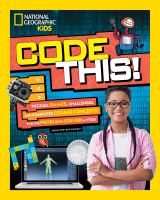
 

cover image of "Code This" featuring a teenage girl

Code This!: Puzzles, Games, Challenges, and Computer Coding Concepts for the Problem Solver in You 

by Jennifer Szymanski

Code This! contains many puzzles, games, and quirky characters that highlight programming concepts in kid friendly ways. Readers will be engaged as they find hidden treasures, decode ciphers to read secret messages, and more. All in all, a great introduction to coding.


cover image of "The History of the Computer" with icons on black background

The History of the Computer: People, Inventions, and Technology that Changed Our World

by Rachel Ignotofsky


This book provides a comprehensive overview of the computing machines that have changed our world, from the abacus to the smartphone. Everyone knows how much computers have impacted our lives, but this book goes on to answer questions like who created them, why, and how they have transformed the way we interact with our surroundings and each other. It’s also packed with fun facts and engaging illustrations.


book cover featuring a portrait of Ada Lovelace on purple

DK Life Stories: Ada Lovelace 

by Nancy Castaldo


In 1843, Ada Byron Lovelace wrote the first computer program… long before technology was advanced enough to try it out! Part of DK’s “Life Stories” series, this engaging biography brings to life the curiosity, imagination, and scientific contributions of this coding pioneer. Sidebars, quotes, definitions, maps, and photos give readers more historical context about the world where she grew up.


three books. The top one is purple and is titled "Kids Get Coding"Kids Get Coding 

by Heather Lyons and Elizabeth Twedale

This Lerner series includes eight short, illustrated books that bridge the gap between unplugged activities and computer-based skill development. Some of the titles in the series include “Learn to Program,” “Coding, Bugs, and Fixes,”  “Online Safety and More,” and “Coding in the Real World.” A character named Data Duck walks kids through basic concepts within each book, and a companion site gives readers the chance to try out their new skills with book-specific projects.


cover image of "Book Cover" with nine women on red backgroundGamer Girls: 25 Women Who Built the Video Game Industry 

by Mary Kenney, illustrated by Salini Perera


Gamer Girls introduces readers to the dynamic women who created iconic video games and changed the industry forever. From Roberta Williams to Mabel Addis Mergardt, this book highlights the history of how women got started in this industry, and then profiles 25 of them. The text is easy to read and engaging, and it’s accompanied by eye catching illustrations.


book cover of "My Life as a Coder" featuring a cartoon boy typing at a computerMy Life as a Coder 

by Janet Tashjian, illustrated by Jake Tashjian


My Life as a Coder is the ninth book in Janet Tashjian’s fictional My Life series. It stars reluctant reader Derek Fallon. In this particular book Derek receives a new laptop. However, it has no Wi-Fi so he can’t use it for gaming. If he wants to play computer games, he’ll have to learn how to code them himself. This premise will inspire readers as they watch Derek struggle but eventually get the hang of the world of tech and coding.


cover image of the book "Girls Who Code"Girls Who Code: Learn to Code and Change the World 

by Reshma Saujani


Girls who Code champions females and girl-empowerment. The book includes easy to grasp explanations of various coding principles as well as real life stories of girls and women who work for such companies as Pixar and NASA. It goes on to detail what a huge role computer science plays in our lives and how much fun it can be. It also features bold illustrations on every page.


yellow book cover with text, "Coding Games in Scratch"Coding Games in Scratch: A Step-by-Step Visual Guide to Building Your Own Computer Games 

by Jon Woodcock 


For students who are just getting started with coding, Scratch is a great block-based program to use. This practical guide provides illustrated tutorials that show readers not just what to do but also why!  It introduces strategies for problem solving, collaborating, and thinking creatively.


cover image of the book "Get Coding!" featuring two cartoon people, a computer, and a dogGet Coding! Learn HTML, CSS & JavaScript and Build a Website, App, and Game

by Young Rewired State


The beginning of this book contains a plea for help from the fictional Professor Harry Bairstone, who has just found a precious gem called the Monk Diamond. As readers progress through the chapters, they will embark on a quest to help him keep the Monk Diamond safe from nefarious jewel thieves. Along the way, they will complete short coding projects and learn how to use three of the most important programming languages used in web development and design: HTML, CSS, and JavaScript.


cover image of "Python for Kids"Python for Kids, 2nd Edition: A Playful Introduction to Programming 

by Jason R. Briggs


This kid-friendly guide aims to make Python fun to learn and use! Python is one of the most widely used text-based computer programming languages in the world, and this book walks students through the basics of text-based programming in a comprehensive but digestible way. The sample code problems feature everything from gorillas to secret agents, and the main text is accompanied by colorful illustrations, puzzles, definitions, and a section on troubleshooting.

________________________________________________

This month’s STEM Tuesday book list was prepared by:

Author Lydia Lukidis

Lydia Lukidis is the author of 50+ trade and educational books for children. Her titles include DANCING THROUGH SPACE: Dr. Mae Jemison Soars to New Heights (Albert Whitman, 2024), DEEP, DEEP, DOWN: The Secret Underwater Poetry of the Mariana Trench (Capstone, 2023) and THE BROKEN BEES’ NEST (Kane Press, 2019) which was nominated for a Cybils Award. A science enthusiast from a young age, she now incorporates her studies in science and her everlasting curiosity into her books. Another passion of hers is fostering a love for children’s literacy through the writing workshops she regularly offers in elementary schools across Quebec with the Culture in the Schools program. For more information, please visit www.lydialukidis.com.


author Callie DeanCallie Dean is a researcher, writer, and musician living in Shreveport, LA. She writes stories that spark curiosity and encourage kids to explore their world. For more information, please visit https://www.calliebdean.com.


STEM Tuesday– Material Science– Writing Tips and Resources

Materials Science is a new category for me. My research turned up intriguing connections with arts activities because much of it is about discoveries. So, this blog post is about some Very New research on materials and a Very Old technique for science exploration that is wonderfully flexible, easy and inexpensive, and makes use of recycled and sustainable materials.Neri Oxman photo

I was particularly pleased to find the Very New in the work of Neri Oxman. She blurs the line between science and design. Wikipedia describes her work as “embodying environmental design and digital morphogenesis*, with shapes and properties that are determined by their context.” Yes*, I had to look it up too. It means, according to Merriam-Webster – a branch of biology that deals with the form and structure of animals and plants. There have been a number of good books on Materials Science in the previous May STEM Tuesday blogs. Ms. Oxman’s writings and articles are in anthologies and scholarly journals, so instead I have included a link to her documentary “Nature x Humanity,” with the hope that you will find her take on Materials Science to be worth following in the future.

She says that 2020 is the year in which the anthropomass (manufactured materials) will exceed the biomass on our planet. Current building practices are the main culprits. She offers alternate building materials and structures that will break down. For instance, one building material she helped to develop can be disposed of by dropping it into the sea. It will dissolve and provide nutrients for fish.

I emailed her and in her kind response, she sent a link to the documentary about sustainable architecture and protecting the earth’s resources (see below). It’s for adults and older students and very thought provoking. Imagine structures built from apple peels and shrimp shells (what do you suppose Legal Seafoods thought when she asked for all their discarded shrimp shells?). Or imagine a glass structure that can heat your home without conventional fuel, constructed on a 3D printer.

Here is the link to “Nature x Humanity.” The description says, “We are pleased to present our documentary entitled Nature x Humanity. The documentary debuts at a critical juncture when the anthropomass—the mass produced by humans—has exceeded that of the living biomass on our planet. Through the lens of five projects and their related material systems, we propose five tenets for a new Material Ecology: glass, polymers, fibers, pigments, and cellular solids. Motivated to unite the grown and the made, we demonstrate how each material system and the technology invented to shape it embodies and advances Nature’s way while continuing to promote human progress.”

I see such an imaginative approach to science as an argument in favor of including arts with the science curriculum. The processes for creativity and scientific inquiry are very similar – except creativity is much more flexible in verification. When curiosity and ideas reign without stress over outcome, the mind is freer to wander and invent. The kind of creativity that envisions new uses for alternate materials is developed though practice, making connections, and often, no stress over the outcome.

Real invention comes from dreaming and imagining.

Papier Mache Style book coverWhich brings me to the Very Old technique for science activities – papier-mâché. You might think, oh please, we did that in kindergarten. However, the technique deserves a second look in this current world where sustainability and recycling are essential. It’s inexpensive to do. It makes use of throw-away materials – newspaper (if you can find any), brown paper bags, junk mail, plastic bottles, even cloth scraps and shred.

Papier-mâché first appeared in China c. second century AD, where it was used for warrior helmets and pots. It spread along trade routes to the middle east and Europe. Lacquering and papier mâché became a popular and highly-prized art form.

Today it can be used as a great craft technique to design and create scientific models for a better classroom experience. The possibilities are endless – 3D botanical illustrations, bones, insects, display boxes, buildings. Here are some photos of one of my previous classes where we studied historic castles and made models. The students also wrote an accompanying history of their chosen castle. And you can see the imaginative recycling that engaged the students.papier mache clock

There are many recipes for mâché. My all-purpose fallback is cheap white school glue mixed 3 parts glue, 1 part water. That recipe makes a structure that is rigid. If you want flexibility (such as a book cover or mask) use Sobo Glue. I have seen others use glue made with flour, joint compound, and other materials. You can purchase ready-made “paper clay,” which is a delight to work with – and expensive. The paper clay is good for small pieces.

My standby book has been Papier Mâché Style by Alex MacCormack. (Krause Publications, 1994). There are many books available as well as websites and videos. It’s a real smorgasbord of great ideas. You really need no art experience to use papier-mâché, but need to be willing to be adventurous and persistent. And yes, it is messy and needs time to dry. But the results are well worth it.

Student papier mache castle in process. Art and design are essential for communicating science. The best content in the world is useless if nobody reads or looks at it. That means it has to be visually enticing. It also generally invites students to participate in their own learning in a more active way.

************************

Margo Lemieux is professor emerita at Lasell University, Newton, MA. She recently helped organize an exhibit and donation of fine art prints at the DaNang Museum of Fine Arts in Vietnam.

Author Matt McMann Gets Monsterious!

I was so excited when Escape From Grimstone Manor, book one in Matt’s new series Monsterious, showed up at my house. While book mail is always a thrill, this spooky read was high on my list. And of course, Matt did not disappoint. I read it in one sitting!

Monsterious is pitch-perfect middle grade, ideal for both reluctant and avid readers, and fans of Goosebumps and Five Nights at Freddy’s. Each book comes in at fewer than 200 pages, and every chapter ends with a chilling cliffhanger that will keep kids turning the pages. With the first two books publishing simultaneously, each book in the series completely stands alone, with a different setting and main characters—and different monsters—in each installment, and can be read in any order. I see these books as a great addition to summer reading lists.

And fortunately for us, Matt was up for chatting about Monsterious and how it came to be.


Welcome, Matt! Thank you so much for taking the time to talk to us over here at Mixed Up Files! Let’s start at the beginning. What inspired the Monsterious series? Can you remember the spark?

My wife, author Lisa McMann, was reading an article aloud and mispronounced the word “mysterious” saying “monsterious” instead. I said, “That would be a great middle grade book title,” and she replied, “No, it’s a whole series, and you should write it.” So I did! I loved the idea of crafting a series of spooky middle grade monster mysteries.


In Escape from Grimstone Manor (series book #1) is there one character you identify with the most?

Escape from Grimstone Manor features three best friends who are trapped overnight in a haunted house amusement park ride and discover the monsters are real. Taylor is outgoing, brave, and spontaneous to a fault. Zari is cool, level-headed, and intellectual. Mateo is timid, cautious, and artistic. While there’s a bit of me in all of them, I definitely relate the most to Mateo. I was a scared, artistic kid like he is!


The books in the Monsterious series can also stand alone. What made you decide on this approach? What are the challenges of starting over with a whole new cast of characters each time? 

Since the idea for Monsterious came as a series concept vs. an individual book concept, I took the opportunity to choose the type of monster mystery series I wanted to write before thinking of the stories themselves. A dynamic series features the same characters in a multi-book story arc (ex: Lord of the Rings). A static series features the same characters in episodic adventures (ex: Nancy Drew). In an anthology style series, the books are tied together by a place or an idea or a theme, but each entry is a standalone story with a unique cast of characters (ex: Goosebumps).

I chose an anthology style series because I liked the freedom it gave me to write about any monster, anywhere, with anyone. Since it’s a less common format, I thought it might help me stand out to editors in a crowded marketplace. Not being constrained by a single meta story arc was also appealing—I knew if I could sell Monsterious to a publisher and find an audience, then I could write in this series for a long time, which I would love.

The challenge with this type of series is needing to write new characters for each installment who are both interesting and well-rounded. There’s also a lot of names to come up with! It definitely takes additional work and imagination, but it’s totally worth it.

What do you hope young readers will take away from your books?

I was a scared kid. I grew up being afraid of almost everything—the dark, bullies, the woods, our basement. But I loved spooky stories. Seeing the characters in those books face their fears gave me the courage to face my own. And they were just so cool! I hope readers will find the same courage and fun in Monsterious books that I found when I was that age.

What was your favorite book as a kid? Did you like scary stories?

I had so many! I read a lot of adventure and sci-fi books when I was quite young, then got hooked on fantasy with the Earthsea trilogy by Ursula K. LeGuin and Tolkien’s Lord of the Rings. Frankenstein by Mary Shelley was a game changer for me. I was captivated. That led me to Bram Stoker’s Dracula, and then I checked out every book in the library on Bigfoot, the Loch Ness Monster, werewolves, vampires, you name it!

What do you mostly read now?

I’m reading a lot of great middle grade to steep myself in the voice and emotions of that age group. Lindsay Currie writes incredible spooky middle grade, and Starfish by Lisa Fipps was fantastic. I’m reading a lot of standout realistic contemporary work from my 2023 debut middle grade author group, including Good Different by Meg Eden Kuyatt, It Happened on Saturday by Sydney Dunlap, and Miracle by Karen Chow.

Talk to me about your path to publication. Did you encounter surprises or unexpected twists in the road?

I wanted to be author since I was a kid, but studied music in college and was a professional musician for twenty-six years. When I burned out on music about five years ago, Lisa suggested I go after my dream of writing books. We went to a hotel for a weekend getaway, and she said we couldn’t leave until I wrote my first chapter!

I had a chance to pitch that first book to an agent over dinner and he requested the manuscript. After reading it, he said it had potential but needed a lot of work, and if I was willing to make significant edits, he’d read it again. I did everything he suggested, and after that second reading, he signed me!

We went on an exclusive submission to an editor at a Big Five publisher, and she said the same thing—it had potential but needed a lot of work, and if I’d do some edits, she’d read it again. I made her changes, she liked it, and said she was taking it to her team. I was floored. What I thought was going to be a throw-away practice novel not only got me an agent, it was going to get me a book deal on my first submission! And then it didn’t. The team wasn’t excited, and she passed. The manuscript went out on multiple waves of submissions for over a year and never sold.

During that time, I wrote a second book. That went out and got rejected by everyone. I wrote a third book that never even went out on sub. Then I came up with the idea for Monsterious, and my agent loved it. He took it on an exclusive submission to Penguin Random House, and it sold immediately in a four book deal. My childhood dream has come true!

You have the good fortune to be married to New York Times bestselling author Lisa McMann. What did you learn from watching her journey that helped with your own?

I was the luckiest aspiring author in the world to have Lisa as my mentor and writing coach. I’ve learned too many lessons from her to count, but one of the biggest was that being an author is business. If you want a long-term career, you need to know as much about marketing and admin as you do about writing. I think that’s where a lot of really talented writers struggle—to think and operate like a small business. Lisa is the most creative person I know, but she also has a great business sense, so I’m trying to emulate that in my own career.

What advice would you offer to aspiring authors of all ages?

  1. Read great authors
  2. Write what you love
  3. Find a supportive writing community
  4. Share your work with writers you trust and believe their critiques
  5. Listen to good writers talk about writing (podcasts, videos, webinars, books, live events, etc.). I highly recommend the Writers With Wrinkles podcast for craft, inspiration, and entertainment value!
  6. Write! Practice, practice, practice, and don’t give up

Do you have any writing rituals you swear by?

When drafting, I write at least 1000 word a day. Having that as a minimum gives me a clear sense of accomplishment and, when I know my target book length, allows me to map out how long it will take me to complete a first draft. I also start each drafting session by editing what I wrote the previous day. It gets me back in the flow of the story and when the draft is completed, I’ve already finished one round of edits.

Where can readers best find you if they want to reach out?

I really pumped about my newly revamped website MattMcMann.com (thank you Deena at deenawarnerdesign.com!). Readers can contact me there and get my free spooky short story for signing up for my newsletter. I’m also @matt_mcmann on Instagram and Twitter.

Thank you, Matt!