Welcome to STEM Tuesday: Author Interview, a repeating feature for the last Tuesday of every month. Go Science-Tech-Engineering-Math!
Today, Andi Diehn interviews Sue Heavenrich and Alisha Gabriel, authors of Funki Fungi: 30 Activities for Exploring Molds, Mushrooms, Lichens, and More! Sue is a writer and educator who also hosts a book review blog at Archimedes Notebook. Alisha is an elementary music teacher and writer of fiction and nonfiction elementary through middle grade. They teamed up to bring the wonder and magic of fungi to kids through lots of hands-on STEM projects!
* * *
AD: What inspired you to write about fungi?
Alisha: I’ve always found mushrooms and fungi fascinating! There are so many shapes and colors, and new varieties being discovered each year. Every time I turn around there’s something more to learn about fungi. 
Sue: My interest was piqued when I interviewed mycologist Kathie Hodge about an insect-infecting fungus for an article in a local newspaper. She took me on a fungus-looking walk, and showed me her workspace at her lab. That article never got published, but it made me think about fungi in a different way. A couple years later I met Alisha at a Highlights Foundation workshop on nonfiction writing. While out on a nature walk, we stopped to look at some interesting fungi and got to talking about potential book ideas. I ended up shelving my idea, so when Alisha asked if I wanted to collaborate on a book I said “sure.”
AD: There’s such a huge variety of fungi out there! How did you decide what information to include in your book and what had to be left out?

Alisha finds some funky fungi!
Alisha: When the editor liked our pitch and asked to see a proposal, Sue and I jumped into the research feet first. First, we determined how to break up the chapters by topic. There are certain types of fungi that had to be included in each chapter and simply couldn’t be left out of the book! After that, it became much more difficult to narrow down.
AD: What do hands-on projects add to the reader’s experience of your book?
Alisha: This book is part of the Young Naturalists series from Chicago Review Press and all of the titles include 30 activities. The activities are important to help readers extend their learning, and to gain even more enjoyment, as they discover more about fungi!

Sue gets hands-on with fungi!
Sue: As a science teacher and, later, homeschooling parent, I know that many kids learn best by doing. That’s what this book addresses. By design, it incorporates activities throughout the chapters as an integral part of exploring the topic. I mean, how can you read about mushrooms and not want to cut one open to see inside?
AD: Some of the projects focus on an art or language activity – why is the A in STEAM so important?
Alisha: Everyone learns in different ways. In education, there’s a huge push for STEM topics, but the artistic aspect of learning isn’t always valued as highly. Sketching a mushroom, or even creating their own, will help readers focus on the minute details. And writing a poem about a mushroom can help a young reader utilize vocabulary and scientific terms, while accurately describing it and its surroundings.
Sue: Art and language are part of science. Scientists in the field often make sketches in their field journals alongside their notes – whether it’s fossils or insects. I feel that drawing a mushroom or other fungus helps develop observation skills. So does writing haiku and poetry. I think there’s a lot in science that inspires art, and art that inspires science.
AD: You mention a lot of different people who work with fungi or have made discoveries about fungi. Why did you include these brief biographies in your book?
Sue: Science is a human endeavor. When I was a kid, I loved reading the stories about people who discovered things: Fleming and penicillin, Jenner and the smallpox vaccine. We want to show readers that people are still discovering things about fungi – and maybe some of those readers will see that they could be scientists, too.
AD: There are fungi that do beneficial work and fungi that do detrimental work. Why is it crucial to our understanding of fungi to learn about all aspects of the fungal world, not just the ones that help humans?
Alisha: It’s true that some fungi attack our crops or cause human diseases, but other kinds of fungi are used to counteract them. All types of fungi play a role in the environment, even those that are yet to be discovered. It’s important to show readers the great diversity of fungi because we never know how or when new discoveries will be made. 
AD: If you could choose a state fungus, what would it be?
Alisha: In an interesting twist, I live in Texas, which is the most recent state to adopt a state fungus! It’s Chorioactis geaster, often called the Texas Star Mushroom, because it’s only found in some parts of Texas and Japan. At first this mushroom resembles a small cigar, but when the spores mature, they burst forth with a popping sound and the sides crack open into a star shape.
Sue: I personally like the Stinky Squid fungus – it looks like an orange squid or chicken claws reaching up through the soil. Its stinky smell attracts flies that will spread the spores. But there is actually a bill in the New York State legislature to name Peck’s milk-cap (Lactarius peckii) as our state mushroom. It’s a pretty orange gilled mushroom and not stinky in the least. And it is named for Charles Horton Peck, New York State botanist from 1867 to 1915, who described and named more than 2,700 species of fungi in North America.
Want more fun with fungi? Check out Funky Fungus Friday photo posts at Sue’s Facebook page!
And Alisha’s #FungiFriday posts on Twitter!
Sue Heavenrich writes about science for children and their families, from space to backyard ecology. Bees, flies, squirrel behavior—things she observes in her backyard and around her neighborhood—inspire her writing.
Alisha Gabriel is an elementary music teacher and adjunct professor who has written several fiction and nonfiction books for children, from preschool to middle graders.
Today’s host, And Diehn, is an editor and marketer at Nomad Press and has published 11 nonfiction books.
Like this:
Like Loading...


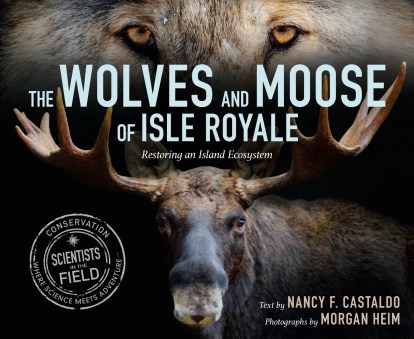 Nancy Castaldo: This is a book project that began decades ago in my college ecology class. That is where I first heard of the important predator/prey study on Isle Royale. I was intrigued by this long study and have followed it ever since. When I found out that wolves might be released on the island I started to formulate the book project.
MKC: Care to share a favorite research moment from your time on Isle Royale?
Nancy: Spending time on the island was wonderful. I truly can understand why so many people return to the park after visiting. Photographer Morgan Heim and I stayed on the island, got up super early every morning, and hiked well past 10 pm each night to complete this book. The remoteness of the island provided some travel challenges, but they were well worth it. It is an exceptional place that deserves protection. I only wish we had more time there. It was a great experience. My favorite moment? Perhaps when we were in the forest with Cara as she was investigating wolf pings and we came across a spot where a moose had bedded down. We could see where it had folded its legs to rest. And beside this spot we found one where a wolf had bedded down. They were side by side. Of course, it is highly unlikely they were there at the same time. I couldn’t resist curling my body up to fit in those spots where they had rested. And then, I coaxed Cara and Morgan to do the same. It filled me with lots of feelings of connection and also fun. Those moments were so unexpected.
MKC: To whom did you imagine yourself writing to while drafting the book?
Nancy Castaldo: This is a book project that began decades ago in my college ecology class. That is where I first heard of the important predator/prey study on Isle Royale. I was intrigued by this long study and have followed it ever since. When I found out that wolves might be released on the island I started to formulate the book project.
MKC: Care to share a favorite research moment from your time on Isle Royale?
Nancy: Spending time on the island was wonderful. I truly can understand why so many people return to the park after visiting. Photographer Morgan Heim and I stayed on the island, got up super early every morning, and hiked well past 10 pm each night to complete this book. The remoteness of the island provided some travel challenges, but they were well worth it. It is an exceptional place that deserves protection. I only wish we had more time there. It was a great experience. My favorite moment? Perhaps when we were in the forest with Cara as she was investigating wolf pings and we came across a spot where a moose had bedded down. We could see where it had folded its legs to rest. And beside this spot we found one where a wolf had bedded down. They were side by side. Of course, it is highly unlikely they were there at the same time. I couldn’t resist curling my body up to fit in those spots where they had rested. And then, I coaxed Cara and Morgan to do the same. It filled me with lots of feelings of connection and also fun. Those moments were so unexpected.
MKC: To whom did you imagine yourself writing to while drafting the book?