Posts Tagged Book Giveaway

STEM Tuesday– Food Science — Book List


Food science focuses on many facets of our food system: chemistry, biology, nutrition, engineering and more! The books listed below are just the beginning for budding scientists who want to learn more about how food shapes our world; where it started, where it’s going and how to improve what we have.


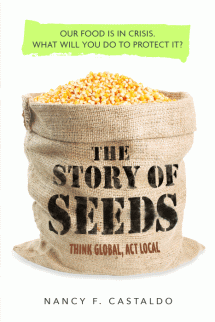
The Story of Seeds

by Nancy Castaldo

Do you want to know where our food comes from? And where it is going? The Story of Seeds will let you know. The author investigates the importance of seeds in our world, how they’re preserved, and more importantly what readers can do to help preserve the variety of them through simple actions.


The Chemistry of Food

by Carla Mooney

Learn the science behind the food you love as you explore the chemistry within the meal. This hands-on book is a delicious way to learn more about flavors, nutrition, and the texture of food. It even includes recipes!


Forthcoming | Skyhorse Publishing

Food Weird-o-Pedia: The Ultimate Book of Surprising, Strange, and Incredibly Bizarre Facts about Food and Drink

by Alex Palmer

Want to learn weird facts about food that you can share with friends and family? This is the book for you. Each chapter offers an encyclopedia of strange facts about everything from junk food to vegetables – and then some! Learn about the odd and obscure aspects of food – including some of your favorite snacks.


Buy Food Anatomy: The Curious Parts & Pieces of Our Edible World Book Online at Low Prices in India | Food Anatomy: The Curious Parts & Pieces of Our Edible World Reviews

Food Anatomy: The Curious Parts & Pieces of Our Edible World

by Julia Rothman and Rachel Wharton

This engaging book starts with an illustrated history of food. As you continue to read, you’ll learn about street eats and short-order egg lingo. Curious? This book has the recommended daily allowance of facts and fun. You’ll be sure to eat it up.


Eating Bugs as Sustainable Food

by Cecilia Pinto McCarthy

This book tells us why eating bugs might help feed more people around the world – after all, bugs take less space, water and food than livestock. It also talks about the science behind raising bugs, and there are a ton of images and infographics.


Bugs for Breakfast: How Eating Insects Could Help Save the Planet : Boone, Mary: Amazon.in: Books


Bugs for Breakfast: How Eating Insects Could Help Save the Planet

by Mary Boone

This book takes a look at entomophagy, the practice of eating bugs for nourishment. It talks about why it makes sense from a nutritional point of view. As a bonus, it’s good of the planet. There are recipes as well!


Introduction to Food Science: An Overview (Edible Knowledge)

by Dale W. Cox

The first book in a series of workbooks gives an introduction about food science, food processing, careers in the field, and a lot of experiments on food science theory designed for children 10 and up.


100 Things to Know About Food (Usborne)

by  Alice James, Jerome Martin, Sam Baer, Rachel Firth, Rose Hall, Federico Mariani and Parco Polo

This bright book is full of fascinating fun-filled browseable facts about food, from farming to cooking, from nutrition to tastes, and everything in between.


The Science Chef: 100 Fun Food Experiments and Recipes for Kids (Second Edition – 2020)

by Joan D’Amico and Karen Drummond

This book teaches the basics of food science through hands-on experiments and detailed recipes. How does food cook? How does popcorn pop? How does bread rise? How do beans sprout? Information about all these and much more within these pages.


Susan Summers is a wildlife enthusiast and an author. Contact her at: https://susan-inez-summers.weebly.com/


Shruthi Rao is an author. Her home on the web is https://shruthi-rao.com


STEM Tuesday– Entomology– Book List

There are more than a million different kinds of insects living on our planet. They live in rivers and deserts and forests and … even our homes … and they outnumber us. So it only makes sense that we get to know them better.

Meet the Bugs:

Cover image og grasshopper and a bee

Buzzkill: A Wild Wander Through The Weird And Threatened World Of Bugs by Brenna Maloney

Reading this book is like listening to a friend tell stories. For example, there’s the time Brenna bought caterpillars watched their transformation into adult painted lady butterflies. She gives her personal take on insect defenses (getting stung), wrangling ants into an ant farm, and more.

Cover image with a number of bugs and a praying mantis

1,000 Facts about Insects by Nancy Honovich

This browsable book is perfect for the kid who wants to know cool insect facts without reading an entire book. Each spread focuses on some aspect of the insect world, from life cycles to senses to defenses. There are facts about migration, endangered insects, and conservation, about light-makers and love bugs, 50 fluttering facts about butterflies and lots, lots more.

Cover image with butterfly and bees flying and a ladybug and grasshopper peeking from the grass.

Encyclopedia of Insects: An Illustrated Guide to Nature’s Most Weird and Wonderful Bugs by Jules Howard, illustrated by Miranda Zimmerman

After some basic information and a list of some amazing insect feats, the book groups over three hundred insects by their orders. It provides the common and scientific names, size, diet, location and interesting details for some colorfully painted familiar and freaky insects from around the world. You’ll also find information on arthropods and invertebrates and a handy guide to determine whether you are an insect.

Cover image with a moth flying at night.

Moth: An Evolution Story by Isabel Thomas, illustrated by Daniel Egnéus

One of the most remarkable stories about natural selection is that of how the pepper moth adapted to the sooty pollution of the industrial revolution. Evolution is a big concept, hard to grasp sometimes, and this book does a marvelous job telling – and showing – how environmental changes affect insect populations. A picture book for the 8-10 crowd.

Cover image with a bumblebee

The Beekeepers : How Humans Changed the World of Bumble Bees by Dana L. Church

Bumble bees are a vital part of our ecosystems, pollinating crops that feed people and wildflowers and trees that feed wildlife. They are so successful, that people have commercialized their breeding, shipping bumble bee colonies to greenhouse growers across state – and country – borders. But what happens when commercially raised bumble bees escape the greenhouse and begin nesting in the wild?

For another book about bees, check out our interview on Where have all the bees gone? : pollinators in crisis, by Rebecca E. Hirsch from a couple years ago.

Cover image with a spider, centipede, ants and fly

Wicked Bugs: The Meanest, Deadliest, Grossest Bugs on Earth by Amy Stewart

Engaging and terrifying, this book explores the life cycles, habits, and dangers of forty-eight of the deadliest, dangerous, unwelcome, destructive, painful, and seriously threatening insects on earth – plus a few spiders, worms, and scorpions for good measure. It includes case studies of recent and historic instances of attacks or bites from these insects and any known treatments. Not for the faint of heart, though it is a good resource for identification, insect transmitted diseases and pest control.

Meet The Folks Who Study Them (Entomologists):

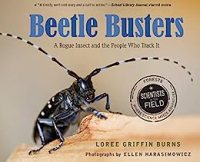
Cover image with a spotted beetle.

Beetle Busters: A Rogue Insect and the People who Track It (Scientists in the Field) by Loree Griffin Burns, photos by Ellen Harasimonwicz

The Asian Longhorn Beetle came to the US as a stowaway, tucked into wood used to ship products. With no natural enemies to control its spread, the beetle now infests trees from Massachusetts to New York and into Ohio, with the potential to cause more damage than Dutch elm disease, chestnut blight and spongy moths combined. This book follows the scientists tracking the insect and trying to save the forests.

Cover image with a boy lying in the grass with a magnifying glass looking at bugs.

Buzzing with Questions: the inquisitive mind of Charles Henry Turner by Janice N. Harrington, illustrated by Theodore Taylor III

At a time when most colleges didn’t accept black students, Charles Turner went to study zoology. He had a particular fondness for small creatures, insects, and used them to help answer big questions: how do ants find their way home? Can an insect solve a maze? Can bees learn to identify colors? This book will inspire emerging entomologists of all ages.

Cover image with two beetles facing off with large pincers.

Beetle Battles: One Scientist’s Journey of Adventure and Discovery by Douglas J. Emlen

Doug Emlen studies antlers, horns, tusks… weapons that just happen to belong to dung beetles. The cool thing about beetle weapons, he says, is their diversity: some are stubby, some long and slender, some like crowbars, some like sabers. Emlen shows readers how science happens in the field, from designing experiments and collecting data to rethinking the experiments (when they don’t work), and doing it all again.

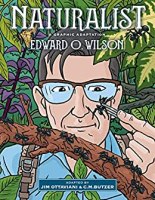
Cover image of man using tweezers to examine ants climbing up a branch.

Naturalist: A Graphic Adaptation by Edward O. Wilson and Jim Ottaviani, illustrated by C.M. Butzer

E.O. Wilson is an insatiably curious biologist, well-known for his work on ants and insect societies. He reminisces about childhood expeditions to the creek with friends, and an effort to collect and study “all the ants in a vacant lot.” Ants may be small, but examining their societies led Wilson to ask big questions about social structure, genetics, and biogeography.

Cover image collage of scientists using bugs to solve crimes,

The Forensic Entomologist by Diane Yancey

A fascinating examination of the history (a collection of cases through time) and the numerous insects that have solved both murders and trafficking cases. It offers a look at the education and procedures for forensic entomologists and medical examiners, a detailed exploration of how bugs illuminate the time of death, location of death, DNA of victim, and neglect, and explores the factors that can cause mistakes and future forensic applications.

Bug Field Guides and Activities:

Cover image with a beetle, ladybug, caterpillar, and bee larvae.

Ultimate Explorer Field Guide: Insects (National Geographic) by Libby Romero

Divided into two sections – Incomplete Metamorphosis and Complete Metamorphosis – this book is loaded with information, photos, jokes, challenges, and interesting behaviors or facts, as well as any bite, sting, or chemical reaction danger an insect poses. Interspersed throughout are double spread “Insect Reports” on wings, bug vs. insect, invasive species, and much more. The introductory information, Quick Id Guide, glossary, and additional resources round out this engaging insect guide.

Insects and Arachnids (Field Guides) by Carla Mooney

After defining each and their roles in nature, vivid photographs accompany descriptions and fascinating side bars, as well as “How to Spot” and “Fun Facts” sections for each insect, spider, and other critter. Easily browsable, it is divided into the categories: True Flies, Beetles, Wasps and Bees, Ants, Moths and Butterflies, True Bugs, Spiders, Ticks and Mites, and Scorpions.

Cover image of bugs visiting a science fair.

Bug Science: 20 Projects and Experiments About Arthropods: Insects, Arachnids, Algae, Worms, and Other Small Creatures by Karen Romano Young, illustrated by David Goldin

A tongue and cheek presentation, full of cartoonish illustrations, guides kids though the scientific process (concept, question, plan, materials, procedure, and recording of data) necessary to perform experiments with flies, ants, butterflies, fleas, spiders, and other creatures.


This month’s STEM Tuesday book list was prepared by:

Sue Heavenrich examines fungi

Sue Heavenrich, who writes about science for children and their families on topics ranging from space to backyard ecology. Bees, flies, squirrel behavior—things she observes in her neighborhood and around her home—inspire her writing. Her most recent book is Funky Fungi (with Alisha Gabriel). Visit her at www.sueheavenrich.com.

Author photo of Maria and pink roses.

Maria Marshall, a children’s author, blogger, and poet who is passionate about making nature and reading fun for children. When not writing, critiquing, or reading, she watches birds, travels the world, bakes, and hikes. Visit her at www.mariacmarshall.com.

An Interview with Zohra Nabi (plus a book giveaway!)

I’ve always been a sucker for beautiful book covers. 

I remember wandering school book fairs in elementary school with armfuls of the most colorful, vibrant-looking books I could find. Even now as a middle school teacher, I display dozens of books in my classroom every year, and I fully admit that the ones getting the most love are the ones with beautiful covers.

Of course, with all that focus on the outside of the book, the stage is set for some occasional disappointment when I actually get down to the business of reading the story. But then there are also those moments when the promise of the front cover is wonderfully fulfilled as the story unfolds, and that’s the sort of thing we’ll be talking about today.

Zohra Nabi’s debut middle grade, The Kingdom Over the Sea, is just as sprawling and fantastical as it looks thanks to Tom Clohosy Cole’s beautiful cover design.  I’m so glad I was able to ask her some questions about the story and her process, and I think you will be, too! Stick around to the end to learn how you can win a copy of the book for free!


Chris: Thanks for taking some time to chat with me, Zohra! Let’s start with you as a writer. Your biography says you studied law at Cambridge and Oxford Universities, so how did you find your way to the world of storytelling?

Zohra: I’ve always liked writing stories, ever since I was a teenager. I liked writing in the style of my favorite children’s fantasy books, although nothing I produced was ever publishable. Even when I was studying Law – which I did really enjoy – I was writing in stolen moments when I should have been studying. Lockdown came just as I was sitting my final exams, and when I graduated there was suddenly no legal work experience I could do, and nowhere I could travel. But I did have some money saved up from a legal essay prize I had come second in. So, I decided to put the money towards a creative writing course, and try to write a book.


Chris: What an interesting way to come into publishing! Let’s talk abut your process —  I love learning how authors develop their characters. Your main character, Yara, is such a passionate and adventurous person. How did you work behind the scenes to create her for this story?

Zohra: Yara is such an interesting one! For me she’s a real mix of my two younger sisters, with her determination, and her strong moral compass. She also definitely has quite a bit of me in her as well – I loved debating and campaigning when I was Yara’s age. I wanted her to be someone who was shaped by how she grew up in the UK, who was equipped to fight injustice in a fantasy world because of what she had experienced here. I wrote her life story in first person to find her voice, and did little questionnaires to work out her favorite foods and biggest fears.  But even with all that preparation it was difficult to get her on the page. I had to really work with my editors to make Yara’s personality come through in the text, and to make sure that she continued to be a believable girl from our world even after she travels into Zehaira.


Chris: There are references in the book to Yara being a champion of causes, one of them being the banning of books / closure of libraries. Was there anything in your personal experience that made you want to incorporate this into Yara’s backstory?

Zohra: When I was Yara’s age there were a lot of library closures, and people in communities all up and down the UK really turned out to protest – in some cases successfully. Libraries are such an important part of a community; the ability to access information, or even just to print out the documents you need and talk to someone who wants to help you is such a necessary thing, especially when you’ve recently moved to a new country. My dad always talked about how important his local library was to him growing up, and I loved spending time in mine as a child. I knew Yara would be the kind of person who wouldn’t stand for her local library being shut down. When she gets to Zehaira, the library there has been burnt down – the ultimate in book banning and library closures – and I wanted to be honest about the impact it has had. The sorcerers of Zehaira have preserved some of their culture and knowledge, but a lot of it, maybe most of it, has been lost. I think some people are very casual about book bannings today, saying that will just make kids read those books more – but I think if we’re not careful, we’ll lose important texts for good.


Chris: That’s a great point. Language can be like that, too, and there are some themes of language in the book — what prompted you to incorporate it into the story?

Zohra: I think because immigration and movement of people is such a key theme of the story, and language is such an important part of that. Yara’s mama is preserving their link to their culture and country when she speaks her language to Yara, and I imagine Yara was also an interpreter for her mum growing up, the way many second-generation children are today. But I think it’s also been quite lonely for Yara, not knowing anyone else who can communicate with them in the same way. Speaking to other people in her mother’s language when she gets to Zehaira is a way for her to expand her knowledge of her culture through sources other than her mum, and I think that is a source of wonder for her. I also think it’s really important that when Yara does discover the magical power of language, it’s not by using English, which is the language she would have used when she was campaigning back at home, but in the language her mother taught her – because Yara’s mother is the person who made her want to fight back against everything wrong about the world. 


Chris: The streets of Zehaira are so richly described in the book, which is very atmospheric overall. Were you inspired by any real-world places?

Zohra: Thank you! I was hugely inspired by the cities of the golden age of the Islamic world – which were these places of amazing scholarship and learning and wisdom, with beautiful libraries and universities. I think I must have been influenced by all the different cities I visited before, because I tried very hard to imagine I was walking around Zehaira as I was writing, but I was careful not to create anything that was too close to reality. Part of the magic of Zehaira is that it feels familiar but also strange! There’s a book by Italo Calvino called Invisible Cities which describes different fictional cities, deconstructing and reconstructing the concept of a city itself, but centering the descriptions around an idea of Venice. I’m not trying to do anything so elaborate, but it gave me the confidence to build my own fictional city based on an idea of a city as a place of both culture and corruption.  


Chris: It totally works! So, what’s next for you as an author? Can you give us any clues about new projects you’re working on?

Zohra: I’m currently working on the sequel for The Kingdom over the Sea! I’m really enjoying working on it with my editors, and puzzling out how Yara’s journey can continue. Book 2 takes us deeper into Yara’s past, examining both her family history and the history of sorcery itself. Yara makes an important discovery – but the Chief Alchemist is hot on her heels, lurking in the shadows…


Chris: Sounds amazing — thanks for the sneak peek! Okay, and now for the lighting round…


Favorite place to write?

At my desk in the attic.

Favorite authors?

Diana Wynne Jones, Eva Ibbotson, Judith Kerr.

Best desert?

Tiramisu

Do you have any pets?

No, but I did once have a hamster called Horace

Favorite elementary school memory?

Making up imaginary worlds for pretend games with my friends.

Favorite piece of advice for other writers:

Write to entertain yourself. And drink lots of tea.


Many thanks to Zohra for taking time to chat with the Mixed Up Files. You can find her online on Instagram at @zohra_nabi and Twitter at @Zohra3Nabi, and you can learn more about the book HERE

And last but not least — leave a comment below for a chance to win a free copy of Zohra’s book. We’ll be selecting one commenter at random on Monday, June 19th 2023!