
 In today’s
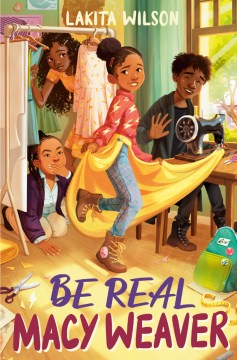
  Author Spotlight, Lakita Wilson chats about her MG debut, Be Real, Macy Weaver—out tomorrow, July 12, from Viking—as well as how she juggles her job as a college professor with her writing life. Plus, scroll down for a chance to win a copy of Be Real, Macy Weaver!
Book Summary
Eleven-year-old Macy Weaver knows relationships are complicated. Fresh off her latest friendship breakup, she’s spent most of her summer break on her own. So, when Macy’s mother decides to go back to college three states away, Macy jumps on the chance to move—anything for a fresh start.
But Macy’s new home isn’t exactly what she expected. Her mother’s never around and her dad’s always working. Lonelier than ever, Macy sets her sights on finding a new best friend. When she meets Brynn, who’s smart and kind and already seems to have her whole life figured out—down to her future as a fashion model—Macy knows she’s it. The only problem is that Brynn already has a BFF and, as everyone knows, you can only have one.
Resorting to old habits, Macy turns one small lie into a whole new life—full of fantastic fashion and haute couture—but it isn’t long before everything really falls apart. Ultimately, Macy must determine how to make things right and be true to herself—rather than chasing after the person she thinks she’s supposed to be.
Interview with Lakita Wilson

MR: Welcome to the Mixed-Up Files, Lakita! Thanks for joining us today.
LW: Thank you, for having me!
MR: First, I have to tell you how much I enjoyed Be Real, Macy Weaver. It’s the kind of book I would have been drawn to as a tween, because—like Macy—I was desperate to have a best friend. I’m guessing the desire for a close friendship was something you craved, too?
LW: Of course. I think, for me, it took so long to find my community because I still struggled to find myself. It’s kind of hard finding people who get you, if you haven’t quite gotten yourself yet.
Would I Lie to You?

MR: Macy, the fashion-forward protagonist, weaves a web of lies to impress Brynn, the object of her BFF affection. At the same time, the lies cause Macy untold guilt, shame, and anxiety (i.e., she gets the “creepy-crawlies” whenever she tells a lie and/or feels anxious). What is it about lying that makes most of us get the “creepy-crawlies”? And what were you trying to say about lying in general?
LW: Macy told pretty big lies throughout the story. Other characters told smaller lies, or let lies linger to cover up things they didn’t want to reveal either. I truly believe that people want to be their most authentic selves, but there’s often an inner voice telling us that our truest self isn’t good enough. So, lying becomes a shield to protect us from the potential rejection of our peers. I think the conflict of needing to live in our truth, yet fearing such vulnerability creates anxiety. Describing the creepy crawly feeling Macy felt on her arms and legs, was my way of showing how this anxiety doesn’t just stay inside of us, but shows up in physical ways.
Significance of Symbolism

MR: Speaking of webs, Macy befriends a spider—Charlotte—with whom she shares her secrets, worries, and fears. I know this is an homage to Charlotte’s Web, but it’s also a symbolic choice. Other bits of symbolism include Macy’s first and last names (i.e., Macy’s = a department store/Macy is into fashion; Weaver = weaver of lies/weaving of fabric). Labels are symbolic, too (clothing labels/labeling oneself and others). I’m guessing these were purposeful choices. Why is symbolism important to you as a writer?
LW: Okay, here’s the funny thing about Macy’s name. I chose Weaver on purpose. Here is a girl who constantly weaves a web of lies and she’s learning to sew in the book. So, it made sense. However, the first name wasn’t an intentional choice. I love Macy Gray, and I think the name Macy is pretty—so that’s how I chose her first name. The ridiculous thing is, I live in walking distance of a Macy’s department store. You would think I would’ve connected the two a LOT sooner than I did. I still shake my head over this all the time!
MR: In addition to friendship, abandonment is a predominant theme in your book. For instance, Macy’s mom uproots the family so she can attend college in another state—and then promptly checks out of Macy’s life. How does this feeling of abandonment affect Macy in terms of the choices she makes, and the lies she tells?
Attachment Theory

LW: As I was writing Macy’s story, I needed to figure out why she was so needy. Everyone wants a best friend, but there was a certain desperation that Macy had about needing a best friend, right from the beginning. And that level of neediness doesn’t come out of nowhere.
When it comes to parenting, there are four different attachment styles. I teach my college students that parents who are present and responsive to their child’s needs help create a secure-attachment. Children who develop a secure-attachment are more confident, trusting, and able to explore the world and interact with peers, knowing that they have this safe base to always go back to—even if situations get a little tough. But Macy didn’t have that with her Mom.
When a parent is sporadic with their time, attention and affection, this creates an anxious-insecure attachment. These children often know deep down they can’t rely on the parent, so they become clingy—with that parent, and other relationships. These children become needy, angry and distrustful. We see this play out in Macy’s behavior almost from the very beginning of the story. She’s very needy in her friendships, clinging to them like they are her only hope. She quickly becomes angry or anxious when her expectations are dashed. And she never gives anyone the true version of Macy, because she’s not only distrustful of others, she doesn’t trust herself to be loveable or worthy of friendship.
Switching it Up


MR: Turning back to writing, Be Real, Macy Weaver is your first MG novel, but you’ve written a YA novel, too (Last Chance Dance is coming out in spring 2023), as well as nonfiction (What Is Black Lives Matter?) and biographies of such luminaries as Thurgood Marshall, Rosa Parks, and Michelle Obama. Is it tricky to switch it up? Or just fun?
LW: For me, it’s super fun. I’m interested in a lot of things, and super curious about the world around me. Being able to write in different genres and for different age groups gives me multiple lanes and strategies in which to talk to children about the world around us.
A Writer’s Juggling Act

MR: In addition to being a children’s book author, you are a college professor. How do you juggle your writing career with your day job? What does your writing routine look like?
LW: I don’t know if I would be able to write as much if I had a typical nine-to-five job. Even though I am full-time faculty at my college, I don’t go into the office Monday-Friday from nine to five. Faculty are fortunate enough to stack our schedules with courses on certain days, freeing other days for things like writing. So, in order to keep up with my teaching responsibilities and write, I usually keep a pretty strict, consistent schedule. I also use a planner that I write down a schedule and a to-do list. I used to get up every day at 5 a.m and write for a few hours while the world slept. Then I would go to work, or run errands. But the pandemic has ruined me. I’m up all night, wandering my house like the resident ghost. So, I’ve switched my writing schedule according to when my kids are in school. When my daughter is home from college, I tend to write overnight because during the day we distract each other with invitations to watch the latest reality show. 🙂
Social Media Star

MR: Lakita, I noticed that you’re killing it on social media, with an impressive 23K followers on Instagram (LakitaReads). What is the secret to your success? Any tips for other writers trying to up their social-media game? Do you have a preferred platform? Also, how much time do you spend on social media?
LW: Yes. I am killing my social media accounts—and not in a good way. Ha! In 2017/2018, I was book blogging and sticking to strict schedules, and posting three times a day, every day. Instagram was my go-to platform. My followers consistently went up, and I formed many cool relationships from the experience. Now I post sporadically, and it’s killing my engagement, and my followers are dropping off by the dozens. Sometimes I feel guilty about wasting a great platform and I just want to donate it to an organization that’s willing to bring it back to life. But, there’s also the hope that one day I’ll revive that page and bring it back to its glory days. Poor @LakitaReads, lol.
Next Project

MR: What are you working on now, Lakita? Can you give us a hint?
LW: Right now, I am finishing up a draft of my second middle-grade novel. I will give you a one-word hint: bald. I’m also working on a non-fiction project centering hip hop and feminism.
Lightning Round!

MR: And finally, no MUF interview is complete without a lightning round, so…
Preferred writing snack? Chipotle. I know this isn’t technically a “snack”, but it’s what I prefer. I need to cut down though. I eat it way too much when the kids are at school.
Coffee or tea? Pepsi.

Cat or dog? Two dogs. One old. One young—to give you the perfect balance.
Favorite designer? Alexander McQueen
Favorite model? Naomi Campbell

Zombie apocalypse: Yea or nay? Nay. I scream when a leaf blows by my window. Do you honestly think I can handle zombies?!
Superpower? I just taught my puppy to push a button when he wants a treat. Is that a superpower, or do I now work on-call for my puppy? Hmm…
Favorite place on earth? My bed. Sleep is the best!

If you were stranded on a desert island with only three things, what would they be? A functional Chipotle restaurant (staffed), one of those inflatable floaties, and Megan Thee Stallion—we’re on a deserted island, so she’ll have plenty of time to teach me to dance! (You know, I almost gave a more acceptable answer here, but in honor of Macy I’m choosing to Be Real, ha!)

MR: Thank you for chatting with us, Lakita—and congratulations on the publication of Be Real, Macy Weaver. I thoroughly enjoyed it, and I know MUF readers will too!
LW: Thank you for having me!
And now…
A GIVEAWAY!
For a chance to win a copy of Be Real, Macy Weaver, comment on the blog–and, if you’re on Twitter, on the Mixed-Up Files Twitter account for an extra chance to win! (Giveaway ends 7/13/22 EST.) U.S. only, please.
About Lakita

Lakita Wilson is a Professor of Education, writer, and advocate for diverse and inclusive children’s literature. A 2017 recipient of SCBWI’s On-the-Verge Emerging Voices Award, Lakita also obtained her MFA in Writing for Children and Young Adults from Vermont College of Fine Arts. Lakita lives in Maryland with her two children and Shih-Tzu. Learn more about Lakita on her website and follow her on Twitter and Instagram: Lakitareads and Lakitawrites.


 ornithologists and expert birders who became my expert readers. I asked a LOT of questions, including “which bird do YOU think is the best, and why?” Once I figured out the structure and organization of the book, and the “world record-holders” hook, I researched animal world records and unusual birds, and continued to read recent articles in science magazines and journals to see which birds scientists were studying and why. I also contacted researchers for further information. There’s always something new in science! While reading recent research on emperor penguins (deepest diver) I learned they had the most feathers of any bird, something researchers had discovered while taking an unexpected opportunity to look at feather density. I had read many references to the tundra swan being the world record-holder for most feathers but it had just been dethroned!
